
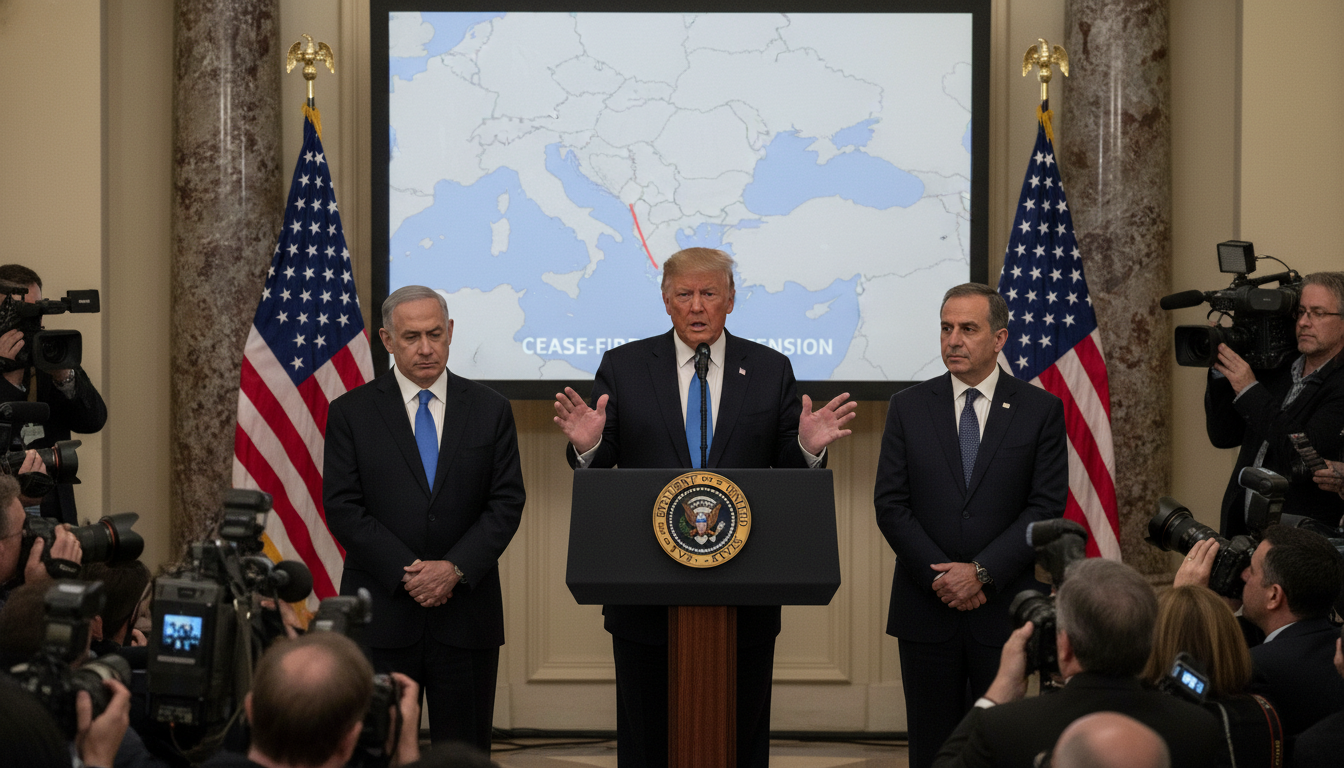
Trump Announces Three-Week Israel-Lebanon Cease-Fire Extension
Trump announced a three-week extension to the Israel-Lebanon cease-fire on April 23, 2026; Hezbollah was silent and international verification remains pending.
President Trump said on April 23, 2026, that Israel and Lebanon had agreed to extend an Israel-Lebanon cease-fire for an additional three weeks, a move he framed as a step toward reducing cross-border violence. The announcement, delivered without detailed supporting documentation, prompted immediate questions about who had formally signed off on the arrangement and how it would be monitored. Hezbollah did not comment on the announcement, leaving a key party to the conflict publicly unaligned with the U.S. statement.
Trump Says Three-Week Extension Agreed
President Trump described the arrangement as a three-week extension to the existing pause in hostilities, expressing hope the parties would refrain from further firing during that period. He presented the update as a development he had helped secure, though he offered limited specifics about the mechanisms for enforcement or the chain of communications that produced the agreement.
The White House statement accompanying his remarks gave few additional details, and no formal text of an accord was released at the time. Analysts cautioned that declarations of cease-fire agreements often precede formal sign-off and that operational pauses frequently require on-the-ground verification.
Hezbollah Offers No Public Response
Hezbollah, a central actor in any Israel-Lebanon border dynamics, did not issue a public statement in response to the announcement. Its silence complicates efforts to confirm whether the group, which has directed or influenced much of the cross-border fire in recent years, is bound by the reported extension.
Observers noted that a credible and durable pause typically requires both public affirmation by armed groups and visible steps—such as redeployments or communications through intermediaries—to be enforceable. Without Hezbollah’s confirmation, independent monitors face difficulty establishing whether the lull will hold.
Border Fighting and Civilian Concerns
Violence along the Israel-Lebanon frontier has periodically escalated, producing casualties, property damage and displacement in border communities on both sides. Local authorities have at times issued evacuation orders for towns near the frontier during spikes of exchange, and cease-fires have provided brief windows for relief and repair work.
Humanitarian organizations and municipal officials have said that even short pauses can ease access for medical teams and supply convoys, and can allow for assessment of civilian needs. The reported three-week extension, if verified, could create opportunities for aid delivery and restoration of essential services in the most affected localities.
U.S. Diplomatic Role and Regional Outreach
The announcement underscored the United States’ continuing role as a diplomatic interlocutor in Middle East security issues, with the president publicly taking credit for arranging the extension. Washington’s involvement can put pressure on parties to limit hostilities, but durable solutions typically require regional and multilateral engagement.
Officials in allied capitals were reported to be assessing the claim and determining next steps to support implementation, including potential monitoring arrangements. Diplomats emphasized that clear lines of communication and independent verification would be necessary to translate a declared pause into a sustained reduction in violence.
Verification Timeline and What Comes Next
Independent verification will be a primary test of the reported extension’s durability, with observers looking for on-the-ground confirmation from monitoring forces, local officials and the parties themselves. The three-week term establishes a fixed timeframe for scrutiny and could prompt short-term confidence-building measures if the pause is observed in practice.
If the lull holds, stakeholders may use the interval to negotiate longer-term arrangements or to de-escalate through phased steps. Conversely, a resumption of exchanges would underscore the fragility of ad hoc pauses and likely prompt renewed calls for formal mediation and clearer enforcement mechanisms.
The significance of the announcement will depend on whether the cease-fire extension is corroborated by independent monitors and acknowledged by the armed actors involved. Until such confirmations are reported, the April 23 declaration stands as a U.S.-led claim that could shape immediate diplomatic activity but remains subject to verification on the ground.
