
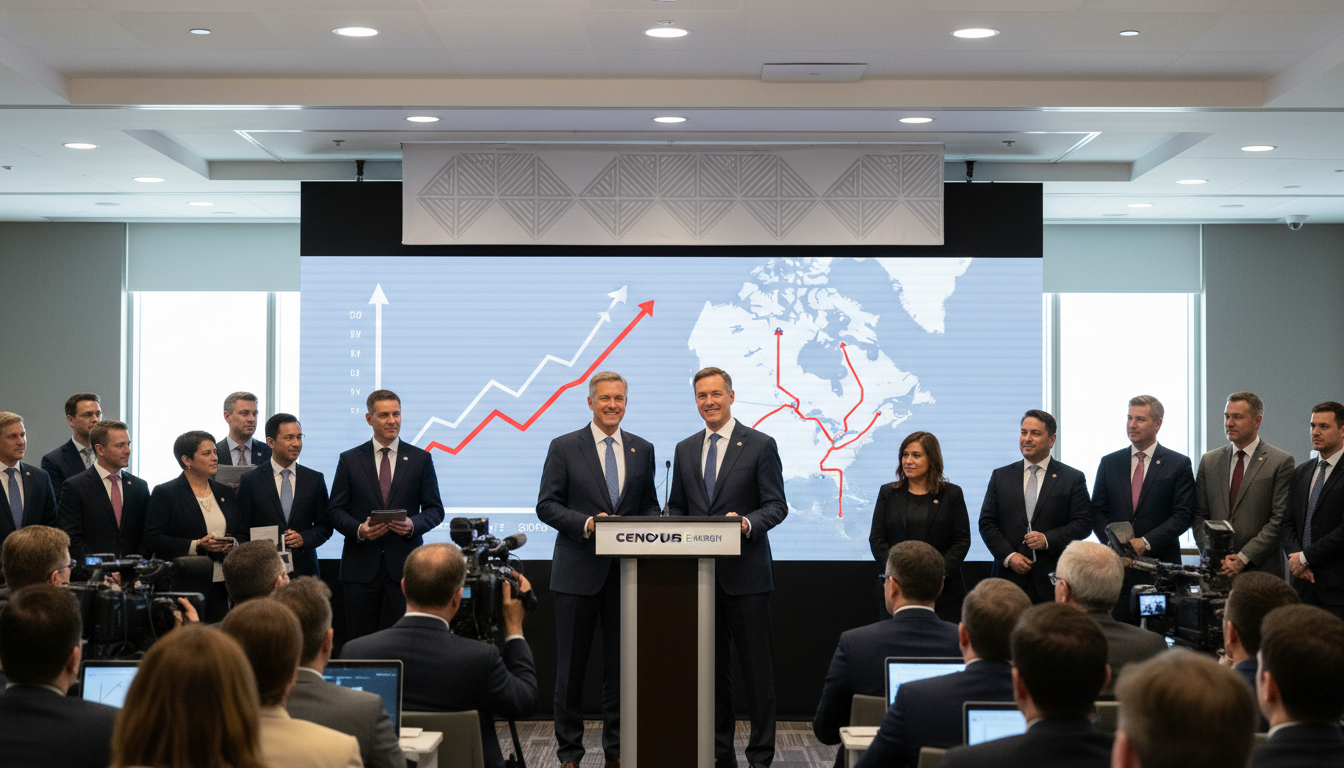
Canadian oil production growth surges as Cenovus and Suncor report record output
Canadian oil production growth accelerates as Cenovus and Suncor report record output; industry urges regulatory changes and new pipelines to expand exports.
Canada’s biggest oilsands producers reported sharp increases in output and earnings this quarter, underscoring a broader surge in Canadian oil production growth that industry leaders say must be matched by pipeline and policy changes. Cenovus Energy and Suncor Energy both posted record first-quarter volumes and stronger profits as global oil markets tightened this spring. Company executives and analysts say the timing of higher production and rising prices has created an opening for expanded exports, but significant regulatory and infrastructure hurdles remain.
Record volumes at Cenovus and Suncor
Cenovus recorded roughly 972,000 barrels of oil equivalent per day in the first quarter, a jump from the previous year that executives attributed in part to the MEG Energy acquisition completed late last year. The Calgary-based producer also pointed to ongoing drilling at offshore West White Rose and its Narrow Lakes thermal project in northern Alberta as contributors to near-term growth.
Suncor reported first-quarter production of about 875,000 barrels per day, also a year-over-year increase, and posted net earnings of approximately $2.1 billion. Cenovus’s net earnings rose to nearly $1.6 billion on higher volumes and stronger prices, reflecting the “high-octane” effect executives described on their earnings calls.
Price spike and geopolitical drivers
Oil prices climbed above US$100 a barrel in March after the outbreak of conflict in the Middle East forced outages in parts of the region, boosting revenues for Canadian producers. While prices eased later, the movement drew attention to North America’s role as a reliable energy supplier in a volatile global market.
Analysts noted that the confluence of increased output and favorable prices created an unusually advantageous window for oilsands operators. One market observer said the timing was “quite favourable” for producers to hit elevated production levels, emphasizing that strategic investment decisions made ahead of the price surge are now paying off.
Caution from company leadership
Despite the windfall, executives urged restraint in response to short-term market swings. Cenovus president and chief executive Jon McKenzie said, “This is our time. We should be an energy superpower,” while stressing that unlocking sustained investment will require deliberate policy choices. Suncor CEO Rich Kruger warned against reacting hastily to temporary market moves, noting that top-performing companies avoid overreacting to short-term phenomena.
Both leaders signaled a longer-term view: capitalize on current momentum but maintain disciplined capital allocation and project selection. That approach reflects concern over geopolitical volatility and a desire to preserve balance-sheet strength even as producers pursue growth.
Pipeline and export capacity proposals
Industry participants outlined several transport options that could move increased Canadian output to market in the coming years. Alberta has proposed a West Coast export pipeline capable of shipping up to one million barrels per day, an initiative tied in government talks to carbon-capture commitments by producers. Enbridge has discussed expanding its Mainline system by as much as 400,000 barrels per day to boost flows into the U.S., while Trans Mountain Corp. is exploring the addition of roughly 300,000 barrels per day of capacity to enable greater access to overseas markets.
A U.S.-led proposal by Bridger Pipeline LLC would carry some 550,000 barrels per day from western Canada to Wyoming and recently received a cross-border permit, a move that would link to previously built segments of pipeline infrastructure. Company leaders and industry advocates argue that expanding transport capacity is essential to fully realize the recent uptick in Canadian production.
Carbon capture pact and regulatory bargaining
The path to larger-scale exports is tied tightly to a contentious policy bargain between governments and industry. The Oil Sands Alliance — a consortium that includes major producers — is negotiating with federal and provincial officials over the proposed Pathways carbon capture network, a multibillion-dollar project intended to enable lower-emission growth in Alberta’s oil sector. The alliance has signaled that support for new pipeline approvals in Ottawa could be contingent on final commitments to the carbon-capture plan.
Under a federal-provincial energy memorandum of understanding signed in November, Alberta agreed to discuss a higher industrial carbon price as part of a broader package to balance growth and emissions reductions. Company executives argue that the current industrial carbon price places Canadian producers at a relative disadvantage compared with some international competitors, and they say a commercially competitive framework will be needed to attract capital for greenfield projects.
Outlook for future growth and investment
Industry leaders say modest production gains in recent years have largely come from optimizing existing assets and consolidation rather than building large new developments, and they contend that materially higher output will require a different investment profile. Executives emphasized that greenfield developments carry higher costs and regulatory complexity, but they also suggested that a clear, competitive market and supportive policy environment would unlock further investment.
Producers and pipeline companies maintain that North American energy security gives Canadian oil an advantage when global choke points are under pressure. At the same time, the debate over climate policy, carbon pricing, and infrastructure approvals underscores the political and economic trade-offs that will shape whether current production gains become a sustained expansion.
The coming months are likely to focus on the outcome of the Pathways negotiations, any federal decisions on pipeline proposals, and how producers balance growth ambitions with evolving climate and fiscal obligations.
