
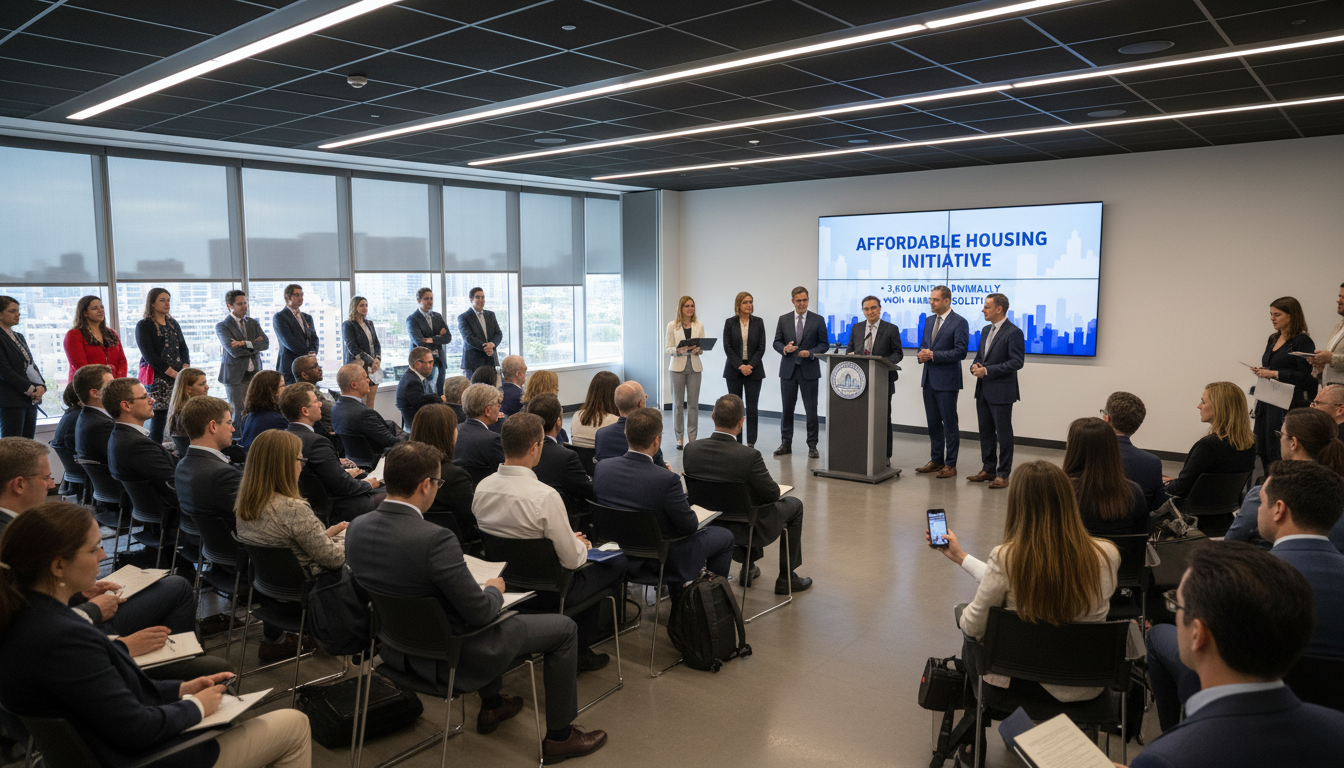
City official outlines three scenarios to deliver 3,000 non-market units under housing strategy
Officials outline three scenarios for the housing strategy’s final three years, including aligning with the 10-year capital plan to meet a goal of 3,000 non-market units annually.
Hendry outlined three possible paths for the remaining three years of the housing strategy and framed the choices in stark terms for city decision-makers. He said maintaining the status quo would be like "keeping the lights on," while aligning the strategy with the city’s 10-year capital plan would be "building momentum." Hendry added that the alignment scenario would help the city achieve its annual target of delivering 3,000 non-market units.
Three scenarios presented to council
Hendry told council members that staff had modelled three scenarios for the strategy’s final phase to show how different approaches would affect outcomes. The scenarios range from minimal change to coordinated capital planning and a third option intended to combine targeted interventions with strategic investments. City officials said the models are intended to guide budget choices and implementation priorities over the next three years.
Status quo would slow progress
Under the status quo scenario, officials warned, the city would likely sustain existing programs without increasing delivery capacity or shifting major capital funding. Hendry described that approach as "keeping the lights on," meaning operations continue but large-scale acceleration of non-market housing would be unlikely. City staff noted the risk that meeting multi-year targets would become more difficult if funding and approvals remain at current levels.
Aligning with the 10‑year capital plan to build momentum
The alignment scenario pairs the housing strategy with the city’s 10-year capital plan and projects more coordinated capital investments, faster project starts, and streamlined approvals. Hendry said this approach would create the conditions needed to hit the city’s stated target of 3,000 non-market units per year. Officials argued that synchronizing operating and capital budgets could unlock larger, sustained production of housing built for low- and moderate-income households.
Potential impacts on non-market housing supply
If the city adopts the alignment pathway, modelling presented by staff suggests an uptick in the pace and scale of non-market housing delivery. That outcome would aim to increase the stock of units not tied to private market rents or ownership, expanding options for households priced out of the market. City planners cautioned that supply gains would still depend on timely capital allocations, partnerships with housing providers, and sufficient construction capacity.
Budget trade-offs and implementation hurdles
City staff acknowledged that choosing the alignment option would require re-prioritizing capital spending and might involve trade-offs with other infrastructure projects. Officials said success would hinge on securing predictable funding streams and improving coordination across departments that manage land use, capital programming, and social services. Hendry emphasized that delivery targets are ambitious and that administrative changes alone would not guarantee results without financial commitments.
Next steps for decision-makers
Council will be asked to weigh the scenarios as part of upcoming deliberations on capital budgets and housing policy settings, according to staff. The housing strategy’s remaining three-year window was presented as a critical period for either consolidating modest gains or accelerating delivery through strategic alignment. Officials said further reports will flesh out the costs, timelines, and partnership arrangements needed to pursue each pathway.
The choices outlined by Hendry pose a clear question for city leaders: maintain steady operations and accept slower growth in non-market housing, or retool capital planning to chase larger, sustained increases in delivery. The coming budget cycle and council decisions will determine whether the city aims to "keep the lights on" or to "build momentum" toward the 3,000 non-market units per year objective.
