
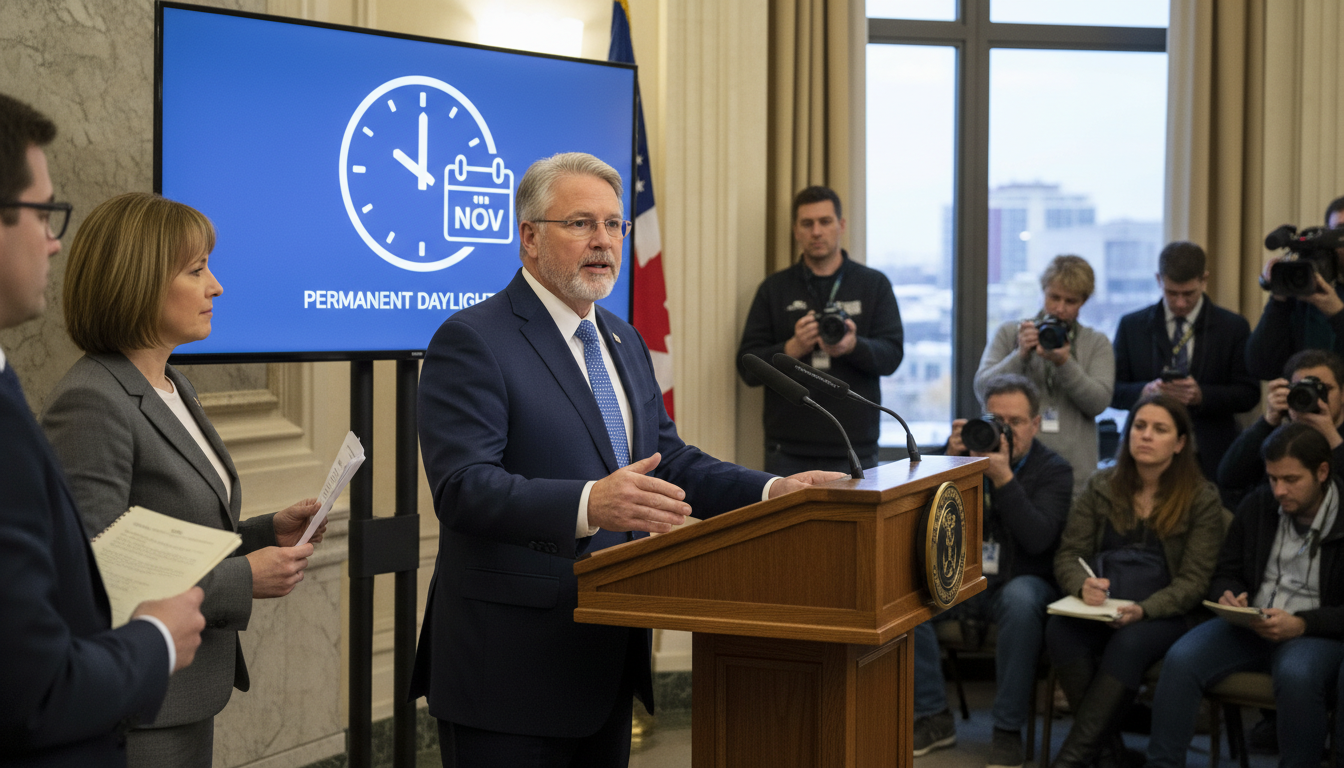
Alberta advances ‘Alberta Time’ bill to adopt permanent daylight time
Alberta advances ‘Alberta Time’ bill to adopt permanent daylight time, ending clock changes; winter mornings darker as provinces weigh regional alignment.
Alberta has tabled legislation to end the practice of changing clocks twice a year and adopt permanent daylight time beginning this November, a move the provincial government is calling “Alberta Time.” The bill was presented by Minister of Service Alberta Dale Nally, who said the province is ready to move past decades of debate over daylight saving and standard time. If the legislation is approved, Albertans would stop setting clocks back in the fall, trading earlier winter sunrises for more daylight in the late afternoon and evening.
Bill introduced to fix clocks year-round under ‘Alberta Time’
The government’s bill seeks to make daylight time the province’s year-round standard, eliminating the twice-yearly ritual that has governed clocks in Canada for more than a century. Minister Nally framed the proposal as a decisive end to ongoing discussions, saying Alberta will no longer defer action on a change many residents have advocated for. The legislation includes a start date in November to coincide with the end of the current clock cycle, allowing a single, predictable transition if the bill is passed.
The move formally sets Alberta on a course already followed by several western jurisdictions that have frozen clocks in recent years. Officials noted the political and practical dimensions of advancing a permanent daylight time, including coordination with neighbouring provinces, territories and cross-border partners in the United States. The bill remains before the legislature and will need to clear debates and votes before becoming law.
Projected daily life changes and sun-timing implications in cities
Under the proposed permanent daylight time, Albertans would experience noticeably later sunrises during winter months, while evenings would remain brighter for longer. In Edmonton, for example, the sunrise would shift to near 10 a.m. on some December mornings, pushing outdoor light into the later part of the daytime schedule. That change is likely to influence morning commutes, school start routines and activities that take place early in the day.
Evening activities such as recreational sports, retail hours and cultural events are expected to benefit from extended daylight, potentially increasing attendance and consumer activity later in the day. At the same time, families with early-morning obligations, shift workers and those whose work depends on morning daylight have raised concerns about darker starts to the day. Municipal services and institutions will need to adapt scheduling, and public outreach will be required to help residents manage the transition.
Regional reactions: western provinces and territories aligning
Alberta’s decision is already prompting shifts across western Canada, where several jurisdictions have signalled they will adopt fixed clocks or are watching closely. The Northwest Territories has indicated it will follow Alberta’s lead, joining Yukon, British Columbia and Saskatchewan in operating without biannual clock changes. Saskatchewan, however, remains on central standard time year-round, a different technical approach that nonetheless results in clocks that align with Alberta for much of the year.
Manitoba has said it is considering whether to follow suit, and Prairie leaders have discussed the potential for coordinated timing across provincial borders. Ontario has previously passed contingent legislation to adopt permanent daylight time, subject to neighbouring provinces and U.S. states taking similar steps, but provincial officials say there has been no change in that position since 2022. In Atlantic Canada, premiers have expressed interest in discussion but have made clear they would not act alone without regional consensus.
Health experts caution while noting benefits of ending clock changes
Medical and sleep experts have long argued that eliminating the twice-yearly clock change reduces short-term harms to health and safety, including disruptions to sleep patterns and increases in workplace and traffic incidents immediately after shifts. Neurologists and circadian researchers say the biannual switch is detrimental, but many emphasize that permanent standard time is the healthiest long-term choice because it aligns better with human circadian rhythms.
Dr. Joanna Fong-Isariyawongse, a neurology professor who studies sleep and circadian health, has said eliminating the clock change is an improvement but cautioned that permanent standard time offers the most consistent alignment with natural light cycles. Other health professionals point to trade-offs: brighter evenings can improve mood and outdoor activity, while darker winter mornings could increase injury risk during morning commutes and impact children’s alertness at the start of the school day. Policy makers will be asked to weigh those competing public-health considerations as part of the legislative debate.
Business, travel and broadcasting sectors warn of logistical complications
Industry groups and event organizers have flagged potential complications for scheduling, travel and commercial coordination if parts of Canada and the United States diverge in how they set clocks. Sports and entertainment operators worry that later start times could disrupt established schedules and audience habits, and airlines and rail operators say any misalignment with U.S. time zones could affect cross-border itineraries and timetables. Broadcasters and live-event producers also noted that differences in local timekeeping could complicate national programming windows and advertising schedules.
Stew MacDonald, chief executive of a major sports and entertainment company, said later local start times present clear challenges for event planning and fan accessibility. Trade and logistics stakeholders added that supply chains that depend on synchronized cross-border timing may face added complexity if neighbouring jurisdictions do not adopt the same system. Governments and industry groups will likely need to coordinate to minimize disruptions and establish clear communications about timing for both consumers and commercial partners.
Legislative timeline, votes and next steps for implementation
If the bill clears the legislature in the coming weeks or months, the government has indicated the change would not take effect until the fall transition in November, allowing time for administrative planning and public information campaigns. The bill’s path includes committee review, potential amendments and final readings before royal assent is required to become law. Lawmakers from across the political spectrum may press for impact assessments, consultation results and mitigation measures to address health, education and business concerns.
Implementation steps would include updating provincial systems, communicating with school boards and municipal governments, and coordinating with federal agencies and neighbouring jurisdictions on border and transportation matters. The province also faces practical tasks such as revising signage, transit schedules, and digital infrastructure that relies on standardized time settings. A clear timeline and coordinated outreach will be essential to ensure a smooth public transition if the legislation is adopted.
Longer-term, provincial leaders have suggested the move could prompt broader national conversations about timekeeping and regional approaches. Premiers are expected to raise the issue in interprovincial meetings, and federal officials may become involved to handle cross-jurisdictional complexities, particularly where time alignment affects commerce and transportation with the United States.
Public response and community perspectives across Alberta
Public reaction in Alberta has been mixed, with many residents welcoming the prospect of avoiding biannual adjustments and enjoying extended evening daylight. Homeowners, recreational groups and businesses that rely on after-work foot traffic have voiced support for a permanent daylight regime that could boost evening activity and consumer spending. Proponents say the change simplifies scheduling and reduces the annual disruption families and employers experience when clocks shift.
Conversely, parents of young children, early-shift employees and some educators have expressed concerns about darker winter mornings and the potential impact on morning routines and safety. Community organizations and local officials have called for targeted support, such as school bus policy adjustments and improved lighting for pedestrian routes, to help mitigate risks during darker morning hours. The government has signalled it will engage with stakeholders to address these concerns and evaluate measures to protect vulnerable groups.
Alberta’s move adds momentum to an evolving patchwork of time policies across Canada and beyond, and it has underscored the tension between local preference and the need for regional harmonization. As the legislature considers the bill, residents and institutions will be watching for details about exemptions, transition rules and any accommodations that might be provided for those most affected.
Public outreach and education campaigns are expected to accompany legislative steps, with officials planning to provide clear timelines, guidance for schools and businesses, and reminders for residents about updating devices and systems. The government has indicated that, if passed, the change will be phased in with ample notice to minimize confusion and give organizations time to adjust.
The fall date proposed for implementation allows for a single adjustment that would effectively eliminate the November rollback, but it also raises questions about how to handle seasonal practices tied to dawn timing. Municipal and provincial planners will face decisions about outdoor lighting, transit schedules and emergency services protocols to ensure public safety during darker mornings.
Despite mixed reactions, the debate has renewed public attention on an issue many Canadians had discussed for years, and it may accelerate conversations about national coordination. Provinces and territories are now weighing whether to align systems regionally, and federal-provincial dialogue may be necessary to smooth cross-border operations and commerce, particularly with U.S. states where legislative positions vary.
The proposal to adopt permanent daylight time, branded as “Alberta Time,” marks a substantive policy shift in the province’s approach to timekeeping and may reshape daily routines, economic patterns and interjurisdictional synchronization if enacted.
