
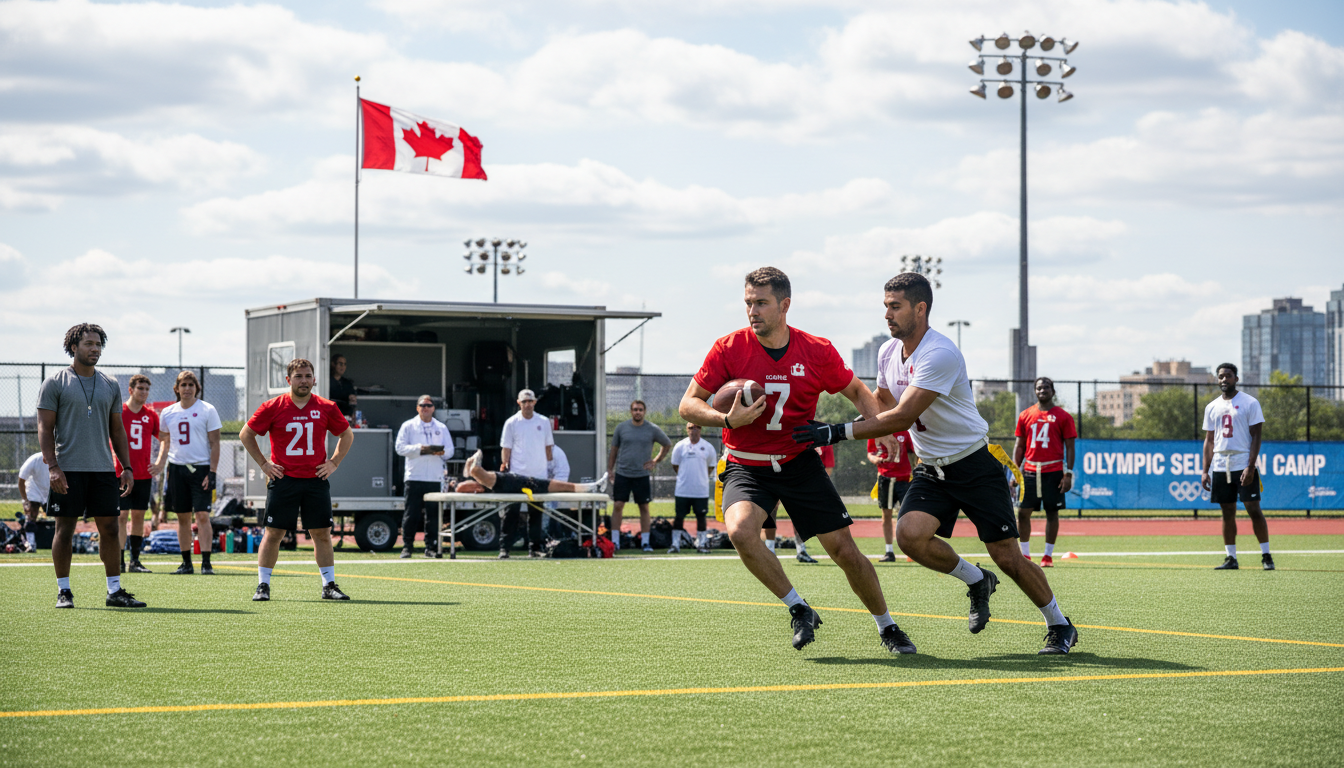
Canadian men’s flag football selection camp aims to build Olympic roster ahead of IFAF worlds
Canada’s men’s flag football selection camp at Princess Auto Stadium begins the final leg of a two-step process to name the team that will chase Olympic qualification at the IFAF world championship in Germany. The Canadian men’s flag football selection camp is the focus as coaches evaluate players for the summer tournament and the 2028 Los Angeles Olympic pathway.
Emile Chenevert, a family physician from Quebec City, is attending the camp in a limited role while recovering from a January foot sprain. He is part of a larger pool of candidates vying for one of roughly 20 spots that will be trimmed to a 12-player roster for the tournament in Dusseldorf, where top finishers will secure places in the Olympic field.
The camp, held over a weekend in Winnipeg, brings together experienced flag specialists, former CFL players and emerging talents in a program that doubled as both national-team preparation and an Olympic-qualification mission. Coaches say the selection will prioritize versatility, speed and defensive range as Canada eyes a place on the podium in Germany and a path to Los Angeles.
Camp opens at Princess Auto Stadium
The selection camp convened this weekend at Princess Auto Stadium in Winnipeg, drawing 28 players for on-field work, team meetings and evaluations. Organizers described the gathering as the first of two domestic selection opportunities ahead of a June training camp in California.
Practice sessions combined position drills, short-field tactical work and situational scrimmages to test players’ adaptiveness to the distinct demands of five-on-five flag football. Staff rotated athletes through defensive back, receiver and special-package roles to identify those who can fill multiple duties at an international tournament.
Coaching staff emphasized recovery and health management during the camp, which is particularly important for players who balance full-time careers with national-team commitments. Medical checks, film review and classroom sessions accompanied the on-field evaluations to provide a complete picture of each candidate.
Physician-player balances clinic shifts with national-team ambitions
Emile Chenevert’s journey highlights the dual-career reality for several national-team hopefuls. Now a practicing family doctor in Quebec City, Chenevert has juggled hospital internships and clinic duties with high-level competitive football since his university days.
Chenevert did not take part in the on-field drills at the Winnipeg camp after sustaining a foot sprain in late January, but he attended meetings and observed practice to remain integrated with the group. Coaches and teammates praised his presence and leadership, noting how his professional discipline translates into preparation and accountability on the field.
A former starter on Laval University’s roster and a member of last year’s 12-man national squad that earned bronze at the IFAF Americas Continental Championship, Chenevert represents a player profile valued by staff: experienced, physical and football-literate. He said the Olympic prospect motivates daily training but that the team’s immediate focus remains on each session and the next selection step.
Selection pathway to the 2028 Los Angeles Olympics
The Canadian selection process unfolds in stages designed to narrow a broad talent pool into a tightly knit roster for the world championship in Germany. From the domestic camps, roughly 20 players will be named to attend a June training camp in California, where the final 12 for the Dusseldorf tournament will be chosen.
At the IFAF world championship — scheduled for mid-August — the top finishers will earn Olympic berths as part of flag football’s Olympic introduction in Los Angeles in 2028. The exact distribution of Olympic spots depends on tournament outcomes and automatic allocation for the host nation, creating a high-stakes incentive for teams to secure top finishes in Germany.
Coaches framed the Germany tournament as both a standalone world championship and an Olympic qualification event, with players aware that performances in Dusseldorf will directly affect Canada’s chances of reaching the 2028 Games. For a sport making its Olympic debut, the opportunity to claim a berth adds urgency and purpose to every selection decision.
CFL veterans and grassroots talent in the mix
The candidate list for the national team blends players with professional football backgrounds and athletes with long histories in organized flag and touch football. Receiver Daniel Petermann, a former CFL player with five seasons of professional experience, is among the camp participants exploring the transition to international flag competition.
Petermann, who played with Winnipeg, Ottawa and the B.C. Lions and now works as a personal trainer and high school coach, described the skill set in flag football as familiar but uniquely technical. He noted the emphasis on low-body control, rapid flag avoidance techniques and the quick, condensed timing of the five-on-five format.
Coaches value the athleticism and tactical acumen that former tackle-football players bring, while also scouting specialists who grew up in touch and flag programs. That mix, staff members say, helps the team adapt to opponents and maintain depth across positions in an intense, tournament-style schedule.
Coach Paul LaPolice outlines team profile and strategy
National team head coach Paul LaPolice, who has national-program experience and CFL coaching background, explained that selection priorities include range in defensive backs, reliable hands among receivers and a roster balanced for quick substitution and situational matchups. He highlighted the need for players who can perform in constrained spaces and defend passes aggressively without contact.
LaPolice praised players like Chenevert for their physical traits and leadership, noting that defensive backs with size and reach provide critical coverage and playmaking potential in flag football. He also pointed to the team’s recent results — including a surprise victory over the United States in an international match last year — as evidence the program can compete with top nations.
During camp, coaches used a combination of measurable testing, live drills and small-sided games to evaluate how players execute game plans and recover between short, high-intensity possessions. Staff members said they were especially interested in athletes’ situational awareness and ability to execute under compressed clocked possessions characteristic of the format.
Tactical demands and the structure of international flag football
Flag football at the international level plays out on a shortened field with five players per side and rules that remove blocking and tackle-style contact. Teams must rely on synchronization, precise route timing and disciplined defensive positioning to create turnovers and keep possessions short.
Matches are fast-paced, and the reduced contact places a premium on acceleration, hip flexibility, and hand speed when pulling flags. Turnovers follow quickly, and the game rewards teams that can execute repeated quick drives and adjust coverages on the fly.
Coaches also noted the psychological side of the sport: players must maintain focus through momentum swings and be prepared to execute special packages that exploit opponent tendencies. That tactical complexity is a reason national staff value experience from tackle football, touch football and organized flag programs.
Next steps toward final roster and international competition
Following the Winnipeg camp, staff will narrow their selection toward the group that travels to California in June for the final training phase. That camp will simulate tournament conditions and allow coaches to finalize the roster for the IFAF world championship in Germany.
Players chosen for the June camp should be ready to demonstrate endurance, quick recovery and the capacity to contribute in multiple phases of the game. The coaching staff will continue to assess medical readiness, versatility and in-game decision-making as they make the final cuts.
For athletes, the path from domestic selection to Olympic qualification is short and intense: perform in Germany and the chance to represent Canada on the Olympic stage in 2028 moves from possibility to probability. For the program, the focus remains on assembling a cohesive unit capable of winning critical possessions in Dusseldorf.
The selection camp in Winnipeg brings visibility to the sport and highlights flag football’s growing footprint in Canada. Organizers and coaches said they hope national-team activity will inspire grassroots participation and provide a clear development pathway for aspiring players.
Canada’s men’s flag football program has signaled its intent on the international stage, and the selection process now in motion will determine whether the team can convert potential into Olympic qualification. The coming months, with a decisive June camp and the mid-August world championship, will shape Canada’s place in flag football’s Olympic debut.
Selection decisions, player recoveries and performances in Germany will determine whether Canadian hopes turn into a place on the Olympic field in Los Angeles. The nation is watching as the program refines its roster and prepares for the high-stakes competition ahead.
