
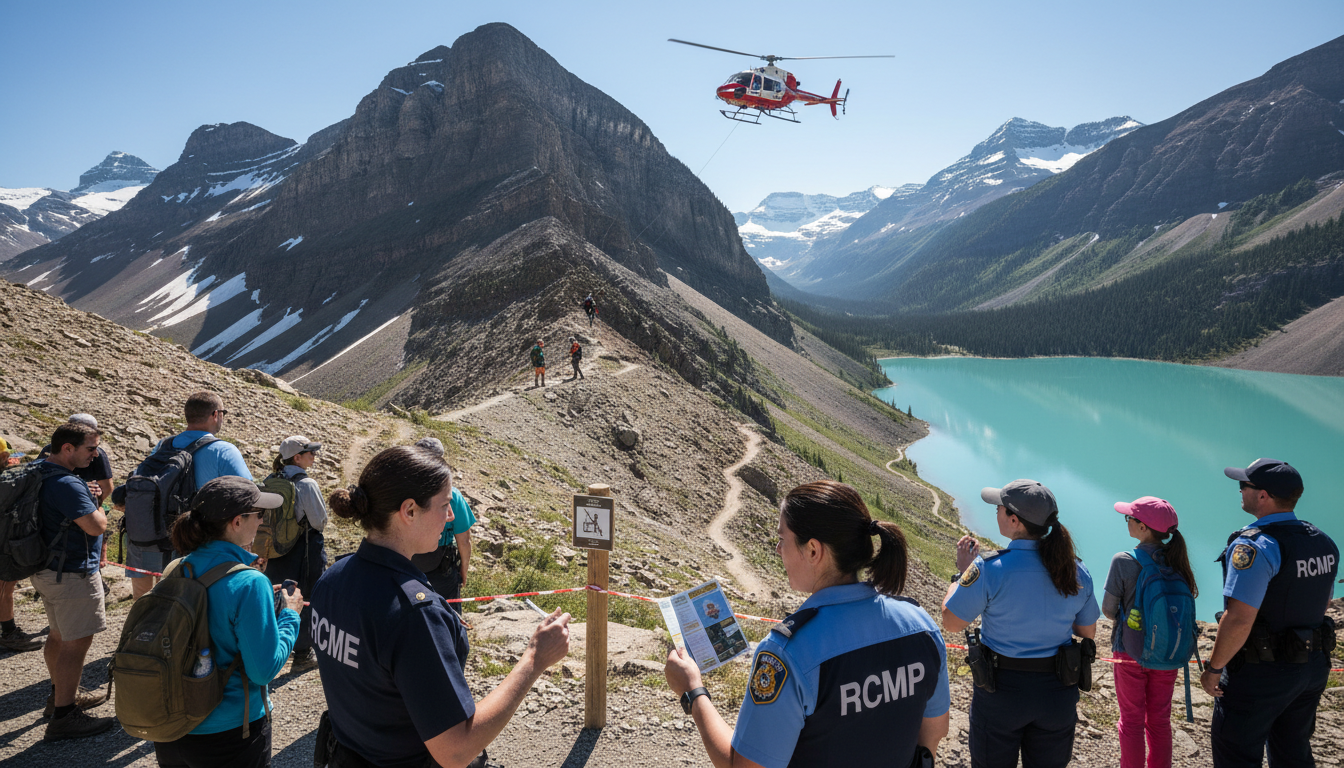
Banff National Park rescue surge: RCMP warn after fatal Johnston Canyon incident
RCMP urge caution after a May 1, 2026 Banff National Park rescue effort for a visitor who entered Johnston Canyon rapids and did not resurface, as officials cite rising spring hazards.
The Royal Canadian Mounted Police and Parks Canada launched a coordinated search on the evening of May 1 after a call reported a person had jumped into turbulent water roughly 40 feet below the Lower Falls at Johnston Canyon.
Search teams worked through the night and into Saturday, but Parks Canada suspended recovery operations because swift currents and unstable conditions made further action unsafe.
The missing visitor was identified as traveling from Pennsylvania, and authorities said they would limit releases of personal details out of respect for the family.
Friday’s incident comes amid a cluster of backcountry rescues across Banff National Park in April, prompting officials to renew safety warnings for spring visitors.
Johnston Canyon search and suspension of recovery efforts
On May 1, 2026 at approximately 6:40 p.m., emergency services received a report that someone had entered the rapids beneath Johnston Canyon’s Lower Falls and failed to reappear.
RCMP officers described the area as having powerful, fast-moving water during the spring melt, and Parks Canada visitor safety specialists joined law enforcement in an immediate search of both the upper and lower pools.
After extensive searching on Saturday, officials determined that continuing recovery operations would pose unacceptable risks to personnel, noting that conditions would be monitored and reassessed if safety improved.
Parks Canada officials also indicated they would not release additional details at this time to protect the privacy of the visitor and their family, while confirming that the investigation remains led by RCMP with park partners assisting.
Recent April rescues across the park
The Johnston Canyon incident followed several rescues in Banff National Park during April 2026 that together illustrate the persistence of winter hazards into the spring.
On April 9 a solo hiker who had climbed the Big Beehive became stuck while descending the Plain of Six Glaciers trail after sinking into unstable, isothermal snow and called 911 for help.
A sling rescue by visitor safety technicians returned the hiker to the lakeshore without injuries, and a similar operation on April 14 rescued two people who had attempted the same route and encountered impassable cliff bands.
On April 22 park staff responded to a visitor who became disoriented and exposed during what was intended to be a short walk; the person had lost footwear after sinking into deep snow and required rewarming before transfer to emergency medical services.
Park conditions: deep snowpack and freeze–thaw hazards
Parks Canada has warned that, despite warmer valley temperatures, mountain and alpine areas remain winter-like with a very deep snowpack in many locations.
A prolonged period of freeze–thaw cycles has left trails icy and unpredictable, while isothermal snow—snow at temperatures near the freezing point—can behave like slush and fail to support a person’s weight.
Near tree lines and on popular trails such as those around Lake Louise and Johnston Canyon, these conditions increase the risk of slips, falls and unexpected avalanches or collapses into hidden snow bridges.
Spring melt also feeds rivers and waterfalls, producing strong undercurrents, submerged debris and cold-water hazards that can rapidly incapacitate a person who enters the water.
Agency response and public messaging
Both Parks Canada and Alberta RCMP have emphasized that their teams are prepared to respond but that rescue operations are inherently dangerous for both visitors and responders.
Parks Canada said visitor safety specialists, park wardens and partner agencies have been conducting targeted patrols and rescues where required, and that decisions to suspend or resume operations depend on ongoing risk assessment.
RCMP representatives stressed the importance of following posted trail closures and of avoiding short-term risk decisions such as jumping into pools below waterfalls, which may appear calm on the surface but conceal powerful currents.
Officials also noted that ignoring closures can create secondary hazards, drawing rescuers into unsafe environments and potentially leading to additional closures when people bypass barriers.
Safety advice for spring visitors to Banff National Park
Visitors are advised to assume that high-elevation trails and backcountry routes still require winter gear, experience and caution even as valley weather warms.
Parks Canada recommends checking current trail conditions and public advisories before heading out, carrying appropriate navigation and emergency communication tools, and informing someone of your planned route and return time.
Avoid water features, do not enter or jump into alpine streams or plunge pools, and respect posted signs and cordons; even shallow-looking pools can conceal undercurrents, submerged rocks and cold-water shock risks.
When venturing into snow-covered terrain, wear suitable footwear with traction aids, carry an ice axe or trekking poles if slopes are present, and consider travelling with companions who understand winter travel and self-rescue techniques.
Operational impacts and planning for visitors
A spike in search-and-rescue incidents places strain on park resources and local emergency services, which must balance rapid response with responder safety.
Trail closures, restricted access and increased patrols can be expected while conditions remain unstable, and visitors should plan flexible itineraries and longer travel times.
Guided outings led by accredited operators can lower risk for those unfamiliar with winter conditions, but even guided groups must adjust plans based on current assessments of avalanche and melt-related hazards.
Visitors should register trips where available, carry proper first-aid supplies, and be prepared to turn back when conditions deteriorate or signs indicate risk.
Emergency services also advise that personal flotation devices do not make river jumps safe, and that cold-water immersion can incapacitate even strong swimmers within moments.
The RCMP reiterated that simple precautions—staying on marked trails, obeying closures and resisting impulsive behaviours near water and cliffs—are the most effective measures to prevent incidents.
Parks Canada continues to monitor weather, water flow and snowpack conditions across Banff National Park and will update public advisories as assessments change.
Officials said that any decision to resume recovery efforts at Johnston Canyon will depend on improvements in water flow and on a safety plan that protects both responders and the public.
Communities around Banff have in recent years worked to raise awareness about the seasonality of mountain hazards, but public messaging faces challenges when attractive scenery and seemingly calm conditions encourage risk-taking.
Local search-and-rescue teams and volunteer groups underscore that high-visitation corridors can quickly become dangerous during transition seasons, when a trail can change from benign to hazardous within a single day.
The RCMP and Parks Canada urged visitors to make conservative choices this spring and recommended checking official channels for trail statuses, avalanche bulletins and water-flow advisories before travel.
As the season progresses, conditions may improve in lower elevations while remaining hazardous at higher altitudes, so visitors should plan based on the most conservative assessments for their intended route.
Final paragraph — as of May 3, 2026, park authorities continue to monitor conditions and advise that anyone planning a trip to Banff National Park should prepare for ongoing winter hazards, heed closures, and prioritize safety to reduce the need for search-and-rescue operations.
