
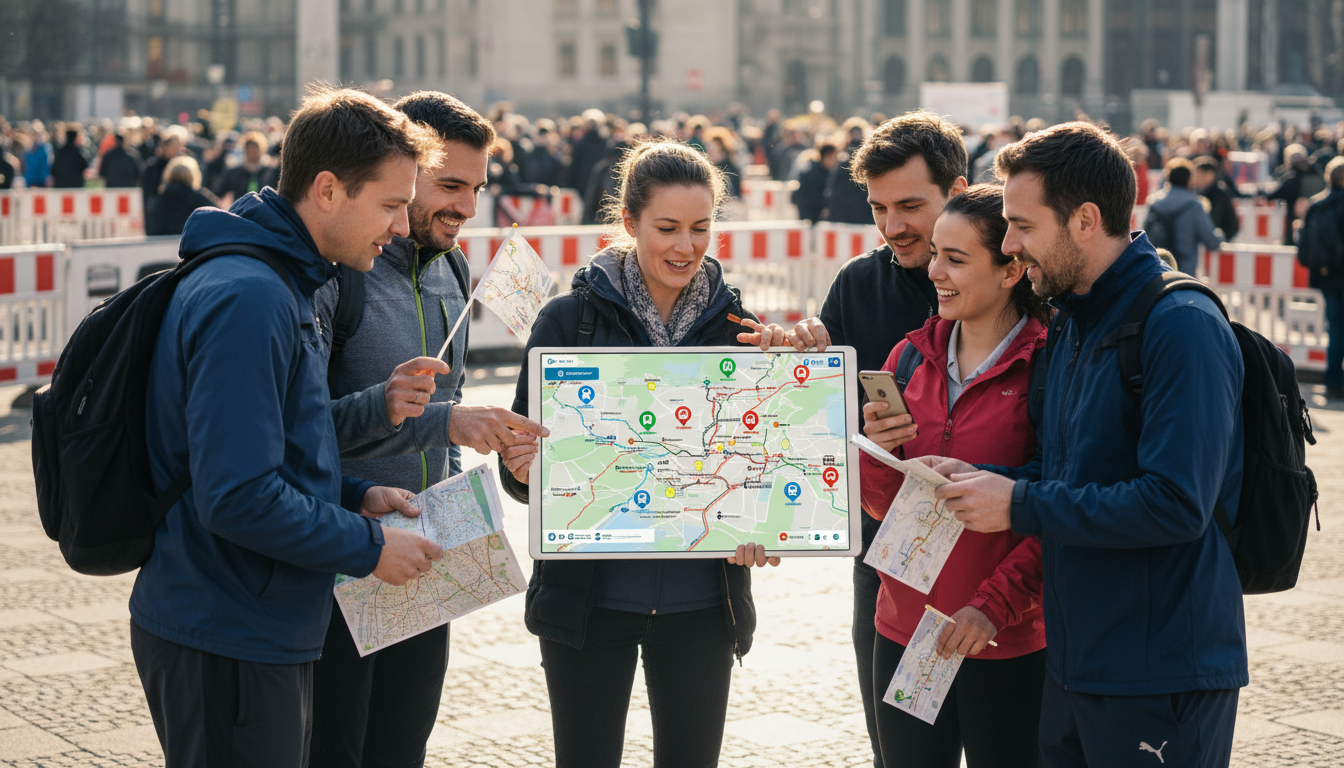
Berlin Marathon cheering route planner helps spectators meet runners at multiple points
Plan to see your runner at several points on the course with the Berlin Marathon cheering route planner, which estimates where a participant will be at every kilometre marker.
The Berlin Marathon cheering route planner gives friends and family a practical way to meet runners at multiple points on race day by translating start times and pace into kilometre-by-kilometre arrival estimates. The tool pairs those estimates with suggested public-transport routes so spectators can move between cheering locations without doing the timekeeping and transit math themselves. For anyone who wants to turn a single roadside appearance into a day of coordinated support, the planner is designed to simplify timing, route choice and day-of logistics.
Tool estimates runner times at each kilometre marker
The core feature of the planner is a simple time-estimate engine that takes a runner’s official start time and average pace to predict arrival at every kilometre marker. Entering the start time and a pace per kilometre produces a table of expected times for kilometres 1 through 42, with brief allowances for common delays. This gives spectators a minute-by-minute roadmap of where their person is likely to be during the race.
These predictions are not live tracking; they are time estimates based on pace. The intent is to remove the mental arithmetic — converting finish-time goals into times for kilometre markers — and to give supporters a reliable schedule to plan moving between locations. For spectators who prefer live updates, the planner can be used in tandem with race-tracking services, but its primary value is rapid route planning based on expected split times.
The approach accounts for staggered starts and multiple waves, a frequent complication at major city marathons. By allowing two participants to be entered separately, the planner can produce combined itineraries that make it realistic to cheer for two runners who started in different waves or hold different paces. That flexibility is particularly useful for families and small groups who want to split their time between multiple friends or relatives.
Four example cheering routes mapped with public transport directions
Included with the planner are four ready-made cheering routes that reflect different priorities: short loop, cross-city tour, central highlights and two-person follow. Each route pairs kilometre markers with efficient public-transport connections so supporters can reach new viewing points with minimal waiting. The examples show how to balance walking, U-Bahn and bus legs to maximize the number of times you see your runner in a single day.
One sample route focuses on staying near the Tiergarten and central Brandenburg Gate area, giving spectators high-profile viewing points with short transit hops. Another route moves from the start area across Friedrichstrasse to lively east-side neighbourhoods, demonstrating how a combination of tram and short walks can yield three or four viewing stops. The two-person examples show how to stagger pickups so both participants are seen without creating impossible travel legs.
Each route includes suggested departure times from transit stations, typical walking durations between stops and contingency gaps to avoid missing runners if they are a few minutes ahead or behind schedule. The planner’s sample itineraries are practical blueprints: they’re not exhaustive but they illustrate how to convert split-time estimates into real-world movement in Berlin’s public-transport network.
How to plan to see one or two participants multiple times
Effective planning starts with realistic pace estimates. Use recent training runs or a recent half-marathon time to estimate each runner’s average kilometre pace, and be conservative if you’re unsure. Entering a slightly slower pace into the planner will increase the margin of error in your favour and reduce the chance you arrive at a location after the runner has already passed.
Next, choose viewing points that are easy to reach from each other. Avoid narrow side streets with limited sightlines unless you plan to stay put there for an extended period. Crowded spectator areas and narrow sidewalks can make moving quickly difficult, so the planner emphasizes stops near tram lines, U-Bahn stations or large public squares where movement is easier and visibility is better.
When following two participants, plot both sets of estimated split times and identify feasible overlaps. The planner can highlight kilometres where both runners are likely to pass within a similar window, allowing you to maximize cheering without making impossible transit transfers. Stagger your final stop so you have slack time before the race’s busiest segments, and build in contingency time for transit delays or unusually heavy crowds.
Finally, decide how many stops you realistically want to attempt. Seeing a runner three to five times is often achievable in Berlin with methodical planning; attempting more than that increases the risk of missed connections and a stressful day. The planner is designed to help you find a balance between ambitious cheering and a manageable, enjoyable spectator experience.
Practical tips for cheering on race day in Berlin
Arrive early at each chosen stop. Even with accurate time estimates, crowding and race-day street closures can add unexpected delays to your own movement. Plan to arrive at least 15–30 minutes ahead of your expected arrival window so you can claim a good vantage point and avoid rushed sprints between viewing locations.
Make a small, visible sign and wear bright clothing so your runner can pick you out quickly. Short, bold messages work best and avoid obstructing other spectators’ views. If you plan to move between locations, keep your sign compact or have a second, lighter sign that is easy to carry on public transport.
Use Berlin’s public-transport apps to check live departure times and to receive alerts about temporary diversions. The city’s transit network is comprehensive and generally reliable, but on marathon day some tram lines and bus routes may be rerouted or suspended. Having a transit app or a downloaded offline map will let you adapt quickly if a planned leg becomes impractical.
Bring essentials for comfort and speed: a small backpack with water, a compact rain jacket and comfortable shoes for brisk walking are advisable. Remember that cheering involves standing, sometimes for many minutes, so portable seating is usually not practical. If you are travelling with children or elderly supporters, choose routes with short walking distances and clear access to seating or nearby cafés.
Plan for meeting points before the marathon. Choose a primary rendezvous near your first viewing location and a secondary meeting place in case your party becomes separated. Clear communication is essential on a busy race day, and a few minutes of pre-race coordination will save a lot of scrambling on the course.
What the planner includes and how to use it
The planner is delivered as a customizable spreadsheet that calculates estimated arrival times for all 42 kilometres when you input a start time and pace per kilometre. The spreadsheet includes columns for alternate pace scenarios so you can compare a target pace versus a conservative pace in seconds. Those comparisons help you decide where to place your viewing stops and how much buffer you want between locations.
Alongside the spreadsheet, the package contains four annotated cheering routes with step-by-step public-transport directions. Each example lists expected arrival windows for the key kilometres, suggested station names and approximate walking times between stops. The documents also include practical notes on where sightlines are best and where race fencing or vendor stands commonly create bottlenecks.
There are short usage tips that explain how to adapt the spreadsheet for two participants and how to factor in staggered start waves. The planner provides a simple method to offset one runner’s start time against another’s, producing a combined itinerary that minimizes unnecessary backtracking. This is especially helpful for groups supporting friends or family across multiple start corrals.
A concise guide covers day-of tools to use in combination with the planner, such as live tracking apps and Berlin transit schedules. It recommends a straightforward workflow: set up split-time estimates before race day, test one of the example routes on a map, and then save local transit stations as favourites for quick access on the marathon morning. These steps are meant to make execution calm and predictable.
Cost, availability and additional resources
The planner is offered as a downloadable digital product for a modest fee of US$15, which covers the spreadsheet, four example routes and the usage tips. The seller presents the package as a time-saver: for supporters unfamiliar with Berlin’s layout or who do not want to perform the time-and-transit calculations themselves, it condenses hours of planning into a practical toolkit. The price reflects a targeted utility rather than a travel guidebook-level scope.
In addition to the planner files, there is a short demonstrative video that walks users through the spreadsheet’s fields and shows sample route logic. The video is intended to speed up the learning curve so supporters can generate an itinerary within minutes. It also shows how to adapt timing in case a runner’s pace changes in the days before the race.
For those who want to expand preparation, the planner’s package recommends a handful of local reading about race logistics, spectator etiquette and public-transport tips that are useful on marathon weekend. These suggestions act as pointers to other practical information — for example, how to navigate street closures or where to find drop-off points for short-term standing. Combined, the resources aim to make a long spectator day more efficient and more fun.
Seeing your runner multiple times is a tangible way to support months of training and sacrifice. The planner’s practical, route-focused approach turns a complicated logistical challenge into a sequence of manageable steps that any supporter can follow. The goal is not to replace live race tracking or to promise real-time certainty, but rather to give friends and family a realistic plan to appear in several memorable moments on race day.
Celebrating a runner’s achievement is about presence as much as timing, and a carefully planned cheering route can make those moments count.
