
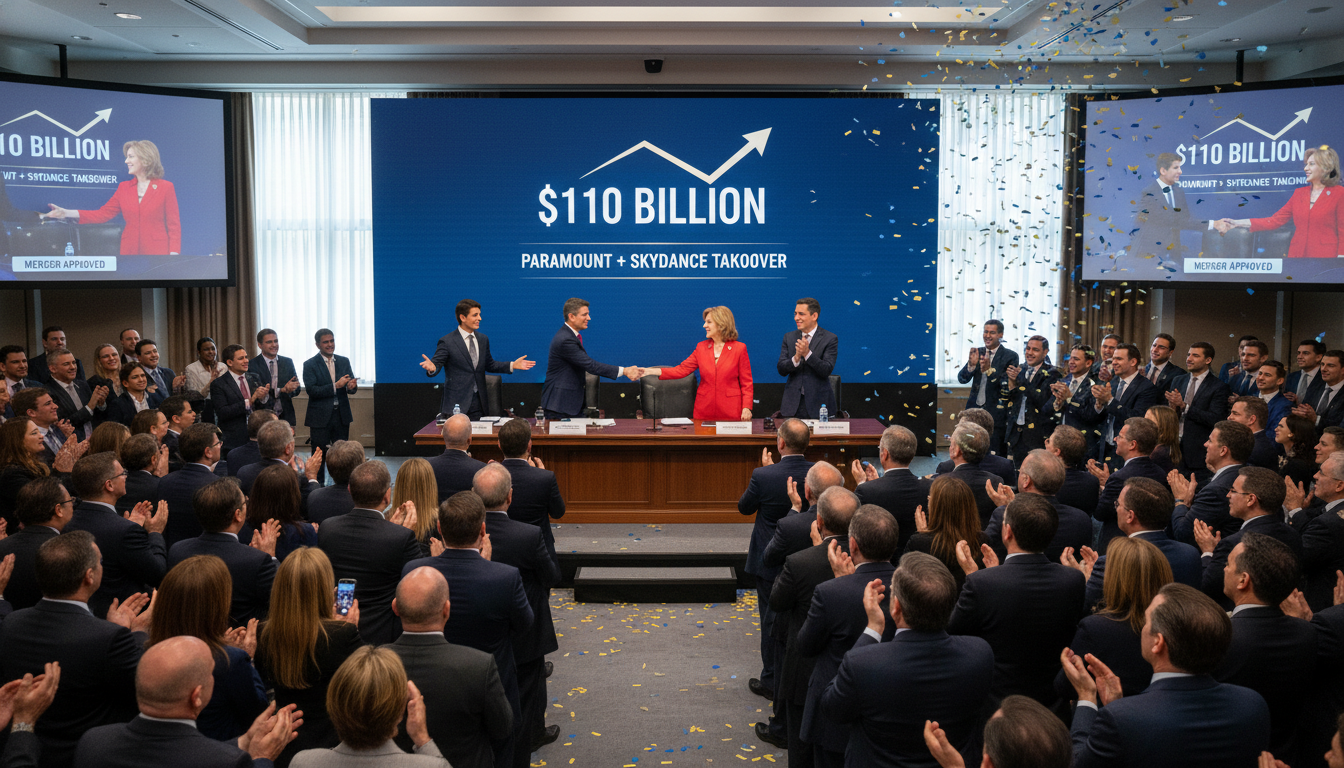
Paramount Skydance acquisition of Warner Bros. Discovery approved by shareholders
Shareholders approve Paramount Skydance acquisition of Warner Bros. Discovery; deal valued at US$110B including debt, now faces regulatory review in US and EU.
Warner Bros. Discovery shareholders voted overwhelmingly Thursday to approve the Paramount Skydance acquisition of Warner Bros. Discovery, clearing a key hurdle in a merger that would reshape Hollywood. The vote came at an extraordinary online meeting, and the transaction—priced at about US$110 billion including debt—now moves into a regulatory review phase. Paramount Skydance and Warner Bros. Discovery said they expect to complete the deal in the third quarter, with contractual penalties scheduled to begin in October if closing is delayed.
Shareholder vote and bid details
Paramount Skydance’s offer valued Warner Bros. Discovery at roughly US$110 billion, or about CA$150.5 billion including debt, according to the companies’ statements. The outcome of the extraordinary meeting was widely anticipated after Netflix, once considered a potential bidder, withdrew from the contest in late February and did not top the final Paramount Skydance proposal. Company releases said a majority of Warner Bros. Discovery shareholders backed the deal, authorizing the boards to proceed with the planned merger.
The approval marks a decisive moment in a prolonged period of deal-making at the top of the media sector, where legacy studios and streaming platforms are consolidating to compete for subscribers, content and advertising dollars. Executives on both sides framed the transaction as a strategic alignment of libraries, production capacity and streaming services that they believe will create scale.
Schedule and financial safeguards
Paramount Skydance and Warner Bros. Discovery set the expected closing window for the third quarter, signaling urgency to implement the combination ahead of the next industry cycle. The buyer has committed to contractual penalties that would begin in early October if the transaction does not close on schedule, reflecting incentives to secure timely regulatory approvals and integration milestones. Those penalties are intended to protect the seller and help maintain momentum as the parties prepare for operational integration.
Analysts note that closing timetables in transactions of this size are often contingent on regulatory clearances and potential remedies, which can extend negotiations. Both companies have outlined initial plans for unifying certain operations, but full integration details and potential cost savings will become clearer only after regulators weigh in and management teams finalize their post-close blueprint.
Regulatory review in the United States and Europe
Regulators in multiple jurisdictions must now examine the proposed merger, with the U.S. Federal Communications Commission and European competition authorities among the principal gatekeepers cited by the companies. The review will assess whether the combined entity would harm competition in broadcasting, streaming, content distribution or advertising markets, and may require commitments or divestitures to secure approval. The process could involve document submissions, hearings and remedies tailored to specific market concerns.
Officials have already signaled scrutiny of large-scale media tie-ups in recent years, citing the potential for reduced choice for consumers and diminished bargaining power for distributors. Paramount Skydance and Warner Bros. Discovery will have to demonstrate that the merger fosters competitiveness and consumer benefits, while regulators weigh the potential for market concentration.
Industry opposition and creative community concerns
The merger has drawn vocal criticism from parts of the film and television community, with hundreds of industry figures publicly opposing the consolidation. A mid-April open letter, signed by numerous creators and talent including Quebec director Denis Villeneuve, warned that the deal could narrow the range of voices and companies capable of funding ambitious filmmaking. Signatories argued that continued consolidation risks reducing competition for projects and diminishing the diversity of production opportunities.
Studio executives counter that scale can enable larger investments in content and global distribution, but skeptics say workforce trims and unified decision-making could prioritize franchise projects and data-driven content over riskier auteur work. The debate underlines broader tensions in the industry about the balance between financial efficiency and cultural plurality.
Local economic risks flagged by New York officials
New York city leaders have joined the chorus of concern, with the mayor identified in company statements as warning of potential job losses tied to the merger. Warner Bros. Discovery is headquartered in New York, and officials cautioned that overlapping corporate functions and duplicated operations could put thousands of jobs at risk in the city’s media sector. Municipal authorities urged the parties and regulators to consider the local economic impact of any restructuring.
City-level concerns often factor into regulatory assessments, especially where employment and ancillary businesses—production services, post-production houses and local suppliers—could be materially affected. The companies have not released a definitive headcount plan, and analysts expect workforce decisions to follow deeper operational reviews after the deal closes.
Streaming strategy and immediate market reaction
Paramount Skydance has indicated that it plans to combine its Paramount+ streaming service with Warner Bros. Discovery’s HBO Max, a move that would consolidate major catalogue libraries and subscriber bases under a single platform. Integrating two large streaming services raises complex questions about pricing, content rights, and subscriber migration, and will be central to the merged company’s strategy for competing with other global platforms.
Financial markets reacted quickly after the shareholder announcement, with Paramount Skydance shares falling about 4.9 percent on the New York Stock Exchange in the immediate aftermath. Investors appeared to weigh the potential benefits of scale against the integration risks and the uncertain path through regulatory reviews. Market observers will be watching subsequent filings and statements for indications of anticipated costs, synergies and a timeline for unifying product offerings.
The shareholder vote moves the Paramount Skydance acquisition of Warner Bros. Discovery from proposal to the next phase of execution, but the transaction’s ultimate shape will depend on regulatory outcomes, detailed integration plans and the responses of creators, employees and global markets. The coming weeks are likely to see intensified engagement with regulators and stakeholders as both companies press to realize the combination they and many investors believe will redefine the entertainment landscape.
