
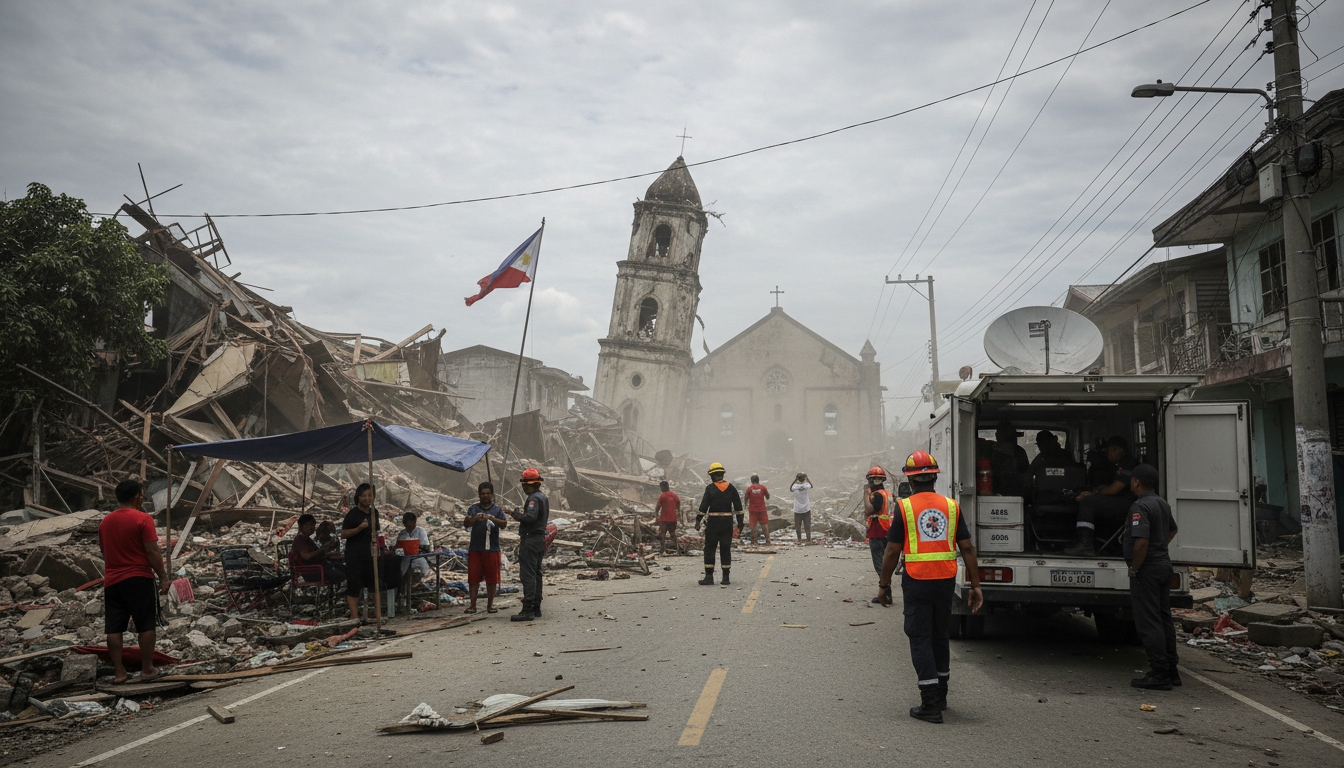
6.0-magnitude earthquake strikes near Nena, Philippines, USGS reports
A 6.0-magnitude earthquake struck near Nena, Philippines, on May 4, 2026 at 2:09 p.m. Philippine Time, the United States Geological Survey says. Seismologists are reviewing data and monitoring for aftershocks as agencies update shake-intensity maps and population exposure estimates.
6.0-Magnitude Quake Strikes Near Nena, Philippines
A strong 6.0-magnitude earthquake occurred about 3 miles northwest of Nena, Philippines, at 2:09 p.m. Philippine Time on Monday, May 4, 2026, according to the USGS. The agency’s initial report places the epicentre onshore and confirms shaking was felt across surrounding provinces.
The USGS noted that reported magnitudes can change as more seismic data are processed, and that this figure represents the agency’s early estimate. The event was detected and timestamped by global seismic networks and appeared in USGS monitoring products within minutes of the tremor.
Epicentre Location and Timing Confirmed by USGS
USGS data show the quake’s epicentre roughly three miles northwest of the small locality of Nena in the Philippines archipelago. The agency provides the origin time in Philippine Time (PHT, UTC+8) and also posts timestamps in Eastern Time for international coordination; the quake’s PHT time corresponds to the early hours of May 4 in North American time zones.
The precise location and depth reported by the USGS are subject to refinement as additional seismograms are analysed. Seismologists routinely revise location and magnitude in the hours after a quake, using arrivals from regional stations to improve parameter estimates.
Shake Intensity Map and Population Exposure
The USGS shake-severity map for the event highlights areas that experienced shaking of Modified Mercalli Intensity (MMI) level 3 or greater. Those maps are routinely paired with population-density data — in this case derived from LandScan via Oak Ridge National Laboratory — to estimate how many people may have felt perceptible shaking.
Maps released with the initial USGS bulletin show stronger shaking concentrated near the epicentre, with weaker intensities radiating outward. The agency cautioned that the earthquake may have been felt outside the areas shown on the initial map and that updates to the map may follow as scientists refine the event parameters.
Aftershock Monitoring and Magnitude Revisions Underway
Seismologists emphasized that the 6.0 magnitude is an early estimate and could be revised upward or downward as analysts incorporate seismic records from a broader network. The USGS methodology notes that aftershock sequences and additional arrivals are used to update both magnitude and shake maps.
The agency also monitors aftershocks in the days following a mainshock, typically tracking events within 100 miles of the epicentre and within a seven-day window for the initial sequence. Aftershock data timestamps accompanying the USGS products show routine updates in the hours after the main event as more detections are confirmed.
Initial Damage Reports and Local Assessments Pending
The USGS bulletin itself does not serve as a damage assessment and did not include immediate reports of casualties or infrastructure damage. Official damage and casualty information is ordinarily provided by local authorities, emergency services and national agencies as ground assessments are completed.
Local governments and disaster response units in the Philippines generally conduct rapid assessments following significant earthquakes to determine structural impacts and urgent needs. Those assessments often take several hours to compile and are released through regional offices and national media channels.
What Residents and Travellers Should Do Now
Authorities typically advise residents in affected areas to expect aftershocks and to follow instructions from local emergency management officials. Basic precautions include moving to open areas away from potential falling debris, checking for gas leaks and structural damage, and using established emergency contacts to report emergencies.
International travellers and Canadian residents with family or business ties to the Philippines should monitor official government and USGS updates for confirmed information. Embassies and consulates may also issue advisories or assistance instructions for citizens in affected regions.
Initial USGS products and the accompanying methodology note that shake data in the public bulletin were current as of Monday, May 4, 2026, and that aftershock tracking was updated in the hours following the quake. Follow-up reports from seismological agencies and local authorities will provide additional detail as assessments continue.
