
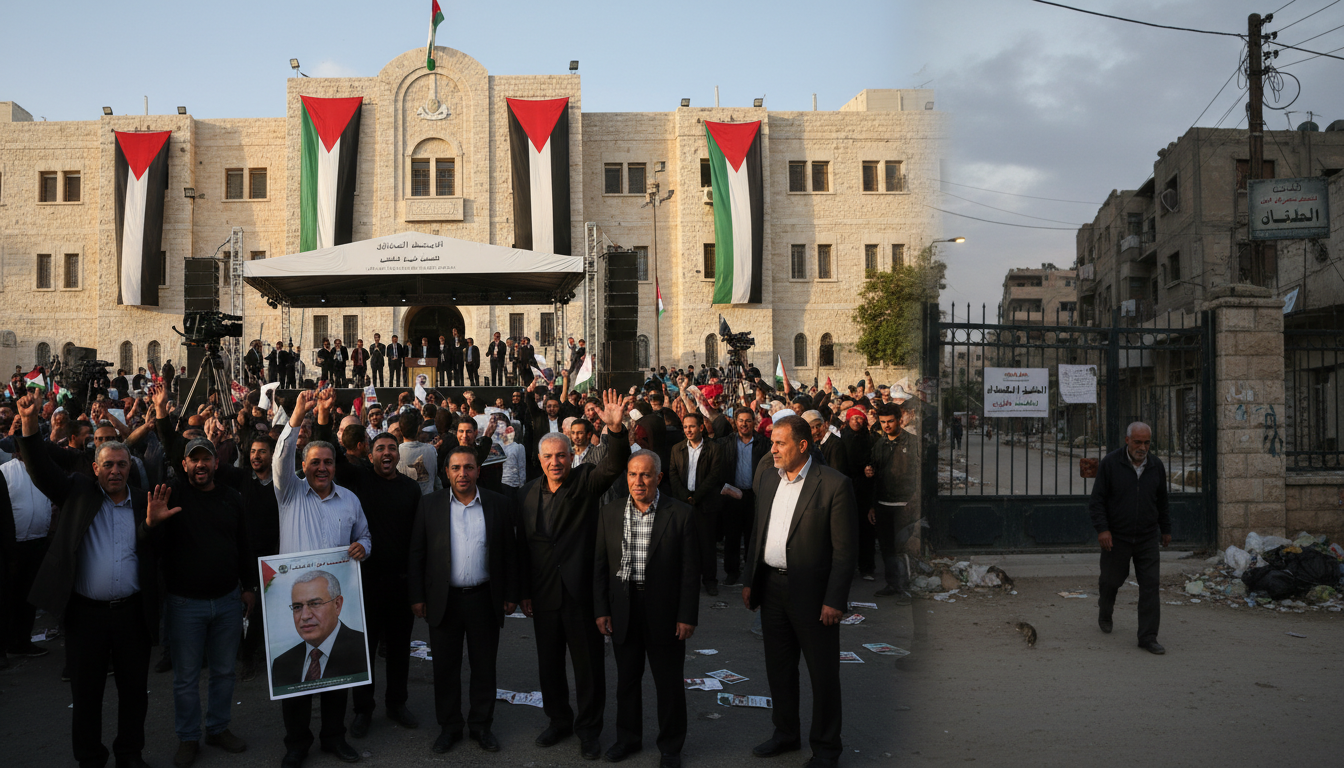
Palestinian municipal elections: Abbas loyalists win most seats as Gaza’s Deir el‑Balah holds symbolic vote
Abbas loyalists won most seats in Palestinian elections; Deir el‑Balah’s vote in Gaza saw low turnout amid wartime devastation and access restrictions.
The Palestinian municipal elections held on April 25, 2026 saw loyalists of President Mahmoud Abbas capture the majority of contested seats, while a symbolic ballot in Deir el‑Balah, Gaza, marked the first vote in the territory in nearly two decades. The Palestinian municipal elections included races across the occupied West Bank and a single city inside Gaza, a step authorities said was intended to reaffirm Gaza’s place in any future Palestinian state. Voter turnout in Gaza was notably low, reflecting the humanitarian crisis that followed the outbreak of full-scale war in October 2023.
West Bank results and Fatah consolidation
In the occupied West Bank, candidates aligned with Mr. Abbas and his Fatah party won by large margins, often running unopposed in municipal contests. Palestinian officials described the West Bank outcome as a consolidation of authority for the Palestinian Authority at a time of heightened political strain. Palestinian Prime Minister Mohammed Mustafa said the elections were held “at a highly sensitive moment amid complex challenges and exceptional circumstances.”
Deir el‑Balah described as a pilot election
The ballot in central Gaza’s Deir el‑Balah was presented by Palestinian Authority officials as a pilot exercise intended to demonstrate the enclave’s administrative link to Palestinian institutions. It was the first election held inside Gaza since 2006 and the first Palestinian polls since the war that began in October 2023, officials noted when announcing results on April 26, 2026. Local lists ran in Deir el‑Balah despite Hamas’s decision not to formally nominate candidates in the enclave.
Seat distribution in Deir el‑Balah
Preliminary tallies showed the Deir el‑Balah Brings Us Together list secured two of the 15 seats contested in the Gaza city, while the Nahdat Deir el‑Balah list, backed by Fatah and the Palestinian Authority, won six seats. The remaining seats went to two Gaza‑based groups called Future of Deir el‑Balah and Peace and Building, both of which officials said are not officially affiliated with the major factions. Observers cautioned that local alignments can mask broader political affiliations, and some lists were viewed by residents and analysts as sympathetic to Hamas despite the group’s formal boycott.
Turnout disparity and reasons cited
The Central Elections Commission chairman, Rami Hamdallah, reported turnout at roughly 23 percent in Gaza and about 56 percent in the occupied West Bank. Election officials and journalists in Gaza attributed the disparity to the massive displacement and destruction caused by the war that began in October 2023, which left many residents homeless or otherwise focused on survival. Al Jazeera correspondent Hind Khoudary, reporting from Gaza City, said the voter registry is outdated because of the conflict and many eligible voters remain displaced or unreachable.
Logistical barriers and access limits
Officials said some ballot boxes and voting equipment did not reach Gaza because of restrictions on what could enter the territory, complicating the organization of the poll. Journalists and election officials reported continuing limitations on movement and supplies, which they said hampered turnout and the administration of the vote. Observers also noted that Israeli military operations have continued in and around Gaza despite a ceasefire that took effect in October 2023, affecting civilian life and public services.
Voices from the ground
Reactions among residents in Deir el‑Balah were mixed, with some turning out to exercise their civic rights and others staying away because of insecurity or displacement. One voter, identified by the Associated Press as Ashraf Abu Dan, said he cast a ballot because he considered it his right to elect municipal representatives who could provide basic services. At the same time, local aid workers and community leaders described polling stations hampered by damaged infrastructure and a lack of clear records for many residents.
Political implications beyond municipalities
While municipal elections focus on local governance, analysts said the results could carry wider political symbolism for Palestinian politics, especially given the inclusion of a Gaza city after nearly 20 years. A modest showing by lists perceived as sympathetic to Hamas in Deir el‑Balah may be read differently by different stakeholders: as a limit on the movement’s political reach, or as an incomplete picture given the small scale and exceptional conditions of the vote. Prime Minister Mohammed Mustafa framed the exercise as part of a broader effort to maintain Palestinian institutions amid ongoing challenges.
The elections on April 25 and the results announced on April 26, 2026 underscore the political and humanitarian complexities facing Palestinian governance today, with clear differences in participation between the West Bank and Gaza and ongoing questions about how future ballots might be held under more stable conditions.
