
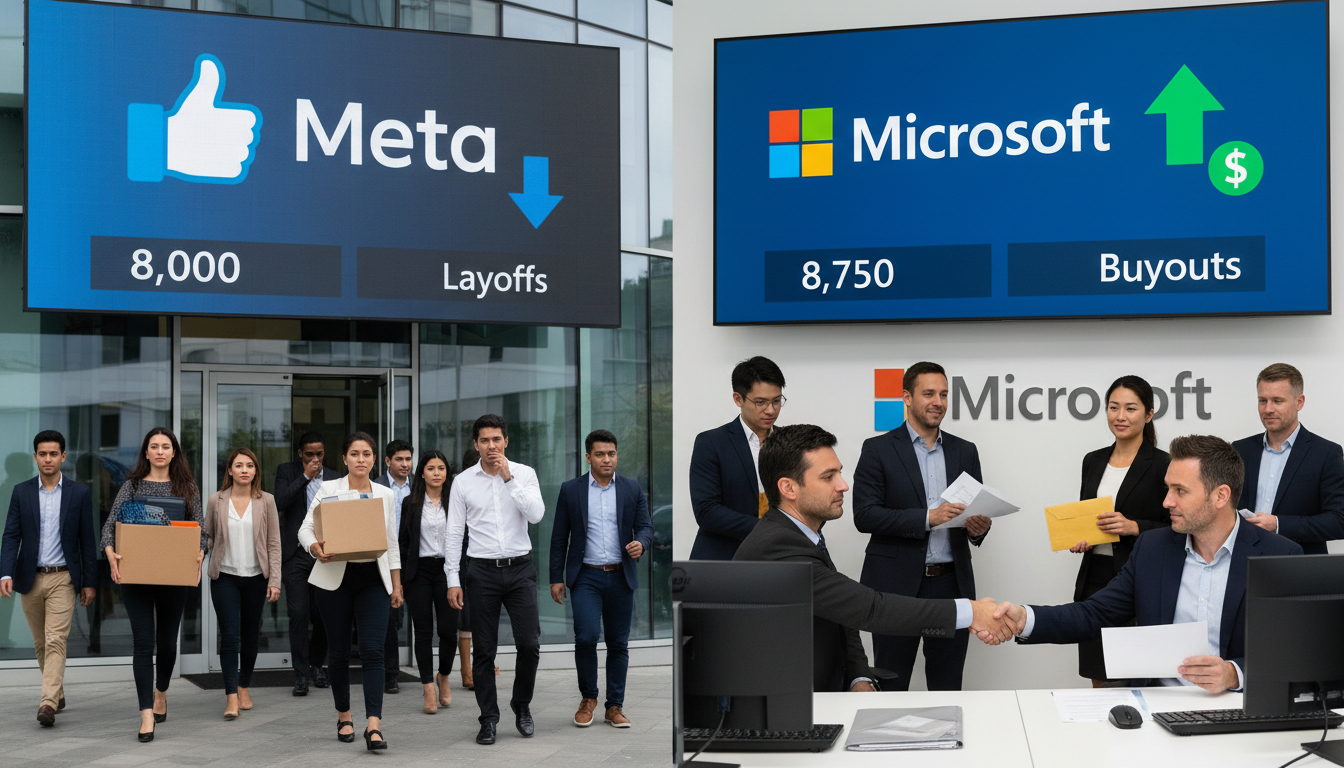
Meta layoffs hit 8,000 as Microsoft offers buyouts to 8,750 US employees amid AI spending surge
Meta lays off 8,000 workers as it shifts spending to AI infrastructure; Microsoft offers voluntary buyouts to roughly 8,750 US staff as both firms reshape workforces.
Meta layoffs mark major workforce reduction as company reallocates to AI
Meta announced on April 23, 2026, that it will cut about 8,000 jobs — roughly 10 percent of its global workforce — as it increases investment in artificial intelligence infrastructure and highly paid AI hires. Company executives said the reductions are intended to improve efficiency and free resources for new AI-related projects while leaving thousands of roles unfilled.
Bloomberg reported details of the plan, and Meta confirmed the target headcount reductions along with an intention to leave approximately 6,000 openings vacant as part of the reshaping. The move comes as Meta forecasts steeply higher expenses for 2026 driven by data‑centre and compensation costs tied to AI talent.
Scope and numbers of the workforce moves
Meta’s announced cuts amount to one of the largest single-company layoffs in the tech sector this year, directly affecting teams across the business. The company framed the reductions as a shift of resources towards areas it expects will drive future growth, rather than a narrow cost-cutting exercise.
At the same time, Microsoft is pursuing a different path in the United States by offering voluntary departure packages to a significant portion of its staff. Reports indicate Microsoft plans to invite about 8,750 eligible employees to take voluntary buyouts, representing roughly 7 percent of its U.S. workforce, with offers expected in early May.
Microsoft’s voluntary buyouts and employee choice
The voluntary program at Microsoft is structured as a retirement or separation incentive aimed at giving employees a choice to leave with company support. A memo reported by CNBC described the initiative as intended to allow eligible workers to “take that next step on their own terms” with financial assistance, according to people briefed on the plan.
For Microsoft, the approach avoids abrupt involuntary layoffs while still enabling workforce realignment and potential headcount reductions over time. The company has been expanding cloud and AI services, and the buyout program is widely read as a tool to rebalance staffing as those investments scale.
AI infrastructure spending reshapes priorities
Both companies are facing a common pressure: the cost of building and operating AI platforms and the premium paid for engineers who can develop and run them. Meta has told investors that 2026 spending will climb substantially, in the range of $162 billion to $169 billion, reflecting infrastructure and compensation increases tied to AI initiatives.
Meta’s recent ground‑breaking for an AI‑optimised data centre in Tulsa, Oklahoma — a project reported to cost about $1 billion and mark its 28th U.S. facility — illustrates the scale of capital investment. Microsoft likewise runs a vast and growing global data‑centre footprint supporting Azure, Copilot and other AI services, and has invested billions in that capacity.
Analyst commentary and market reaction
Analysts offered mixed assessments but some welcomed the moves as pragmatic responses to a changing operating environment. Wedbush analyst Dan Ives suggested the restructurings align with broader automation trends, arguing that AI tools can replace some labour-intensive tasks and justify a leaner operating model.
Financial markets reacted to the announcements: on April 23, 2026, Meta shares declined and Microsoft shares also fell, reflecting investor concern about higher near‑term costs and uncertainty around how quickly efficiency gains from AI investments will materialize.
Implications for workers and regional economies
The contrasting approaches — involuntary layoffs at Meta versus voluntary buyouts at Microsoft — could produce different outcomes for employees and local labour markets. For affected workers, buyouts may offer a softer landing for some, while layoffs create immediate displacement for others and raise questions about severance, rehiring and retraining opportunities.
Regional effects will vary. Construction and service work linked to new data centres can boost local employment during build phases, but long‑term demand will increasingly favour specialised AI engineers and operations staff. Communities hosting large tech facilities may see short‑term gains and longer‑term shifts in the types of available jobs.
As companies continue to pivot toward AI, businesses, employees and policymakers will monitor whether investments translate into sustainable productivity gains or simply higher fixed costs for running advanced compute infrastructure in the years ahead.
