
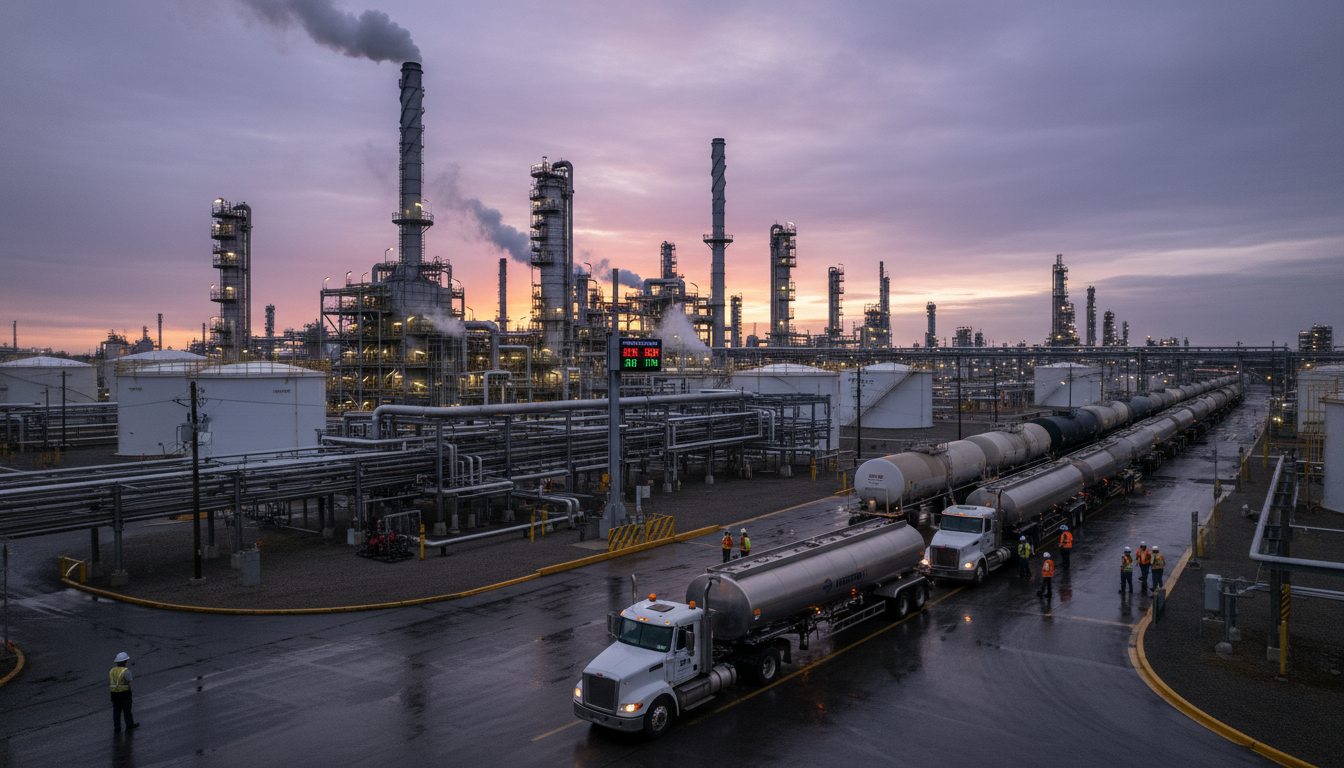
Imperial Oil boosts diesel and jet fuel production as prices surge amid Middle East disruption
Imperial Oil boosts diesel and jet fuel production, shifting refinery output to meet Canadian demand and opportunistic exports as fuel prices climb and Q1 results show lower profit.
Imperial Oil announced a strategic shift to increase diesel and jet fuel output at its Canadian refineries, citing stronger market prices and supply disruptions linked to fighting in the Middle East. The company said it has prioritized diesel and jet molecules over gasoline across its downstream operations, a change that reflects rising international demand and tighter product availability. Executives told analysts the move is intended to serve domestic customers while allowing the company to sell additional volumes abroad when market conditions are favorable. The decision comes as Imperial reported first-quarter results that showed lower profit and slightly reduced refinery utilization.
Refineries redirected to diesel and jet production
Imperial Oil has reconfigured its refinery operations in Canada to produce a larger share of diesel and jet fuel instead of gasoline. Company executives explained to analysts that this adjustment responds directly to stronger pricing for distillate products and regional shortages created by constrained crude shipments. The majority of the extra output is intended for the domestic market in Canada, though Imperial also said it will opportunistically export surplus volumes when prices and logistics permit. The refinery changes reflect a tactical response to market signals rather than a permanent shift away from gasoline production.
The company’s downstream vice-president, Scott Maloney, told investors the firm has been “maximizing” diesel and jet production in recent weeks. That emphasis was concentrated at Imperial’s three major refineries, two located in southwestern Ontario and a third in Edmonton, Alberta. Those facilities supply heating oil, diesel, jet fuel and other refined products to Canadian wholesalers, transportation fleets and retailers. By emphasizing higher-margin distillates, Imperial aims to capture elevated spreads between gasoline and diesel prices that have widened amid supply constraints.
Market forces shaped by Middle East conflict
Market participants linked the change in refinery output to a deterioration in supply lines stemming from heightened tensions and military activity in the Middle East. Disruptions in and around the Persian Gulf have limited crude flows from a region that remains a major source of seaborne oil, pushing many purchasers to seek alternate supplies and elevating prices for refined products. Global airlines and freight carriers have felt the impact most acutely, as jet fuel and diesel costs are a major component of operating expenses and have risen sharply in recent weeks.
Natural Resources Canada data cited by industry analysts showed a meaningful jump in the national diesel price, with weekly averages rising to roughly $2.21 per litre during the recent period. Those higher pump and wholesale prices have led trucking companies, rail carriers and other large fuel consumers to implement surcharges or to revise logistics plans to mitigate cost impacts. Airlines globally have also trimmed schedules and suspended certain routes where fuel-driven economics no longer allow profitable operation, a trend that has pressured carriers to reassess capacity and guidance.
Production and throughput figures for the quarter
Imperial’s reported volumes for the first quarter show how the company balanced downstream product mixes with upstream production realities. The company sold about 169,000 barrels per day of heating oil, diesel and jet fuel during the quarter, modestly lower than the roughly 175,000 barrels per day it sold a year earlier. Throughput at Imperial’s refineries averaged 384,000 barrels per day in the three-month period, down from 397,000 barrels per day in the prior-year quarter, reflecting operational challenges and supply disruptions.
Refinery utilization was reported at 88 per cent for the quarter, which compares with 91 per cent utilization in the equivalent period a year earlier. The company attributed the decline to a combination of unplanned downtime at certain facilities and an interruption of feedstock supplies linked to third-party issues at a Syncrude oilsands processing plant. Those constraints reduced the volume of crude-derived intermediates available for refining and limited how much product Imperial could produce overall.
Upstream performance and oilsands resilience
On the production side, Imperial’s upstream operations delivered largely stable results through the quarter. Average upstream production came in at about 419,000 gross oil-equivalent barrels per day, a slight increase from 418,000 barrels per day a year earlier. The company’s Kearl oilsands operation north of Fort McMurray demonstrated resilience, lifting bitumen output to near 259,000 barrels per day despite facing a third-party natural gas supply outage during the period.
Management cited operational work to maintain steady oilsands performance while managing external supply interruptions. The Kearl mine’s incremental output helped offset some constraints in refinery feedstock, though it did not fully counterbalance the throughput reduction caused by third-party processing issues. Overall, Imperial’s upstream portfolio provided a steady source of crude and bitumen that underpins the company’s refining and marketing activities.
First-quarter results and financial drivers
Imperial reported a first-quarter profit of $940 million, down from $1.29 billion a year earlier, reflecting a mix of higher compensation charges and narrower refining margins in the period. On a per-share basis, the company recorded diluted earnings of $1.94 for the quarter, compared with $2.52 in the first quarter of the preceding year. The company’s revenue for the period totaled $12.45 billion, marginally below the $12.52 billion posted a year earlier.
Executives identified incentive compensation charges linked to Imperial’s share price as a meaningful component of the earnings decline, noting an after-tax charge of approximately $143 million that reduced reported results. Daniel Lyons, Imperial’s senior vice-president of finance and administration, explained that the higher charge stemmed from the company’s compensation framework and stronger share performance over recent measurement periods. Analysts had been expecting earnings of about $2.39 per diluted share for the quarter, according to consensus data, leaving the company below the average estimate.
Operational disruptions and logistics constraints
Operational disruptions in both refinery feedstock and refining processes contributed to lower utilization rates and constrained product availability in the quarter. Imperial pointed to unplanned downtime at certain refining units, as well as a supply interruption from a Syncrude oilsands processing facility, as key reasons throughput fell. Those kinds of disruptions can force companies to rearrange production schedules, prioritize certain product slates, and in some cases seek third-party feedstock to maintain runs.
Logistics and export opportunities became factors in how the company allocated output. While most refined product from Imperial’s Canadian refineries serves domestic consumption, the company said it periodically pursues export sales when market conditions allow. Exporting distillates can help capture higher international prices, but logistical considerations such as shipping capacity, regulatory approvals and bilateral trade dynamics shape how readily a refinery can divert volumes abroad.
Implications for consumers and transport sectors
Higher diesel and jet fuel costs have immediate consequences for end users across the economy, particularly in transportation, agriculture and aviation. Trucking firms and rail operators typically pass higher fuel expenses to customers through surcharges, which raises costs for shippers and ultimately for consumers. Airlines, already exposed to volatile jet fuel markets, have trimmed capacity and in some cases suspended guidance for the year as they reassess the economics of routes rendered unprofitable by elevated fuel costs.
Industry observers say sustained higher distillate prices can feed into broader inflationary pressures by increasing the cost of moving goods and the price of energy-intensive services. Companies that cannot readily hedge fuel exposure or that operate on thin margins may reduce operations or seek alternate suppliers. Policy-makers and regulators watch these developments closely because extended fuel-price shocks can affect economic growth, consumer spending and transportation networks.
Company ownership and strategic context
Imperial Oil is majority-owned by U.S.-based ExxonMobil Corp., a relationship that influences capital allocation, trading strategies and access to international markets. That parent–affiliate link provides Imperial with integration advantages and the ability to coordinate crude sourcing and product sales across a broader corporate footprint. Management decisions to emphasize distillate production align with the broader objective of optimizing margin capture and responding to near-term market dynamics.
The strategic emphasis on diesel and jet fuel also reflects a wider industry trend where refiners adjust product slates to exploit price differentials between gasoline and distillates. These adjustments are tactical and can be reversed as market signals change, including shifts in crude differentials, seasonal demand patterns, and restoration of supply from affected regions. For Imperial, the current approach aims to balance serving Canadian consumers while taking advantage of export windows when they provide incremental value.
Final paragraph
Imperial Oil’s decision to boost diesel and jet fuel production underscores how international conflict and regional supply interruptions can quickly reshape refinery economics and product availability in Canada. The company’s first-quarter results reflect the trade-offs of managing operational disruptions, compensation charges and shifting product mixes amid volatile markets. For consumers and transportation sectors, the immediate effect has been higher distillate prices and increased cost pressures, while Imperial evaluates export opportunities and steadies upstream output to support downstream needs.
