
Calgary wind warning forces Parade of Wonders cancellation as downtown sees debris and street closures
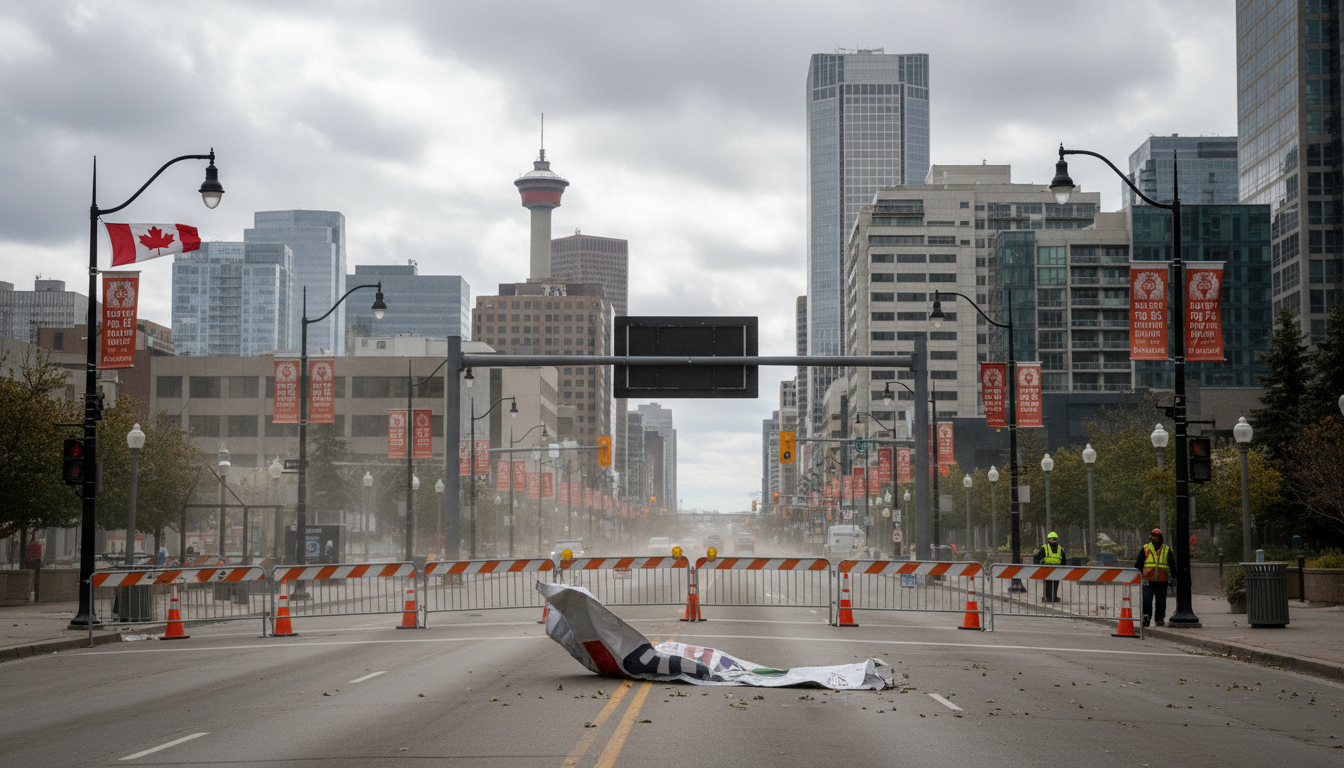
Calgary wind warning: strong gusts up to 90 km/h forced Calgary Expo to cancel its Parade of Wonders, closed downtown streets and scattered construction debris.
Strong winds that prompted an Environment Canada wind warning on April 24, 2026, disrupted Calgary’s downtown and forced organizers of Calgary Expo to cancel the Parade of Wonders.
The storm-strength gusts, forecast to reach up to 90 km/h, created hazardous conditions for a major outdoor gathering and sent building materials tumbling onto public streets.
City crews and emergency responders moved quickly to clear debris and secure affected areas while officials said no injuries were reported.
Calgary Expo cancels Parade of Wonders, moves kickoff to BMO Centre
Calgary Expo organizers announced the cancellation of the Parade of Wonders on the morning of April 24, 2026, citing high wind speeds that made the procession unsafe.
Rather than hold the outdoor march, the event’s opening was shifted to the front steps of the BMO Centre, where organizers said the festivities would continue in a modified format.
In a social media message, event staff emphasized that while the parade portion would not proceed, the convention’s scheduled opening activities would go ahead in a more sheltered location.
The Parade of Wonders has served as a high-profile kickoff for Calgary Expo in recent years, drawing costumed participants and large crowds to downtown streets.
Organizers faced the immediate challenge of reconfiguring crowd management and security plans to move the opening into a more controlled environment at short notice.
Attendees arriving for the weekend convention were advised through official channels to follow updated entry instructions and to monitor social updates for any further changes.
Environment Canada issued wind warning with gusts measured up to 90 km/h
Environment Canada issued a formal wind warning for the Calgary region on April 24, 2026, forecasting sustained northwest winds of around 60 km/h with gusts up to 90 km/h.
The warning covered the city and surrounding areas, and meteorologists noted that the peak gusts arrived in the early evening, producing sudden, damaging wind events in exposed locations.
Officials urged residents and organizers to secure loose objects, avoid unnecessary travel in affected areas, and stay clear of trees and scaffolding during the height of the winds.
The warning also advised building managers and construction crews to enact site-specific safety protocols designed for high-wind scenarios.
Forecasters said conditions were expected to ease through the afternoon and into the overnight period, with diminishing winds after the initial surge.
City officials reiterated that the priority during the advisory was protecting public safety and minimizing the risk of falling debris.
Downtown section closed after metal panelling fell onto Second Avenue S.W.
Shortly before 5:30 p.m. on April 24, emergency responders were called to a downtown scene where sections of metal panelling from an elevated walkway fell onto Second Avenue S.W.
Police closed the stretch of road between Third and Fourth streets while specialized crews from the Calgary Fire Department’s technical task team worked to remove the hazardous material.
Witnesses reported sudden cracking sounds and visible pieces of cladding littering the roadway, prompting an immediate safety perimeter to keep pedestrians and vehicles clear.
Battalion Chief Mike Lazaick of the Calgary Fire Department explained that the technical task team uses specialized access equipment and techniques that standard apparatus do not carry.
Those crews are trained to evaluate and manage precarious building materials and to perform controlled removals in complex urban environments.
Police and fire officials coordinated traffic detours and monitored adjacent buildings for additional damage as crews completed their operations.
Construction sites showed vulnerabilities despite mandatory forecasting requirements
Since 2011, the city has required an advanced weather forecasting system for all construction sites five storeys or higher in downtown Calgary and the Beltline.
The system is intended to give builders up to 48 hours’ notice of severe wind events so materials can be secured or removed, reducing the risk of debris becoming hazardous.
Despite that requirement, city officials received reports of loose construction materials being blown from sites in the northwest and other sectors during the gusts on April 24.
Photographs from the day showed torn protective coverings and scattered sheeting at construction locations, including a site on Quarry Park Road S.E. where high winds ripped draping covers.
City building inspectors and project managers typically rely on forecasting alerts to lock down scaffolding, tie down tarps and fasten loose cladding ahead of strong wind advisories.
The extent of damage and whether all affected sites fully implemented the forecast-based precautions will be subject to follow-up by municipal inspectors.
Contractors and site supervisors face regulatory obligations to prevent wind-related hazards, and the incident on April 24 will likely prompt additional reviews of on-site preparedness.
Officials said the forecasting requirement is one part of a broader framework that includes site-specific safety plans and municipal enforcement options when compliance falls short.
Investigators will assess whether any lapses contributed to material dislodgement and whether additional measures are needed to protect pedestrians and traffic corridors.
Emergency response and city services mobilized to secure affected areas
Emergency crews, including police and municipal fire units, were deployed across downtown after the reports of falling debris and loose materials.
The Calgary Fire Department’s technical task team closed the affected road section and employed specialized tools to remove panels and assess building façades for further risk.
Police officers managed perimeter control and traffic rerouting to keep the public at a safe distance while cleanup proceeded.
A Calgary International Airport spokesperson reported that commercial flights were not impacted by the wind event on April 24, 2026, and airport operations continued without reported disruption.
City officials confirmed that, despite the localized damage in the downtown core and construction sites, there were no reported injuries related to the falling material.
Municipal crews were dispatched to sweep affected streets, secure loose signage and coordinate with property owners to inspect building envelopes for wind damage.
Public transit agencies and private carriers monitored conditions throughout the afternoon and evening and adjusted operations where necessary to ensure passenger safety.
Transit riders were advised to expect possible delays in areas where debris removal and safety assessments were under way.
City communications teams used social channels and emergency alerting to keep residents informed about closures, detours and safety precautions.
Organizers and businesses weigh impacts as winds subside overnight
Calgary Expo shifted its planned outdoor activities into indoor or sheltered spaces, and local businesses near the BMO Centre adapted to a changed foot-traffic pattern.
Retailers and restaurants reported stepped-up employee action to secure outdoor furniture, signage and canopies in the hours leading up to the gusts.
For many downtown merchants, the priority during the advisory was protecting customers and limiting property damage until winds diminished.
Municipal crews prioritized inspections of known vulnerable façades and public walkways once conditions stabilized, and they coordinated with building owners on immediate remediation steps.
Event organizers said they would continue to monitor weather updates and consult with city emergency services before resuming any outdoor programming.
The rapid shift in plans underscored the logistical challenges that large public events face during short-notice severe weather advisories.
City officials encouraged Calgarians to report any remaining hazards to municipal non-emergency lines so crews could address loose material and potential safety risks promptly.
Those reports will help prioritize follow-up inspections and targeted enforcement if construction sites were found to be non-compliant with mandatory safety systems.
Officials said they would review the response timeline and consider whether further public messaging or operational changes are needed ahead of future high-wind warnings.
Closing paragraph
City crews and event organizers described the response to the April 24, 2026 wind event as swift and coordinated, with priority placed on preventing injuries and restoring safe access to downtown streets.
As winds eased overnight, authorities shifted from immediate hazard removal to inspection and recovery, and no injuries were reported in connection with falling materials.
Calgarians have been asked to remain attentive to Environment Canada advisories and to report hazards so that municipal teams can complete repairs and ensure public safety in the days following the advisory.
