
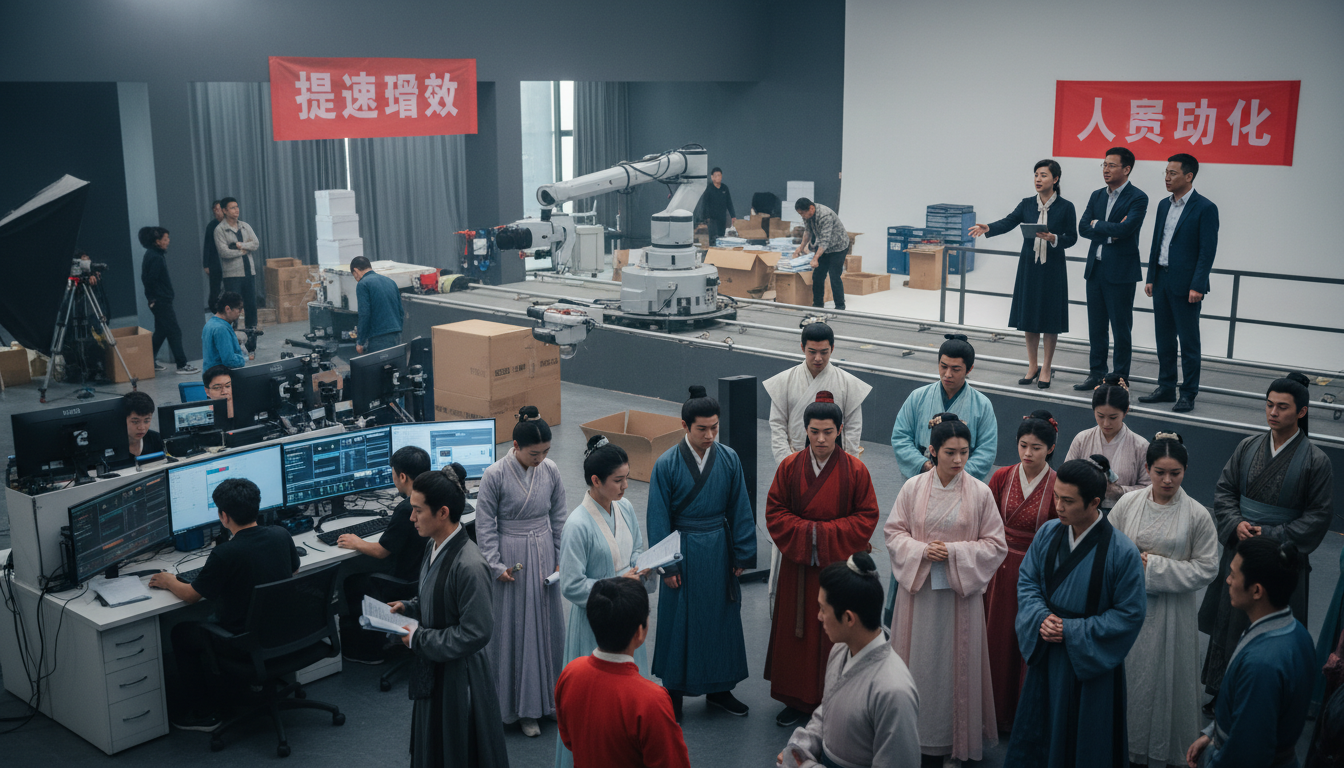
A.I. Transforms China’s Microdrama Boom, Displacing Actors and Crews
A.I. tools such as Seedance are reshaping China’s microdrama industry, cutting costs and staff, boosting effects and prompting debate over jobs and creativity.
A.I. technology has rapidly altered the production and economics of China’s microdrama market, a sector built on short, serialized videos designed for mobile viewing. The emergence of advanced A.I. video models in early 2026 accelerated the shift, allowing producers to generate cinematic scenes and visual effects with far fewer people and in far less time. That change has delivered higher production value but also forced widespread layoffs and left performers and crew members uncertain about their future.
Microdramas Have Become a Major Commercial Force
Microdramas — compact episodes intended for phones with rapid plot turns — have grown into a multibillion-dollar business in China in just a few years. Industry estimates place the market value in the low tens of billions of dollars, driven by subscription revenue and heavy viewer engagement on dedicated streaming platforms. Their short form and serialized momentum make them a prime target for automation because episodes must be produced quickly to sustain audience interest.
Seedance and New A.I. Video Models Accelerated Change
A new class of A.I. video models, including a widely discussed tool called Seedance, surfaced in February 2026 and demonstrated capabilities once limited to big-budget studios. Public demos showing cinematic, multi-camera sequences with lifelike likenesses highlighted how readily these models can generate complex scenes. Producers quickly adopted the technology to cut turnaround times and create effects that previously required extensive post-production and specialist teams.
Producers Report Faster Output and Lower Costs
Independent directors and small studios report dramatic reductions in production time and expenses after incorporating A.I. tools into their workflows. Where weeks of effects work and location shoots once were necessary, teams can now prototype and finalize scenes in days using machine-generated imagery and automated compositing. That efficiency has allowed some creators to expand output and explore more ambitious genres, including science fiction and elaborate action sequences.
Layoffs and Fewer On-Set Opportunities Follow
The same efficiencies have translated into job losses across production crews and supporting staff. Several small production companies have reduced field crews, visual-effects teams, and producers after A.I. adoption made many roles redundant. Performers who previously worked steadily in supporting parts report far fewer days on set, challenging them to find alternative income streams or retrain for new roles in the changing ecosystem.
Actors and Creators Face Career Uncertainty
Actors who specialized in microdramas say their workloads have contracted since A.I. tools became widespread. Many who were regularly cast in character or romantic supporting roles now contend with fewer calls and competition from digitally generated talent. Directors and screenwriters also face pressure to adapt storylines to formats that leverage A.I. capabilities, shifting creative priorities away from performance-driven storytelling toward spectacle and visual novelty.
Platforms Increase Quality Expectations and Monetization Rules
Streaming platforms that host microdramas have raised production standards as viewers respond to more cinematic content, prompting publishers to demand higher-resolution assets and more polished episodes. That shift has altered monetization models: platforms are willing to pay premiums for higher-quality series but also expect faster delivery and lower per-episode costs. The new economics favor companies that can scale A.I.-driven pipelines, squeezing small teams that rely on traditional production methods.
Industry Debate Over Creativity, Ethics and Regulation
The rapid uptake of A.I. in entertainment has ignited debate among creators, unions and regulators over ethics and intellectual property. Questions about rights in synthesized performances, consent for likeness use, and the provenance of training data are increasingly urgent. At the same time, some filmmakers and actors acknowledge that A.I. can expand creative possibilities by enabling scenes and creatures that were previously unaffordable for small producers.
The industry’s next steps remain uncertain as stakeholders weigh short-term gains against long-term implications for employment and artistic practice. Some production houses are investing in hybrid models that combine human performance with A.I. augmentation, while others are lobbying for clearer rules on digital likenesses and compensation. As A.I. tools continue to improve, the balance between technological advantage and the human workforce will likely shape how China’s microdrama sector evolves in the months and years ahead.
