
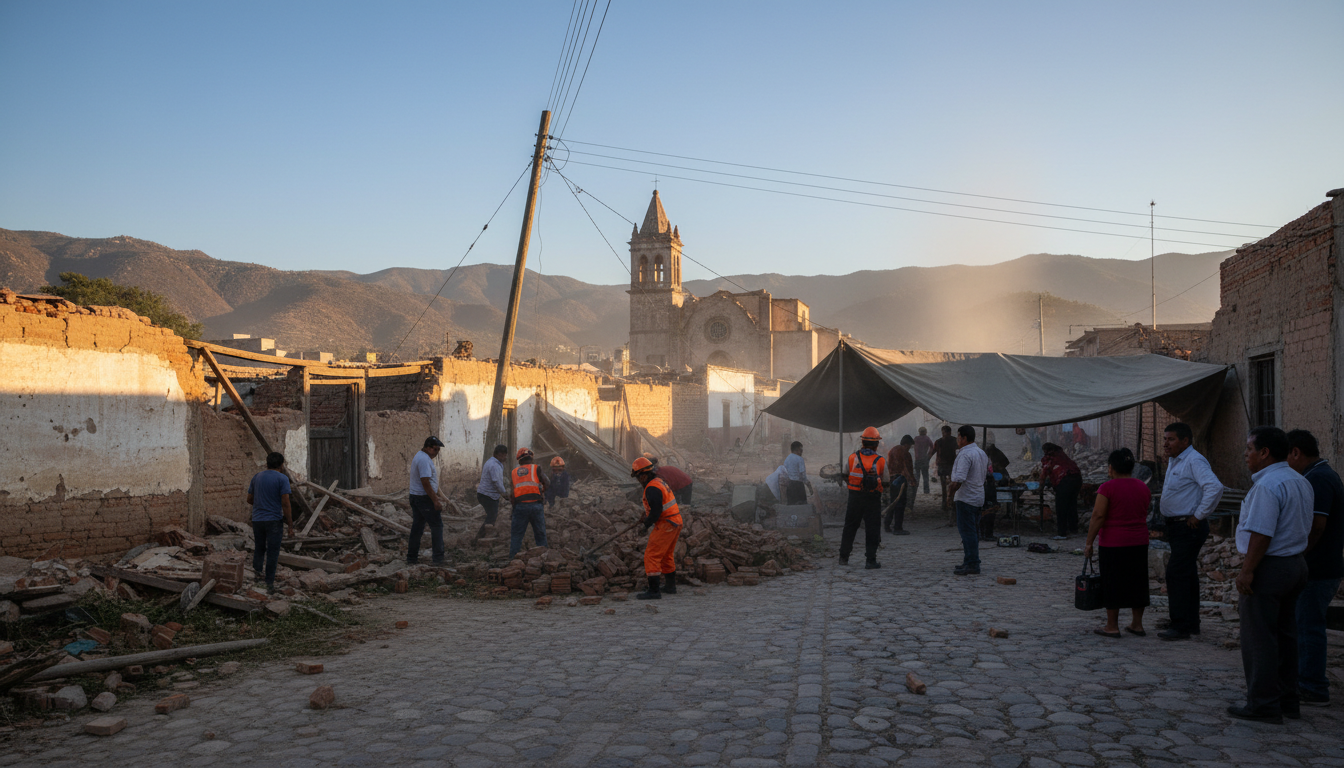
5.7-Magnitude Earthquake in Mexico Shakes Near Zocoteaca de León
A 5.7-magnitude earthquake in Mexico struck near Zocoteaca de León on Monday, May 4, 2026, shaking communities and prompting continued monitoring by the U.S. Geological Survey (USGS). The temblor was recorded at 9:19 a.m. Central time and was initially reported as magnitude 5.7 by the USGS, with seismologists warning that the figure could be revised as more data are analyzed. Authorities and scientists emphasize that shake-intensity maps and aftershock listings will be updated as additional measurements and reports come in.
Epicenter and Timing
The USGS located the quake’s epicenter roughly one mile southeast of Zocoteaca de León, Mexico, at 9:19 a.m. Central time on Monday, May 4, 2026, according to agency data released immediately after the event. Early bulletins listed the magnitude as 5.7, a value subject to change as seismologists review waveform data, station corrections and depth estimates that can alter magnitude and perceived intensity. The initial public maps and notices were timestamped in Eastern time for distribution, with shake data posted as of May 4, 2026, at 11:36 a.m. Eastern and aftershocks tallied through 6:34 p.m. Eastern.
Shake Intensity Footprint
USGS shake-severity mapping for the event highlighted areas that experienced a shake intensity of 3 or greater on the Modified Mercalli Intensity scale, a threshold the agency classifies as “weak” shaking in public guidance. Those maps are designed to show where people could have felt the tremor and to guide rapid assessments, but officials note that perceptible shaking can extend well beyond the colored footprint depending on local geology and building types. Population density layers used in the mapping, derived from LandScan via Oak Ridge National Laboratory, help emergency planners understand how many people live within zones of elevated shaking.
Aftershocks and Monitoring Activity
Seismologists monitoring the region cautioned that aftershocks are common following an event of this size and that the network will register smaller earthquakes in the days that follow, typically within a 100-mile radius and for at least a week. The USGS and affiliated observatories continue to analyze seismic records and incorporate new stations’ readings, which can refine the initial magnitude and modify the depicted shaking contours. Publicly released aftershock charts and lists were updated through the evening of May 4, 2026, and agencies said they would publish further revisions as more data become available.
Reports From the Ground
Initial public releases accompanying the seismic data did not include verified reports of widespread structural damage, and local emergency services had not issued broad alerts in the immediate aftermath of the quake in the material provided by monitoring agencies. In many earthquakes of comparable strength, impacts range from minor cosmetic damage to older or poorly constructed buildings, while modern, code-compliant structures often sustain minimal harm; however, the full picture depends on depth, distance and local construction. Local authorities and emergency management offices in the affected states and municipalities are the primary sources for damage assessments and relief coordination, and residents were advised to follow official channels for verified information.
Scientific Context and Safety Guidance
A magnitude-5.7 event is classified as moderate in seismological terms and can be strongly felt at the epicenter while decreasing in intensity with distance, though geological conditions can amplify shaking in some communities. The USGS uses standardized intensity categories to communicate expected effects, but those categories are part of a technical framework that is regularly refined as more observations are gathered after a quake. Officials encouraged residents to check for structural hazards, avoid downed power lines and gas leaks, and to follow basic earthquake safety measures—drop, cover and hold on—while awaiting official advisories from local emergency agencies.
Seismologists and emergency managers said they would provide updated maps and magnitude estimates as new station data are processed and as citizen reports are compiled, and they stressed that initial numbers may be adjusted during the hours and days following the event.
