
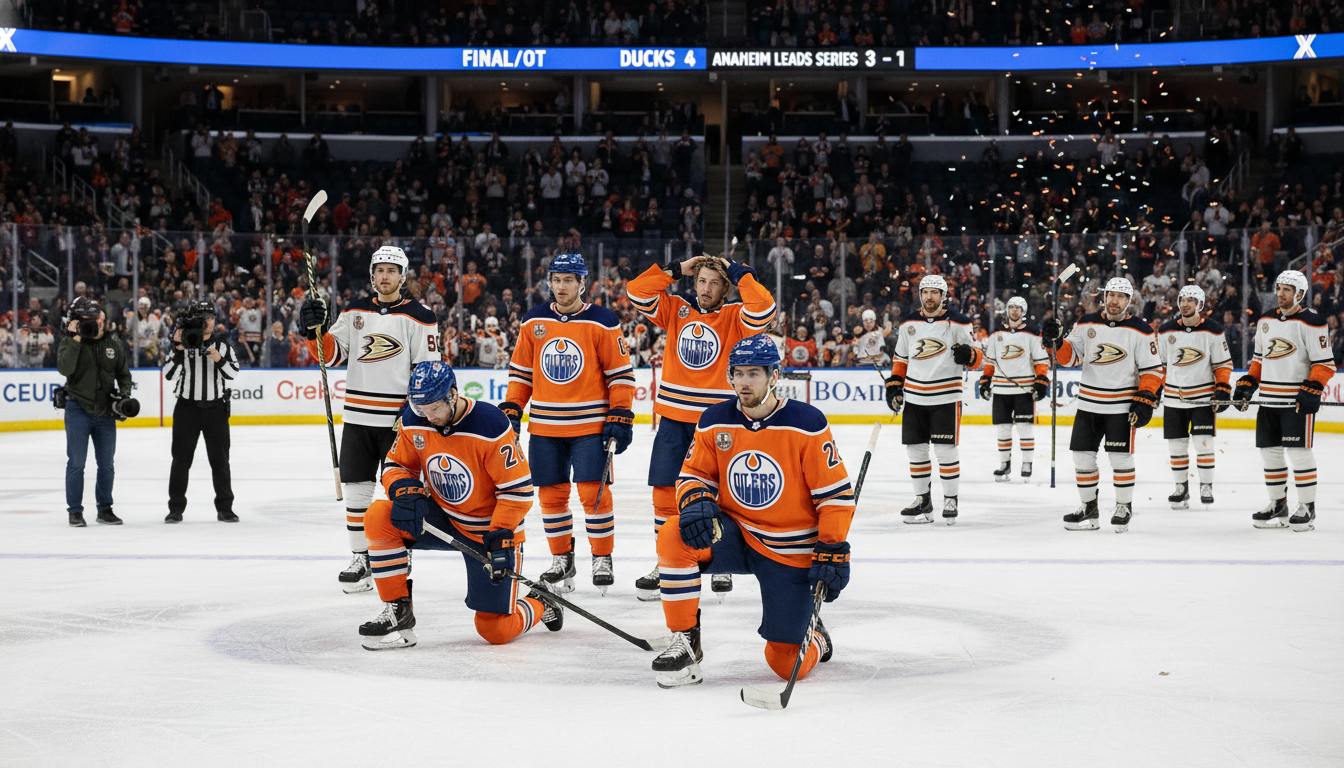
Oilers fall 4-3 in overtime to Ducks, trailing series 3-1 ahead of April 28 Game 5
Edmonton Oilers lose 4-3 in overtime to Anaheim Ducks, now trailing 3-1 in the first round as Ryan Poehling’s reviewed goal stands ahead of Game 5 on April 28.
The Edmonton Oilers dropped a 4-3 overtime decision to the Anaheim Ducks at Honda Center on April 26, 2026, leaving the visitors down 3-1 in their opening-round Stanley Cup playoff series. Ryan Poehling scored the decisive goal in sudden death, and the tally was upheld after reviews by on-ice officials and the NHL’s situation room. Edmonton now returns to Rogers Place for Game 5 on Tuesday, April 28, 2026, with little margin for error if it hopes to keep its postseason intact.
Oilers lose tight overtime game and now trail series 3-1
The Ducks converted a late chance in overtime to take the fourth game of the best-of-seven series and seize a commanding lead. Anaheim rallied from an early deficit, responding to Edmonton’s opening goals with key strikes on special teams before Poehling’s winner finished the night. The result extended a troubling pattern for the Oilers, who have trailed by one or two goals in each of the series’ four games and have been unable to string consecutive wins. With the series shifting back to Edmonton, the onus is on the Oilers to respond immediately at home.
Both clubs traded momentum swings through 65 minutes of play, and the margin was decided by a fraction of an inch on an over-ice camera angle. The defeat leaves Edmonton with limited options and an urgent need to tighten fundamentals, remove undisciplined penalties and regain a finishers’ touch in critical moments. The tone in the visitor dressing room after the loss was measured but tense, with team leaders stressing belief while acknowledging the practical reality of facing elimination before a home crowd.
Overtime goal survives multi-stage review after slow-motion scrutiny
Officials on the ice signalled a goal and then referred the play to the NHL situation room for further examination, a process that scrutinized multiple camera angles for conclusive evidence. Replays showed the puck carom off a Ducks player and touch a defending Oilers skater before sliding into the net, and several frames suggested Tristan Jarry’s skate may have been over the puck as it crossed the line. League reviewers determined the evidence did not conclusively overturn the on-ice call, and the goal was allowed to stand.
That ruling left Edmonton coaching staff and players visibly frustrated but without immediate recourse. Head coach Kris Knoblauch described the footage as inconclusive after the game, while his players said the images could be interpreted in more than one way. The decision underscores the narrow margins of playoff officiating and the role of video review in settling contests that turn on thousandths of a second. For the Oilers, the review’s outcome will be examined repeatedly in the upcoming hours, but the practical focus shifts quickly to preparation for Tuesday’s elimination game.
Tristan Jarry’s first playoff start for Edmonton drew mixed reviews
The game marked the first playoff start for goaltender Tristan Jarry in an Edmonton uniform, a move that followed three consecutive starts by Connor Ingram earlier in the series. Jarry, a 30-year-old from Surrey, B.C., made 34 saves and faced a high volume of traffic in front of his net, including traffic-heavy sequences that challenged his sight lines. He had been out of action since April 8 and returned to competitive game duty in a high-stakes environment, settling into the net but ultimately on the losing side of a one-goal game.
Jarry’s crease work was solid for long stretches, and he earned praise for several timely stops that kept Edmonton within striking distance. The overtime sequence that produced the game-winning goal featured heavy congestion and a puck that deflected off a defender’s skate and through Jarry’s pads, a play the goaltender felt was ambiguous in real time. While his performance offered signs of steadiness that the Oilers will need in Game 5, the manner of the loss leaves open questions about net-front coverage and rebound control under playoff pressure.
Special teams decided the middle frame and swung momentum
Special-teams execution proved pivotal as Anaheim scored twice on the power play in the second period, erasing a multi-goal Oilers lead and flipping momentum in the Ducks’ favour. Edmonton did capitalize on its own man-advantage opportunities, converting both power plays it received, but the timing of Anaheim’s strikes — two in the middle period — allowed the hosts to seize control. The interplay of successful and unsuccessful penalty kills became a defining element of the game’s flow.
Edmonton’s penalty kill, which had struggled at times earlier in the series, was caught out of position on crucial sequences that invited high-percentage scoring chances. Defenceman Mattias Ekholm noted that the Oilers made better five-on-five adjustments, but remained vulnerable when shorthanded. On the other side of the coin, Evan Bouchard’s third-period goal gave Edmonton a brief 3-2 lead and illustrated the team’s ability to generate traffic and scoring from the point, even as special-teams swings ultimately decided the night.
Connor McDavid’s condition and influence remained front-and-centre
Connor McDavid assisted on two of Edmonton’s three goals, continuing to shoulder the offence despite appearing less than fully comfortable after a rolled ankle sustained earlier in the series. He remains the focal point of the Oilers’ attack and displayed enough speed and playmaking acumen to create danger for Anaheim, including a notable individual rush late in the third that nearly produced a wild-card equalizer. McDavid’s mobility appeared limited at times, and he downplayed the narrative of his own health, emphasizing instead the collective challenge ahead.
The captain framed the team’s situation in stark terms, acknowledging that the club was in a hole but underscoring belief in the group’s resilience. His remarks reflected a mix of realism and motivation, urging teammates to dig deeper at home. The supporting cast showed flashes, including Ryan Nugent-Hopkins scoring in his 100th career playoff game, yet the team was unable to muster a late, sustained assault that would have altered the series trajectory.
Series context and what Edmonton must change before Game 5 at Rogers Place on April 28
Edmonton reached the Stanley Cup final in each of the previous two seasons, an experience that provides a blueprint for comebacks but not a guarantee of success. Historically, teams leading 3-1 in a best-of-seven have an overwhelming probability of advancing, leaving Edmonton with limited allowance for mistakes. Coach Knoblauch stressed the team’s familiarity with adversity and credited his players with resilience, but also acknowledged that the margin for error is vanishingly small as the series returns to Edmonton on April 28.
Tactical adjustments likely to surface in practice include tightening the penalty kill, sharpening puck retrievals in the defensive zone and generating cleaner neutral-zone exits to reduce turnovers. The Oilers will also need to reclaim the simple, hard-zone possessions that produce second-effort opportunities in front of the opponent’s net. On the personnel front, goaltending decisions, whether to stick with Jarry for a second consecutive start or revert to Ingram, will be discussed behind closed doors, with the club weighing confidence, rest and matchup factors.
Edmonton’s home-ice atmosphere and crowd energy at Rogers Place will be factors the team hopes to leverage. The club must convert urgency into execution while avoiding the types of penalties that allowed Anaheim back into the game on Sunday. The Ducks enter Game 5 with confidence gleaned from three straight wins, and the Oilers must disrupt that momentum with a disciplined, high-tempo response that minimizes defensive breakdowns and maximizes offensive zone time.
Edmonton’s coaching staff will emphasize mental clarity and structural discipline in the days ahead, while veterans who have navigated long playoff runs will be asked to drive tempo and set the tone from puck drop. The series still contains possibilities, but only immediate, measurable gains on both special teams and five-on-five play will extend the Oilers’ post-season past Tuesday night.
For Edmonton, Game 5 is not merely another contest; it is a domestic test of resolve where a single home victory will keep the season alive and a loss will bring the postseason to an abrupt close. The Oilers must marshal tighter defensive coverage, fewer penalties and sharper shooting to alter the series script. With the building set to erupt on April 28, Edmonton will have one final chance on home ice to force a shift in momentum and extend its run in the 2026 Stanley Cup playoffs.
