
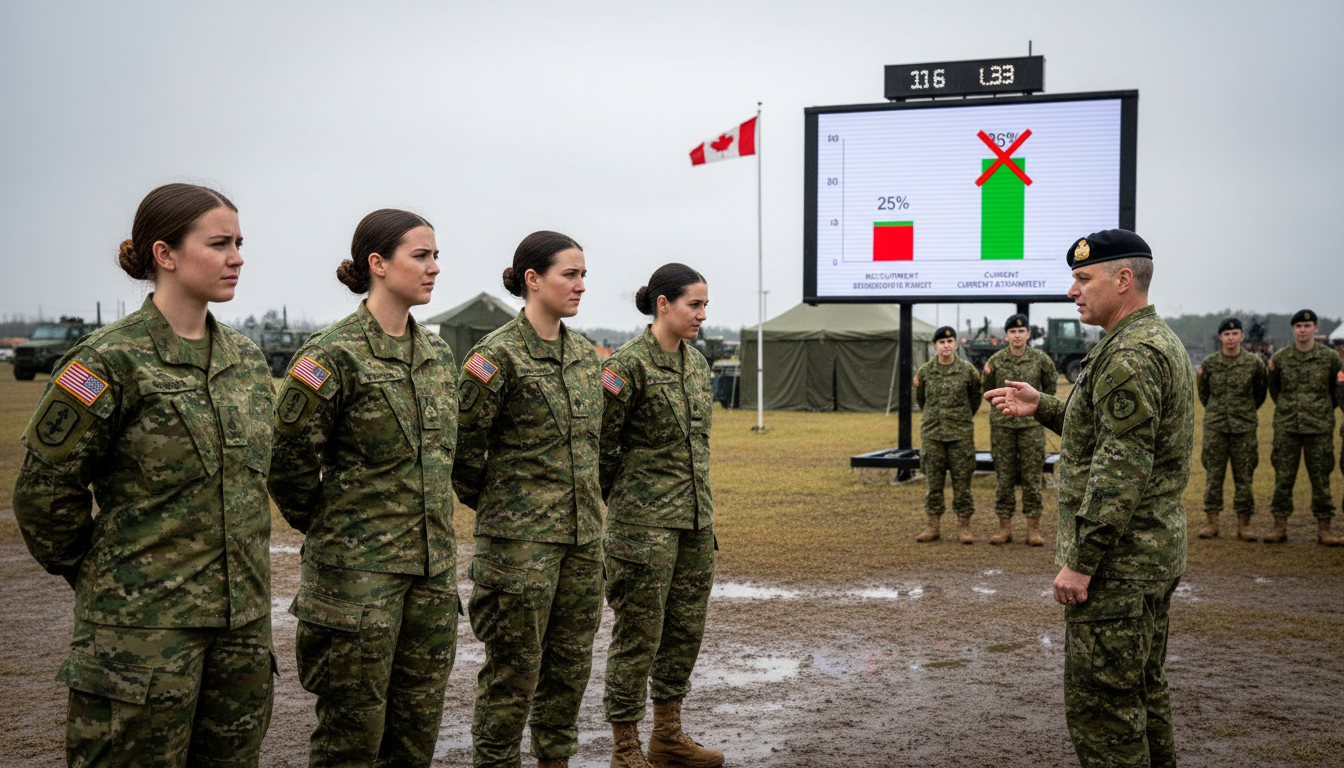
Canada set to miss 25% target for women in the Canadian Armed Forces, top officer warns
Erick Simoneau warns Canada will miss its 25% women in the Canadian Armed Forces goal for 2026 as recruitment and retention lag despite funding and outreach.
The Canadian Armed Forces are on track to fall short of a decade-old target to reach 25% women among service members by the end of 2026, Lieutenant‑General Erick Simoneau told parliamentarians. The shortfall reflects slow recruitment growth and rising departures, even as the military reports a record intake year. Women in the Canadian Armed Forces remain concentrated in a handful of occupations, and officials say dramatic changes are needed to meet the target.
Recruitment goal and where it stands
As set in 2016, the goal was to increase the share of women in uniform by roughly one percentage point a year so that women would represent 25% of the force by 2026. A decade later, women represent about 16.7% of the total Canadian Armed Forces, up from roughly 15% in 2016. Simoneau told MPs the current pace of recruitment will not close the gap and that the service would need to nearly double the share of women among new recruits to stand a chance of hitting the 25% mark.
Historic intake in 2026 but not enough
The Army reported a historic recruitment year in 2026 with women accounting for about 17% of new enlistees, a record for recent years. Defence officials hailed the intake as progress, but senior leaders cautioned that a single strong year cannot offset years of low application and retention rates. Simoneau said the forces would have to sustain substantially higher recruitment percentages—around 30% of new recruits—to alter the overall composition of the military in the near term.
Retention and departures driving the gap
Retention is a major contributor to the shortfall, with the Department of National Defence recording 1,070 women leaving the Forces in the 2025–26 fiscal period. That figure is the highest attrition among women in five years and erodes gains from recruitment campaigns. Experts and military figures point out that departures are driven by a mix of factors including family considerations, injuries and experiences of misconduct that make continued service untenable for some women.
Barriers identified by auditors and experts
A report by the Auditor General last year highlighted structural obstacles to increasing the number of women in uniform. The review found that although selection processes sometimes prioritise women to meet diversity goals, fewer women apply because of concerns about fitness requirements, the risks of combat and mental health implications. Academic and policy experts stress that addressing tangible barriers—such as parental facilities, protective equipment and workplace culture—is essential to improving both recruitment and retention.
Concentration of women in few trades
Roughly half of women serving in the Canadian Armed Forces are employed in just eight occupational streams, with large cohorts in health, logistics and operations roles. Fewer than 5% of combat trade personnel are women: about 600 women serve in combat roles, representing approximately 4.4% of those occupations according to 2025 data. That imbalance underscores the challenge of diversifying all branches of the military, particularly those traditionally dominated by men.
Recruitment tactics and leadership examples
To boost enlistment, the Forces are deploying female combat personnel to recruitment centres to share firsthand accounts and encourage other women to consider service. Simoneau cited General Jennie Carignan, who became Chief of the Defence Staff in 2024 and is the first woman to hold the post, as a visible example intended to demonstrate opportunity and leadership paths for women. Defence leaders argue that visible role models and targeted outreach can help shift perceptions about who can serve in combat and leadership positions.
Government investments and policy responses
The federal government has signalled a significant investment in the military over the coming years, including a planned $2‑billion increase to military pay and benefits intended to improve recruitment and retention. Defence officials say enhanced compensation is only one piece of a broader strategy that must include improved facilities, equipment tailored to women’s needs and stronger measures to prevent and address misconduct. Analysts warn that funding alone will not automatically reverse the trends unless it is paired with sustained cultural and policy reforms.
The coming months will test whether the Canadian Armed Forces can translate a high‑profile recruitment year and new investments into lasting changes in workforce composition. With the 25% target date at the end of 2026 approaching, senior officers say the service either needs sustained recruitment rates far above recent norms or a fundamental rethink of how to remove barriers that push women out of uniform.
