
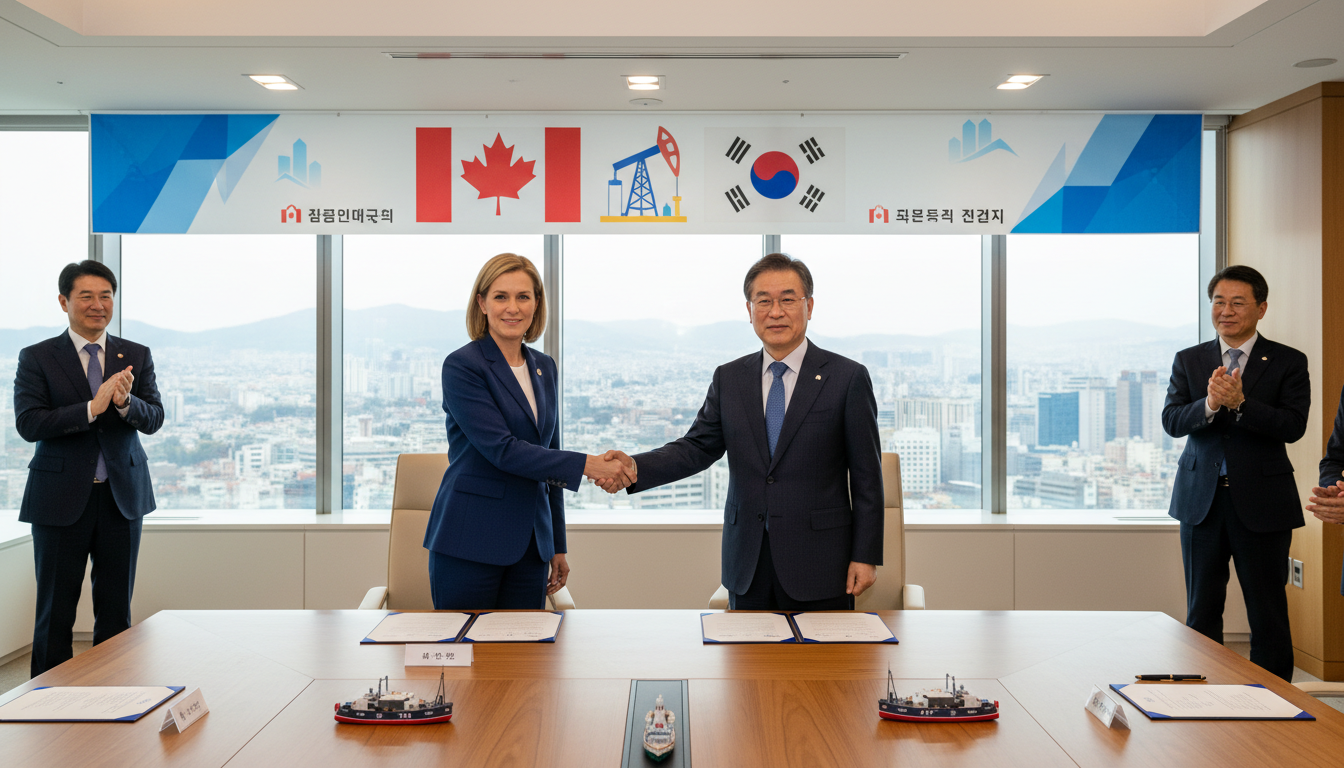
Canada oil exports to South Korea surge after tariff waiver and Hanwha MOU
Canada oil exports to South Korea accelerate after Alberta secures a 3% tariff waiver and signs an MOU with Hanwha, building on Trans Mountain’s market access to Asia.
The Alberta government announced this week that Canada oil exports to South Korea could expand following a bilateral customs decision to waive a three per cent import levy on Alberta crude. The move, paired with a memorandum of understanding with South Korea’s Hanwha Group, removes a key trade barrier and lays the groundwork for deeper commercial and defence-linked investment. Officials and industry analysts say the developments capitalize on new marine export capacity opened by the Trans Mountain pipeline expansion.
Alberta secures tariff waiver with South Korea
Alberta and South Korean customs officials signed a joint statement this week that exempts certain Alberta-origin diluted bitumen from a three per cent tariff previously applied to most oil imports. The waiver addresses a technicality that had affected bitumen diluted with U.S.-sourced condensate under the Canada–Korea free-trade agreement, according to provincial officials.
Jobs and Economy Minister Joseph Schow described the change as a step toward a tariff-free commercial relationship that improves Alberta’s competitiveness as an energy supplier. Industry watchers say removing the fee clears a predictable commercial obstacle for Korean refiners evaluating Canadian heavy crude.
Trans Mountain expansion drives Asian sales
The Trans Mountain pipeline expansion, which began shipping crude in 2024, has already opened new Pacific markets for Alberta oil and helped narrow discounts on heavy grades. Analysts cite a sharp increase in tanker loadings from the Westridge marine terminal as evidence that Canadian supplies are reaching East Asian refineries more consistently.
A recent report tracking shipments indicated multiple full-lift cargoes destined for South Korea since the pipeline became operational, reinforcing expectations that logistical access can translate quickly into trade flows. Market watchers add that steady marine capacity is a prerequisite for sustained growth of exports to Korea and other Asian buyers.
Tariff waiver details and trade rules
The waiver clarifies that diluted bitumen originating in Canada should not be treated as subject to the import levy under the 2015 free-trade agreement between the two countries. The technical dispute stemmed from how origin rules applied when condensate used for dilution was sourced outside Canada, a complication that deterred some commercial arrangements.
With customs providing written assurance, exporters and refiners can refocus negotiations on price, logistics and refining specs rather than on duty exposure. Observers say the practical effect on margins is meaningful: a three per cent levy on a high-priced cargo can materially influence contracting decisions.
Economic impact and export projections
Alberta reported a multi-fold increase in oil sales to South Korea last year, with provincial figures showing a jump driven by new pipeline access and targeted trade outreach. Officials project that annual sales to Korea could reach roughly $1 billion if refinery demand and commercial conditions hold.
Economists caution that while tariff relief improves competitiveness, volumes will ultimately depend on refinery configurations, global crude balances and price spreads. RBC and other market analysts note that geopolitical disruptions and regionally shifting demand patterns have made Asian refiners more receptive to securing diverse and reliable sources of heavy crude.
Hanwha MOU signals wider investment interest
Alongside the customs announcement, Alberta signed a memorandum of understanding with Hanwha Group to explore potential investments across energy, manufacturing and defence sectors. The Seoul-based conglomerate operates businesses spanning advanced manufacturing, defence systems and energy, and the MOU frames commercial talks rather than committing capital.
Provincial officials said the agreement aims to position Alberta within Hanwha’s supply-chain planning, particularly as Canada seeks to expand its domestic defence industry. The MOU also reflects growing Korean interest in securing stable sources of energy and industrial partnerships outside the Middle East and Russia.
Infrastructure constraints to scale exports
Industry representatives stress that further scaling of exports to Korea will require continued optimization of existing export infrastructure and additional pipeline capacity to the Pacific coast. While Trans Mountain provides a lifeline to Asian markets, some analysts and provincial leaders continue to press for new west-coast pipeline projects to unlock larger and more diversified shipping options.
Economists say that a new pipeline would not only boost volumes but also strengthen bargaining positions with long-term buyers by reducing reliance on a single export corridor. For now, Alberta will rely on a combination of marine loadings, commercial contracts and diplomatic outreach to convert the tariff waiver into sustained trade growth.
Canada’s recent agreements with South Korea mark a notable shift in the trade landscape for Alberta crude, removing a technical barrier and opening dialogues for investment and defence collaboration. The practical outcome will depend on refinery demand in Korea, continued reliability of marine exports, and progress on additional export capacity from Canada’s energy-producing regions.
