
Air Canada near-miss at JFK prompts FAA probe after Republic Airways missed approach
FAA reports Air Canada near-miss at JFK after Republic Airways missed approach; probe opens amid recent LaGuardia fatal collision and controller staffing strain.
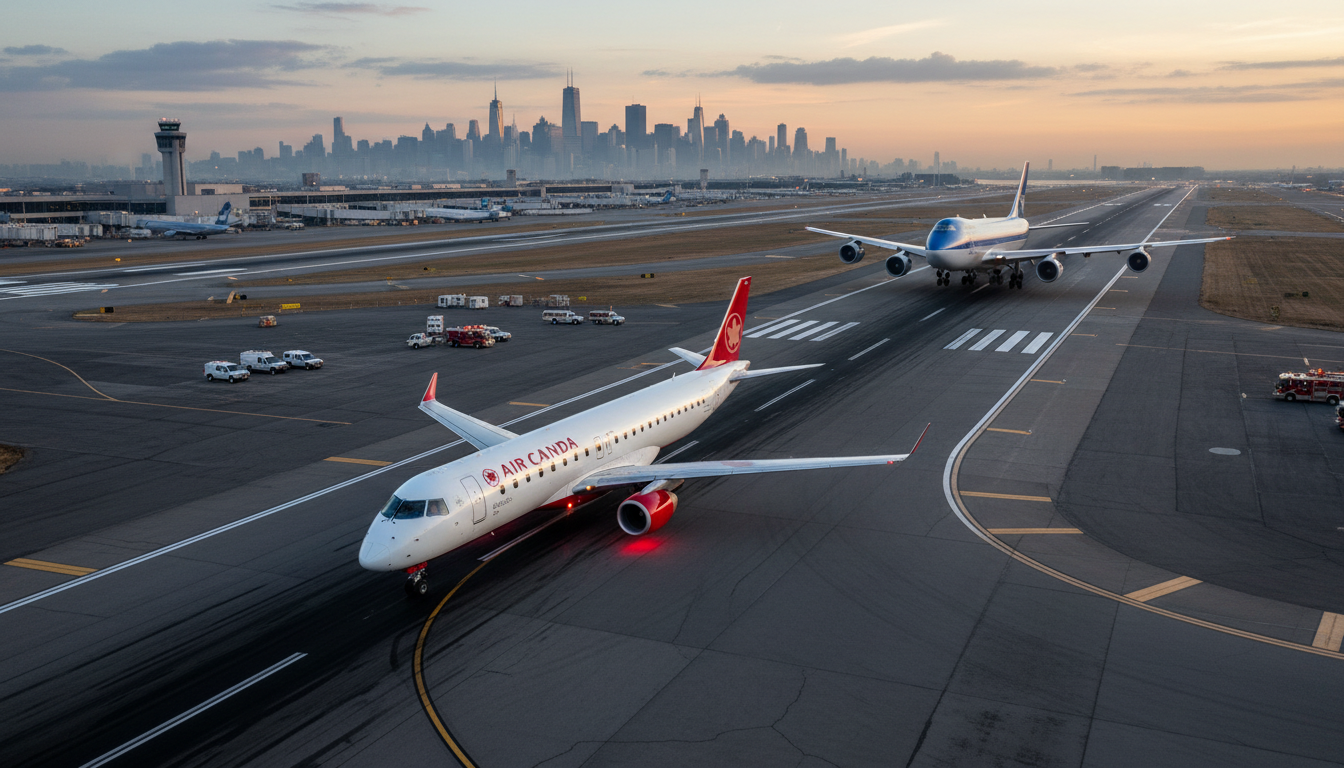
The Federal Aviation Administration reported a near-collision Monday involving an Air Canada Express flight at John F. Kennedy International Airport, marking the latest safety incident to draw U.S. regulators’ scrutiny. The Air Canada near-miss at JFK occurred when a Republic Airways aircraft missed its intended approach and came too close to the Air Canada Express plane that had been cleared to land on a parallel runway. The FAA described the episode as preliminary and said both flight crews received alerts and took evasive action while air traffic controllers issued instructions.
FAA reports near-collision at JFK
The FAA said Monday that pilots aboard the Republic Airways flight performed an avoidance maneuver after their aircraft failed to maintain the planned approach trajectory and encroached on the path of the Air Canada Express plane. The regulator classified the event as a near-collision and opened an initial inquiry to determine the sequence of events and any contributing factors. Investigators will review radio transmissions, radar tracks and air traffic control procedures to reconstruct the encounter.
The agency emphasized that its account remains preliminary while data are collected and analyzed. The FAA typically coordinates closely with the National Transportation Safety Board on matters involving potential risk to aircraft in U.S. airspace, and any formal determination will follow a detailed technical review. Until that process is complete, officials cautioned against drawing conclusions about fault or systemic failures.
Pilots’ actions and air traffic control communications
According to FAA statements, controllers alerted both flight crews during the event and issued instructions that led to immediate corrective actions. Pilots on the Republic Airways aircraft executed an avoidance maneuver after missing their intended approach, while the Air Canada Express crew followed controller guidance and responded to on-board alerts. Both crews reported receiving warnings on the flight decks, which prompted rapid coordination with air traffic control.
Investigators will examine voice recordings and radar data to assess timing and clarity of controller instructions, the exact flight paths involved, and whether standard separation minima were maintained. The technical review will also determine whether equipment, procedures, or human factors played a role in the missed approach and subsequent avoidance. That analysis is central to understanding how close the aircraft came to breaching established safety margins.
Air Canada statement and operational response
Air Canada said in written correspondence to reporters that its crew received an alert from air traffic controllers and took immediate, appropriate action to ensure passenger safety. The carrier reiterated that safety is its highest priority and noted that its crews are trained for a variety of operational contingencies, including missed approaches and runway conflicts. Airline representatives added that operational records will be made available to investigators as part of the regulatory review.
Air Canada Express, which operates regional services including flights from Toronto to New York, confirmed it is cooperating with U.S. authorities. The airline noted that it would review internal procedures and any relevant operational data once investigators release findings. Passengers on the affected flight were reported to have exited the aircraft without incident after the situation was resolved.
Connection to LaGuardia fatal collision under investigation
The near-miss at JFK comes weeks after a deadly collision at LaGuardia Airport in which an Air Canada aircraft struck a firefighting vehicle, killing two pilots. U.S. investigators have identified the pilots as Antoine Forest and Mackenzie Gunther and said the incident prompted a multiagency probe into ground movement authorizations and runway incursion protocols. The National Transportation Safety Board reported that the fire truck had been cleared to cross an active runway only seconds before the collision, a detail that has raised questions about coordination and timing.
Canadian authorities, including the Transportation Safety Board of Canada, are participating in the U.S.-led investigation into the LaGuardia accident, and the outcome of that inquiry is expected to influence broader discussions about airport surface safety. Officials say lessons learned from the LaGuardia probe could bear on similar events and on recommendations for improving communications and procedures at busy metropolitan airports.
Air traffic control staffing and system pressures
Industry officials and regulators have pointed to mounting pressures on the U.S. air traffic control workforce as a factor in recent operational strains. The sector has faced a shortage of certified controllers in many hubs, a situation exacerbated in some periods by administrative disputes that temporarily affected staffing and morale. Regulators and union representatives have warned that staffing gaps can increase workload for on-duty controllers and heighten the risk of errors during peak operations.
Separately, the FAA reported another narrowly avoided incident over the weekend in Tennessee, where two Southwest Airlines aircraft were forced to take evasive action after a controller directed one plane toward the trajectory of another. That event, like the JFK near-miss, is under review and underscores broader concerns about air traffic flow and controller workload. Aviation experts say sustained investment in recruitment, training and operational oversight will be necessary to reduce the probability of future close calls.
The FAA, the NTSB and other agencies will continue gathering records and testimony as they investigate the JFK near-miss, and airline and airport operators have pledged cooperation. Regulators have the authority to issue safety recommendations based on their findings, and any changes could affect procedures at congested airports across North America. As inquiries proceed, both industry observers and passengers will be watching for steps that strengthen separation safeguards and ensure consistent controller staffing to maintain safe skies.
