
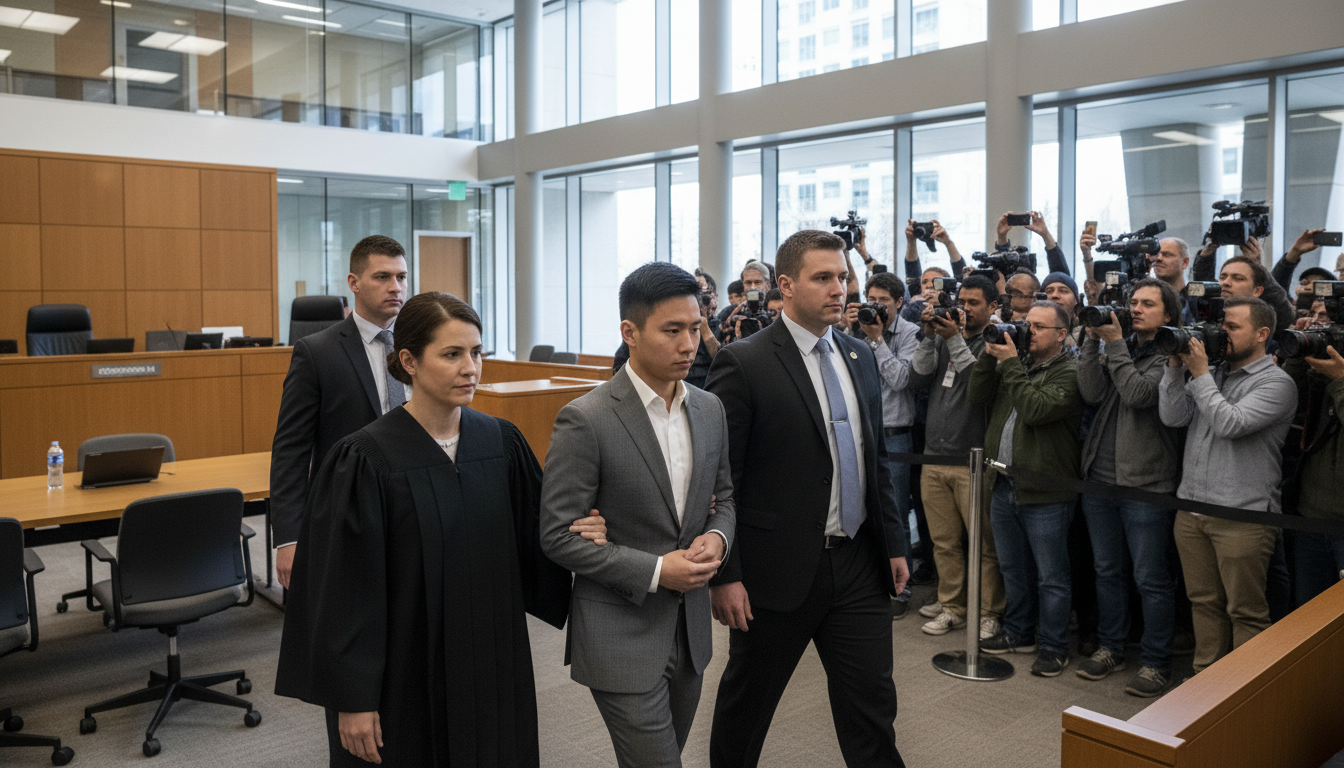
Calgary murder trial begins for man accused of killing his mother after leaving hospital
Calgary murder trial begins as jurors hear Crown’s account that Alex Xu left Foothills Medical Centre on June 30, 2023 and allegedly killed his mother nearby.
A Calgary murder trial opened Monday as the Crown laid out its case that 26-year-old Alex Xu left Foothills Medical Centre in the early hours of June 30, 2023 and, within minutes, allegedly bludgeoned his mother to death in a northwest neighbourhood.
Jurors were told the accused left a hospital waiting room, walked away from his parents, then attacked his 56-year-old mother, leaving her body between two houses in St. Andrew’s Heights.
The Crown characterized the killing as sudden and violent, and said officers found Xu at the scene covered in the victim’s blood after witnesses reported his confessions.
Accused left hospital before the alleged attack
Jurors heard that Xu’s parents brought him to the Foothills Medical Centre because they were worried about his condition in the hours before the incident.
Crown prosecutor Paul Marcellus told the panel the family waited at the hospital for roughly an hour before Xu walked out of the waiting room shortly before 3 a.m.
The prosecution’s theory is that what followed in the minutes after his departure led to the fatal assault.
Marcellus described video footage showing Xu leaving the hospital and then a roughly 20-minute gap before he was next seen by witnesses.
That interval is central to the Crown’s timeline and to its argument that Xu had time to pick up a large rock and carry out the attack.
The prosecutor said Xu’s mother followed him as he headed into the St. Andrew’s Heights neighbourhood while his father went to the parkade.
Defence counsel will challenge aspects of the Crown’s interpretation of those movements, but during opening remarks the prosecution focused on the short window between departure from the hospital and the fatal encounter.
The trial is a contested factual inquiry built on witness accounts, video evidence, and the statements Xu is alleged to have made to people who stopped to help.
Jurors were asked to listen to how those pieces fit together before assessing motive and intent.
Crown outlines a 20-minute window of alleged violence
In court, the Crown framed a crucial 20-minute period as the time in which the alleged homicide occurred.
Prosecutors told jurors they would show that Xu became frustrated with his mother and, during that brief interval, picked up a heavy stone and struck her repeatedly.
The Crown characterized the blows as delivered with “crushing force,” causing catastrophic injury to the back of the victim’s head.
That sequence, the prosecutor said, left the victim face down between two houses with an open wound to the rear of her skull.
Investigators located the body where Xu had indicated when police arrived on scene and placed him under arrest.
The physical evidence and the condition of the body are expected to form a major part of the Crown’s factual case.
The 20-minute timeline is also where the defence is likely to focus its cross-examinations and alternate explanations.
Issues such as the precise timing of movements, the availability of the alleged weapon, and the nature of any interaction between Xu and his mother during that period will be contested.
The jury’s role will be to weigh the credibility of witnesses and the consistency of the evidence presented.
Witness accounts and multiple confessions described to jurors
Marcellus told jurors that after the attack, Xu left his shoes at the scene and stood barefoot on 29th Street N.W., covered in his mother’s blood.
An Uber driver is expected to testify that he was among the first to stop and that Xu told him, “I just murdered my mom and I need you to call 911.”
The Crown said that driver drove away after making the call, and that Xu then flagged down another passing motorist.
According to the opening statement, the second driver put Xu on the phone with 911 after Xu told him he had “just murdered his mom with a boulder.”
Those statements to strangers are central to the Crown’s narrative that Xu openly confessed to the killing immediately after it occurred.
Prosecutors will call witnesses who stopped and spoke with Xu to establish his state and the timing of his admissions.
Witness testimony will also address Xu’s physical appearance and behaviour at the scene, as well as how and when police were alerted.
Marcellus emphasized the immediacy of the alleged confessions and the proximity in time between the attack and Xu’s interactions with passing drivers.
The jury will hear the drivers’ accounts directly and the Crown will seek to corroborate those statements with other evidence gathered at the scene.
Police response, arrest and evidence at the scene
Emergency services and police were summoned shortly after the drivers contacted authorities, and officers arrived on scene around 3:30 a.m., the Crown said.
Xu allegedly pointed to where his mother’s body lay, and investigators found her unresponsive and with an open head wound.
Officers arrested Xu at the scene while he remained covered in the victim’s blood.
Prosecutors indicated physical items such as the shoes Xu left behind and forensic evidence from the scene will be part of the Crown’s presentation.
Photographs, blood pattern analysis, and the medical examiner’s findings are expected to be introduced to describe the condition of the body and the nature of the injuries.
Police will also describe the steps they took at the scene to preserve evidence and to secure statements from witnesses.
The presence of multiple eyewitnesses and the accused’s alleged admissions will be set against forensic findings in the Crown’s effort to prove second-degree murder.
Those forensic details will be critical to establishing the manner and cause of death, as well as whether the accused’s actions meet the legal elements of the charge.
As the trial unfolds, experts may be called to explain how the injuries were sustained and whether they are consistent with the Crown’s theory.
Courtroom procedure and the legal timetable
The trial is scheduled to run for five weeks before Court of King’s Bench Justice Robert Armstrong, with jurors hearing evidence through the Crown’s witnesses first.
Prosecutor Paul Marcellus delivered the Crown’s opening statement, and defence lawyer Dale Fedorchuk is expected to open his case once the Crown has presented its witnesses.
The sequence and length of testimony will determine whether the court proceeds on schedule over the coming weeks.
As in all jury trials, the judge will be responsible for rulings on admissibility, instructions to the jury, and management of procedural matters.
The jury’s role is to assess the evidence and reach a verdict based on whether the Crown has proved the charge beyond a reasonable doubt.
The defence has signalled it will challenge elements of the Crown’s account, and jurors will evaluate competing versions of events.
Throughout the trial, both counsel may call expert witnesses, cross-examine those brought by the other side, and present documentary and physical evidence.
The trial record will reflect testimony from medical, forensic, and civilian witnesses as the parties build their respective cases.
At the conclusion of evidence, the judge will provide legal directions before the jury deliberates.
Victim, accused and community impact described in court
The victim was identified in court as 56-year-old Alice (Jinying) Ai, the mother of the accused, and the circumstances have reverberated through the local community.
Marcellus described the family’s presence at the hospital earlier that night and how the events unfolded after they left the Foothills Medical Centre.
Neighbours and those who discovered the scene are expected to testify on what they observed and how emergency crews responded.
The case has raised difficult questions about family dynamics, the presence of acute crisis at the hospital, and how an apparently brief episode culminated in violence.
Court proceedings will stay focused on the evidence relevant to the charge and the legal standards that govern criminal responsibility.
Community members and local residents may attend proceedings, but jurors will be instructed to consider only the evidence presented in court.
The trial’s outcome will turn on the jury’s assessment of credibility, timing, and whether the Crown has satisfied the high threshold required for a conviction of second-degree murder.
For the victim’s family, the trial represents a public accounting of a private tragedy; for the accused, it determines the trajectory of criminal consequences.
Both perspectives were set out in the opening days as the court moves through witness testimony and evidentiary disputes.
The presiding judge and counsel emphasized the seriousness of the charge and the need for a careful, impartial legal process.
Members of the public and media are watching the case because of its distressing facts and the questions it raises about the moments leading up to the alleged offence.
As testimony continues, the court record will provide a detailed account of what occurred and the basis on which the jury will be asked to render a verdict.
The trial is scheduled to proceed over the coming weeks with witness statements, forensic reports, and cross-examination shaping the narrative presented to jurors.
Once the Crown rests and the defence opens, the court will hear alternative explanations and any evidence the defence wishes to introduce in support of those claims.
Following closing arguments and judicial instructions, the jury will retire to consider whether the Crown has proven the elements of second-degree murder.
A verdict at the end of the trial will determine whether the accused is found guilty of second-degree murder or whether the jury returns an alternative verdict or an acquittal.
If convicted, sentencing would follow through a separate process in accordance with statutory and case-law guidance governing serious offences in Canada.
Until then, the proceedings in the Court of King’s Bench will continue as jurors evaluate the testimony and evidence presented by both sides.
The coming days will see testimony from the drivers who stopped to assist, police officers who responded, and medical or forensic experts who examined the scene and the victim.
Each witness will be tested on timing, observation, and how their accounts square with physical evidence and any available recordings.
The jury’s deliberations will hinge on how coherently the Crown’s evidence forms a persuasive chain linking the accused to the act and the state of mind required for conviction.
Public safety officials and community leaders have not been asked to comment in court, and criminal proceedings remain focused on the facts and law relevant to the charge.
Media coverage will continue to report on developments heard in open court while respecting publication rules and the privacy of those directly affected.
The case serves as a reminder of both the human cost of violent crime and the role of the justice system in adjudicating contested allegations.
Courtroom decorum and the judge’s instructions will govern what jurors may consider, and both sides must abide by evidentiary rules designed to ensure a fair trial.
Counsel for the defence has indicated there will be a structured approach to challenging witness credibility and the interpretation of forensic materials.
Throughout this process, the integrity of the trial record will be paramount to any subsequent review or appeal.
After the Crown’s witnesses finish testifying, the defence will have the opportunity to present its own evidence and theories about what occurred.
That stage may include testimony aimed at explaining Xu’s behaviour, the events at the hospital, or other circumstances relevant to the incident.
Jurors will be reminded that the burden of proof rests solely with the Crown throughout the proceedings.
Final arguments and the judge’s charge to the jury will distill the legal issues and clarify the standards the jurors must apply when they deliberate.
The judge will explain elements such as intent, causation, and the standard of reasonable doubt before the jury begins its deliberations.
Only after the jury reaches a verdict will the public know whether the Crown has succeeded in proving the charge of second-degree murder beyond a reasonable doubt.
Witness testimony in the early days of the trial established a timeline and set of interactions that the jury must scrutinize in light of competing explanations.
How jurors assess the credibility of drivers who stopped, the timing shown on surveillance, and forensic experts will determine the path of the case.
For now, courtroom proceedings continue as the parties present evidence and argue their respective interpretations of the events of June 30, 2023.
The court will remain in session over the weeks ahead as both sides bring forward witnesses and evidence to support their positions.
Members of the public can obtain information about court schedules through official channels while respecting the rules that govern attendance and reporting.
At the conclusion of this trial, the record will reflect a comprehensive account of the evidence relied on by the Crown and the defence.
The jury was selected and sworn to hear the evidence impartially, and their deliberations will decide the outcome in accordance with Canadian criminal law.
As testimony unfolds, jurors will weigh statements, forensic analysis, and the inferences counsel invite them to draw.
The legal process will proceed step by step until a verdict is rendered and any subsequent proceedings, if necessary, take their course.
