
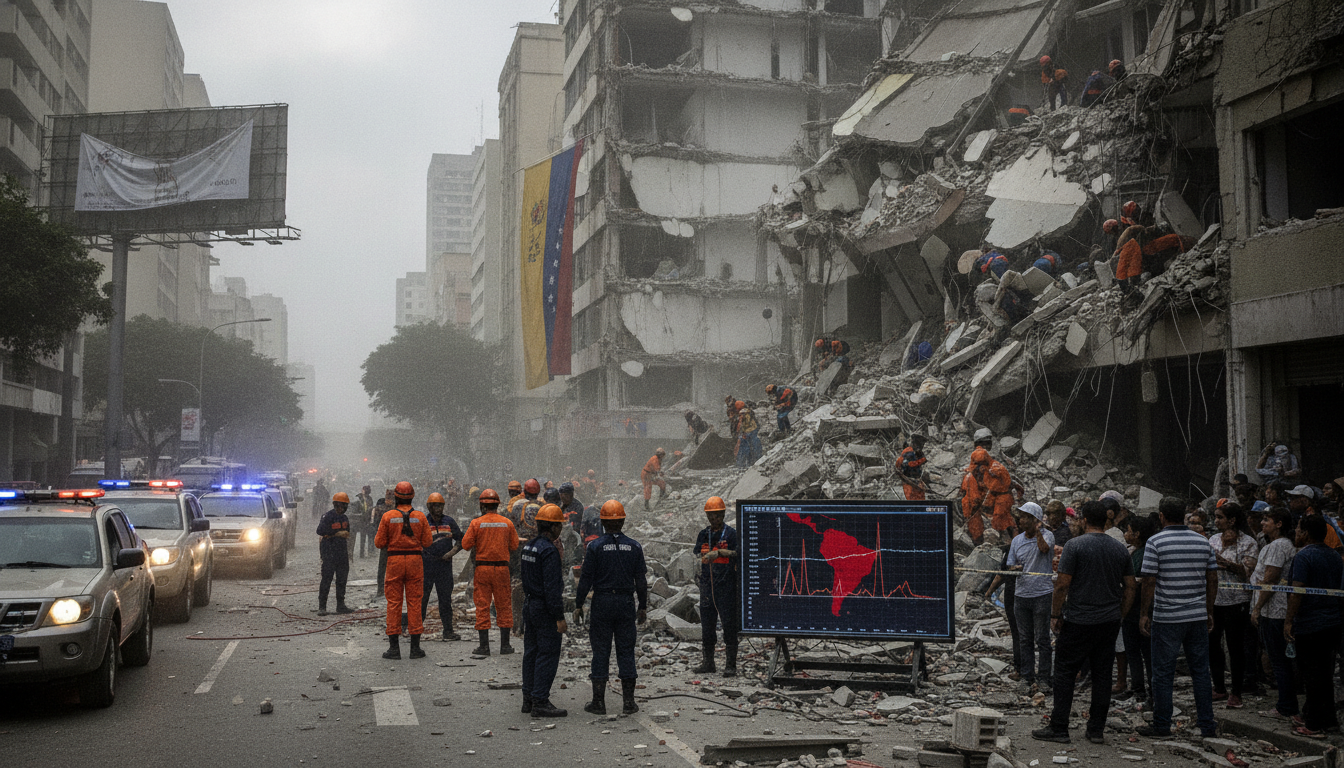
Venezuela earthquake: Two powerful temblors, USGS warns of likely high casualties
Venezuela earthquake: Two powerful temblors (7.2 and 7.5) struck; the U.S. Geological Survey warns of likely high casualties and fatalities in the thousands.
The U.S. Geological Survey reported two major shocks — a magnitude 7.2 quake followed by a magnitude 7.5 — in what it described as among the strongest earthquakes to hit Venezuela in the past century. The agency said the extent of destruction was not yet clear, but warned that “high casualties and damage are probable” and estimated a significant chance that fatalities could rise into the thousands. Initial reports conveyed widespread alarm but lacked firm, ground-level confirmation of damage or casualty totals. Emergency services and observers face a rapidly evolving situation as assessments continue.
Two major temblors struck Venezuela, according to the USGS
The U.S. Geological Survey identified the first temblor at magnitude 7.2 and a subsequent, stronger shock at magnitude 7.5. Those magnitudes place both events among the most powerful seismic episodes recorded in Venezuela over the last century. Such magnitudes typically generate severe ground shaking over broad areas and can cause structural collapses in vulnerable buildings. Officials and seismologists treating the USGS bulletin as the principal scientific assessment emphasized caution as aftershocks and secondary impacts unfold.
USGS warns of likely high casualties and thousands of fatalities
The USGS statement explicitly said that high casualties and substantial damage were probable and that fatalities could number in the thousands. That assessment reflects modeling of shaking intensity, population exposure, and typical building vulnerability in similar events. The agency’s language signals a worst-case scenario is possible, underscoring the need for immediate search-and-rescue prioritization. Humanitarian planners and emergency managers commonly use these early projections to mobilize resources before detailed damage assessments are completed.
Extent of destruction remains unclear amid limited ground assessments
As of the initial reporting, comprehensive information on infrastructure damage, residential collapse, and casualties had not been confirmed. Rapid field assessments often lag for hours or days after large quakes, particularly where communications and transport are disrupted. Without verified on-the-ground surveys, estimates must be treated as preliminary and subject to revision. Local authorities and civil protection agencies typically compile and release verified counts only after teams can access affected communities.
Challenges for search, rescue and emergency response
Large-magnitude earthquakes present immediate challenges including collapsed buildings, interrupted utilities and hampered transportation routes. These obstacles can delay first responders and complicate the delivery of medical care, shelter and food to survivors. Urban areas with older or poorly reinforced buildings are especially vulnerable to higher casualty rates when shaking reaches the intensity suggested by the USGS. International and regional assistance protocols are often activated in such scenarios to augment local capacities.
Seismic context: among the strongest quakes in a century for Venezuela
The USGS characterization of the shocks as among the strongest in a century places the event in a rare and severe category for the country. Historical seismic records show that earthquakes of this size can have prolonged effects, including long-term displacement and economic disruption. Scientific monitoring will continue to track aftershocks and refining of epicenter and depth data, which are critical to understanding fault behavior and future risk. Seismologists will also study the sequence to inform hazard assessments and resilience planning going forward.
Regional and international monitoring underway
Major earthquakes trigger monitoring and situational awareness efforts from international agencies and neighboring countries, even when direct assistance has yet to be requested. Satellite imagery, seismic networks and humanitarian partners commonly contribute to early assessments. Financial and logistical support may be mobilized depending on the scale of confirmed damage and the requests of national authorities. The USGS bulletin and subsequent technical updates will guide both domestic emergency operations and any offers of external assistance.
The coming hours and days will be critical for establishing the human toll and the full scale of damage from this Venezuela earthquake. Rescue priorities will focus on reaching isolated communities and assessing structural safety, while authorities work to restore essential services and account for missing persons. As more verified information becomes available, national agencies and international partners will be expected to provide detailed updates and coordinate relief efforts.
