
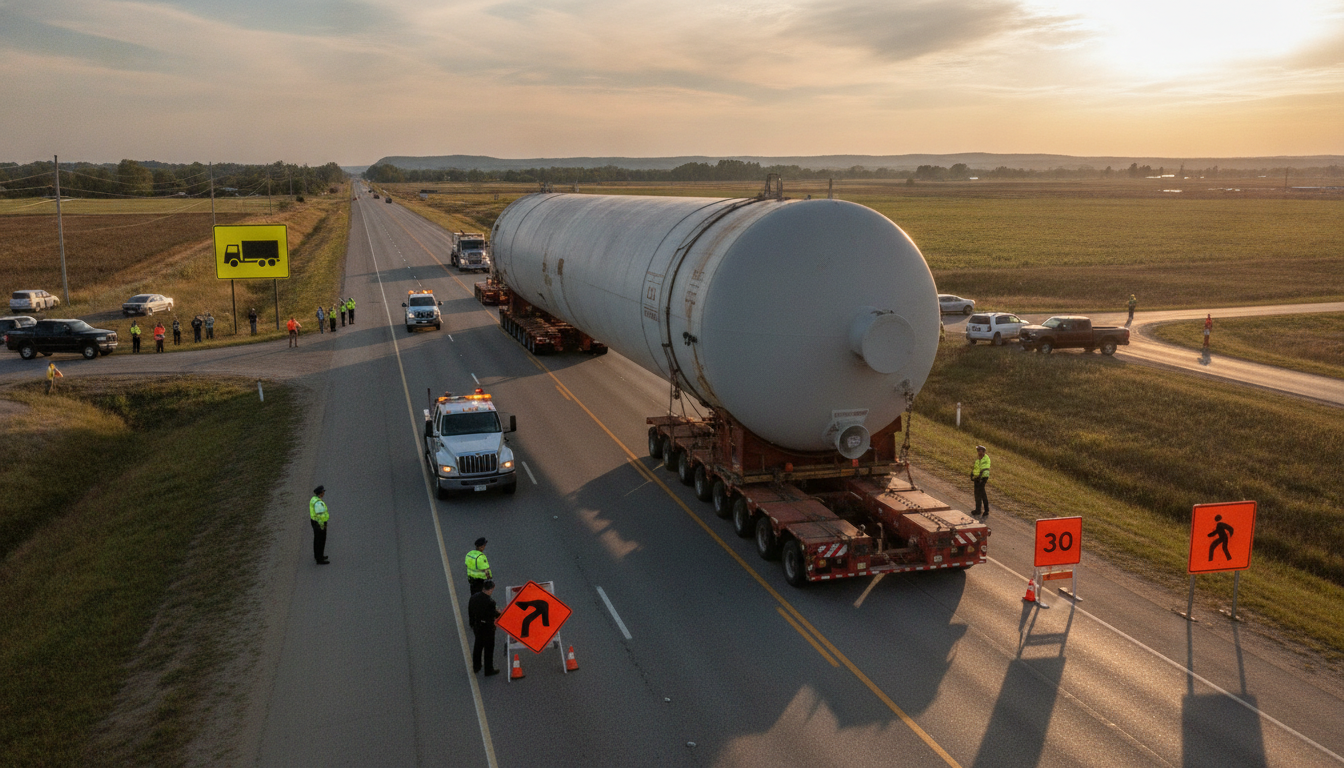
De-ethanizer to Move Across Provincial Highways at 30 km/h, Occupying Full Lane
A massive de-ethanizer will be transported along provincial highways at a restricted speed of 30 km/h with guide vehicles, the province said in a news release. The de-ethanizer, used in natural gas processing, is so large and heavy that it will occupy the entire width of the highway during transit. Officials warned the public the convoy will roll slowly and urged drivers to plan for delays.
Oversized Load to Move at 30 km/h
The province confirmed the convoy will travel at a maximum speed of 30 km/h and will be accompanied by guide vehicles for safety and traffic control. Because of the unit’s extreme size, authorities said the movement will take up the full width of the roadway while in transit. Motorists should expect slow-moving traffic and temporary stoppages where necessary to negotiate intersections and narrow points.
Officials noted the restricted speed is intended to reduce risk to the load, the transport crew, and other road users. The news release emphasized that the guided convoy will proceed cautiously and that adherence to the escort vehicles’ directions is mandatory for drivers in affected areas.
Dimensions and Weight of the De-ethanizer
The province provided detailed measurements for the structure: the de-ethanizer measures 7.7 metres wide, 10.5 metres high and 96.6 metres long. Including its support equipment, the total weight of the unit is 749,142 kilograms, making it one of the largest single pieces of industrial equipment to move on public roads in recent memory. These dimensions exceed standard lane widths and clearances, which is why the transport requires specialized planning and coordination.
Such a large and heavy load places specific demands on bridges, overpasses and roadbeds, and authorities said assessments were undertaken before the move. The height and width figures mean overhead clearances and roadside fixtures will be evaluated and temporarily managed to allow the convoy to pass safely.
Transport Logistics and Equipment
To carry the de-ethanizer, trailers and modular transporters will be arranged under the load; in total the trailers carrying the unit will roll on 448 wheels. That wheel count reflects the distributed-load approach used for heavy haulage, reducing axle load and spreading weight across a longer footprint. The transport will include support equipment to stabilize and secure the unit for the journey, all of which contribute to the overall mass and footprint.
Guide vehicles will travel ahead of and behind the convoy to manage traffic and communicate with the driver teams. The province’s release described the movement as a coordinated operation involving specialized haulers and logistics staff trained in oversize transports.
Traffic Disruptions and Safety Measures
Because the de-ethanizer will occupy the full width of the highway, lane closures and temporary traffic controls will be necessary at points along the route. The province advised motorists to follow posted detours and the instructions of guide vehicles to ensure safety for all road users. Travel times in affected corridors are likely to increase while the convoy is moving, particularly where the highway narrows or intersects with urban streets.
Safety protocols for oversized transports typically include pre-move engineering assessments, traffic control plans, and staged scheduling to avoid peak travel periods. While the release did not specify an exact timetable for every segment of the journey, officials urged drivers to be patient and to give the convoy extra room when encountering it on the road.
Regulatory Approvals and Community Notification
The province said the move follows regulatory approvals and route assessments required for oversized loads of this scale. Notifications to local municipalities and infrastructure authorities were part of the pre-move planning, the release stated, to ensure any necessary temporary modifications or protections to roadside structures are in place. Public advisories were issued so residents and businesses along the corridor can prepare for short-term disruptions.
Transport of industrial equipment of this magnitude often requires coordination with multiple agencies to manage bridge load limits, signal timing, and emergency access. The province’s announcement serves as the primary advisory for affected communities and road users, and officials encouraged those with concerns to monitor local travel advisories.
The movement of the de-ethanizer represents a complex logistical undertaking that blends heavy-haul engineering, traffic management and public communications. The province repeated that the 96.6-metre, 7.7-metre-wide and 10.5-metre-high unit, weighing 749,142 kilograms with support gear and rolling on 448 wheels, will proceed only at 30 km/h under guided escort to protect infrastructure and public safety.
