
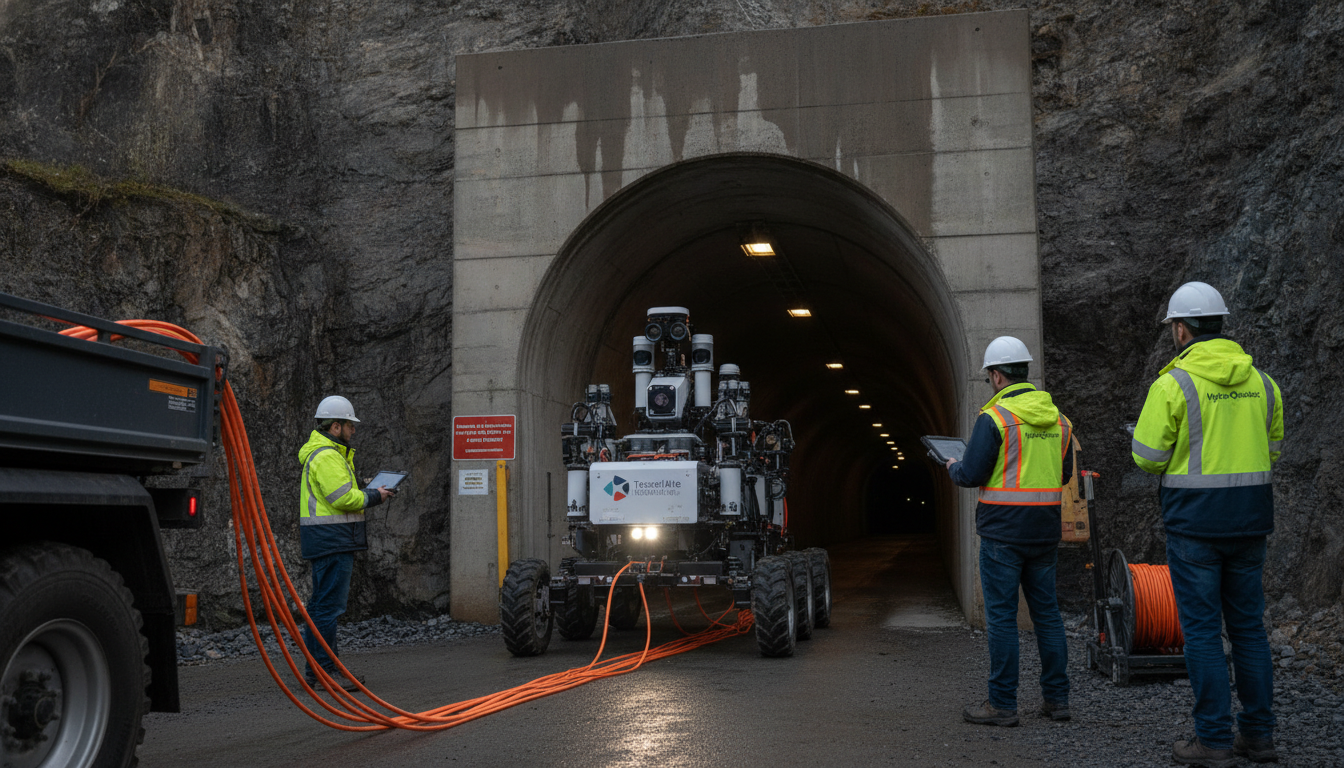
Tessellate Robotics deploys autonomous robot to inspect Hydro‑Québec’s Grondines‑Lotbinière tunnel
Quebec startup Tessellate Robotics deploys an autonomous inspection robot to Hydro‑Québec’s 4 km Grondines‑Lotbinière tunnel, improving safety, speed and data.
Tessellate Robotics has begun operating an autonomous ground robot inside Hydro‑Québec’s Grondines‑Lotbinière under‑river tunnel to carry out inspections of the 4‑kilometre conduit that houses a 450,000‑volt DC transmission line. The Quebec company’s vehicle is designed to operate without GPS, using lasers and cameras to map the tunnel in three dimensions and capture high‑resolution visual and thermal data. Hydro‑Québec expects the system to reduce the manpower and time required for annual inspections while limiting worker exposure to confined, low‑oxygen, and hard‑to‑reach environments.
Deployment inside a critical transmission link
The Grondines‑Lotbinière tunnel, inaugurated in 1992, forms a key section of the transmission route carrying power from the Radisson complex in northern Quebec southward and across the border. Tessellate Robotics’ robot traverses the pipe corridor to film structural elements, track corrosion, and detect water infiltration or deposits that could indicate long‑term degradation. Operators say the platform delivers continuous day‑and‑night measurements, producing a detailed record that engineers can analyze off‑site.
Technical features and navigation in GPS‑denied environments
Tessellate Robotics built the robot to function where GPS and conventional wireless links are not available, combining lidar‑based mapping with camera feeds and onboard processing to build a live model of its surroundings. The vehicle’s sensors filter environmental interference such as dust, snow and magnetic effects common near high‑voltage installations. Its navigation stack enables autonomous positioning and route following within the tunnel so inspections can proceed without continuous external control.
Safety improvements and operational efficiency for Hydro‑Québec
Hydro‑Québec historically dispatched small teams to perform annual tunnel checks, a task that can require four people over roughly two weeks and expose staff to poor lighting, high humidity and potential gas hazards. The robot cuts transit time through the tunnel to roughly one to two hours per run, with subsequent analysis taking only a few hours, according to company and utility representatives. By reducing the number of human entries and the duration of exposure, the system lowers the risk of incidents and eases emergency extraction concerns where a round trip on foot can take about 40 minutes.
Canadian supply chain and manufacturing partnerships
Tessellate Robotics integrates a large majority of Canadian components in its platforms, with between 80 and 85 percent of parts sourced domestically. The tracked base is produced by Movex Innovation in Shawinigan, while other vehicles are assembled in the Saguenay–Lac‑Saint‑Jean region by partner Bionix. Company founders and Hydro‑Québec officials have highlighted the local supply chain as an asset for resilience and for advancing domestic industrial capability in robotics and energy infrastructure maintenance.
Contracts beyond the tunnel: Arctic and defence work
Since its founding in December 2022, Tessellate Robotics has shifted focus toward energy, defence and mining sectors and has secured work for operations in extreme conditions. The firm tested its technology during Operation Nanook in February–March 2026 in Cambridge Bay, performing in sub‑40°C temperatures and during heightened space weather activity. Those evaluations led to a contract with the Canadian Armed Forces to support surveillance and presence operations in the Arctic, where the company notes the platform can patrol, detect anomalies and provide situational awareness in places that are otherwise difficult to reach.
Mining inspections and industrial applications
Aside from tunnels and Arctic deployments, Tessellate’s robot has been applied in mining scenarios, where it can inspect heavy machinery and hard‑to‑access vehicle components. Thermal imaging and high‑resolution video captured during tests in locations such as Fermont helped identify a developing bubble under a large haul‑truck tyre, an issue that can be invisible to human spotters but can lead to catastrophic failures. Company officers say such preventative detection has the potential to reduce accidents and maintenance costs for mine operators.
Tessellate Robotics and Hydro‑Québec describe the tunnel program as part of a broader trend: utilities and industrial operators are increasingly turning to robotics and drones to gather difficult‑to‑reach data while keeping crews safer. Hydro‑Québec already maintains hundreds of unmanned systems, and officials say they will continue to evaluate robotics solutions that can be integrated into routine operations and emergency response planning.
