
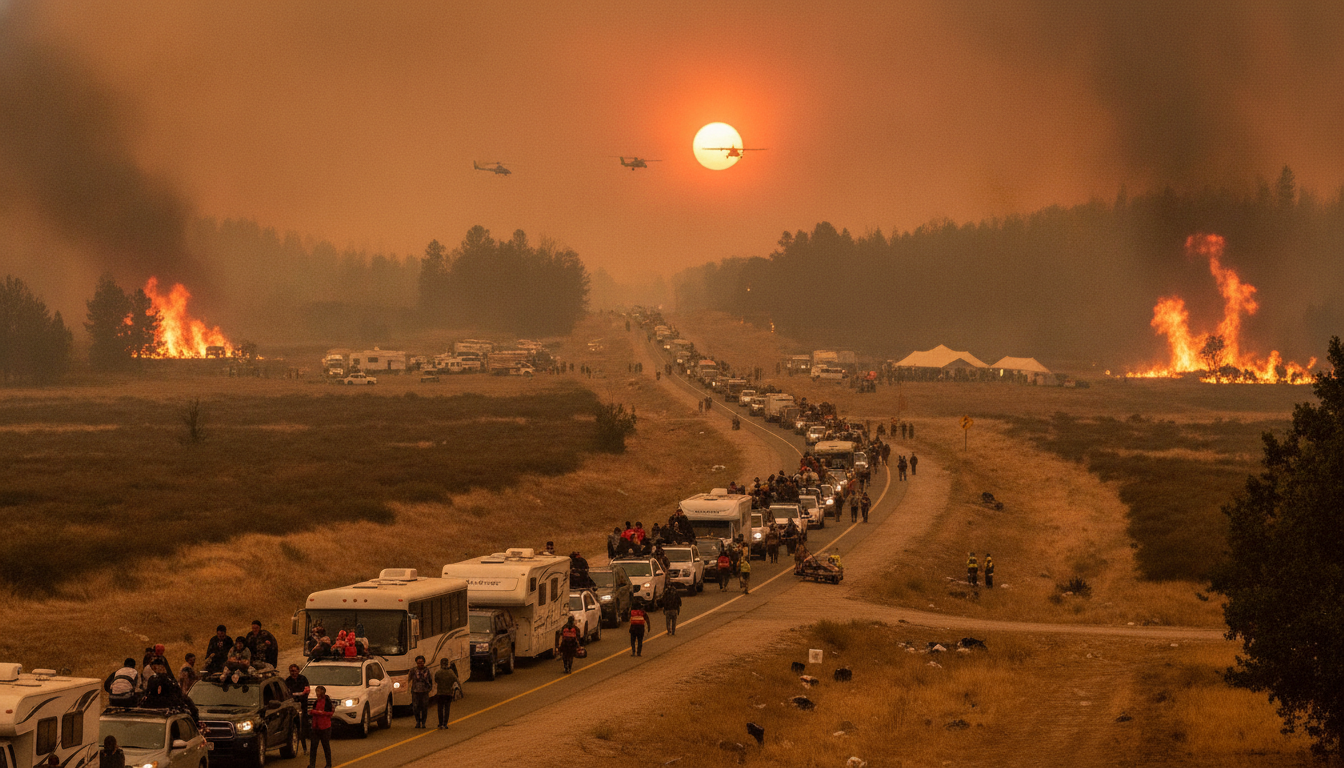
Spain and France wildfires force mass evacuations as smoke chokes Madrid and Bordeaux
Spain and France wildfires force 270,000+ evacuations near Madrid and Bordeaux as smoke and flames scorch tens of thousands of hectares; EU aid mobilized.
A wave of wildfires in Spain and France has forced the evacuation of more than 270,000 people and sent thick smoke over major population centres as firefighters race to contain rapidly spreading blazes. The Spain and France wildfires have consumed tens of thousands of hectares, blanketing Madrid with ash and prompting large-scale departures from coastal areas around Bordeaux. Officials said saving lives is the priority as crews battle erratic winds and high temperatures.
Mass evacuations around Madrid and Bordeaux
More than 70,000 residents were evacuated in the Madrid region after flames raced through dry countryside west of the capital, interior ministry officials reported. In southwestern France, authorities moved roughly 200,000 people from areas between Gironde and Landes, including the tourist-dense Cap-Ferret peninsula. Local governments established emergency shelters in exhibition halls and gyms to accommodate thousands who left homes on short notice.
Health authorities coordinated targeted evacuations for vulnerable groups, with more than 1,200 elderly and disabled people moved from care homes in the Madrid area. Officials urged motorists to avoid affected routes and keep roads clear for emergency services as traffic congestion complicated outbound movements. Despite the scale of evacuations, no fatalities had been reported in either country at the time of the latest briefings.
Smoke, ash and damage to towns and heritage sites
Residents in Madrid awoke to brown-grey haze and layers of black ash on rooftops as smoke poured from fires burning to the west of the city. Journalists on the ground observed smoke surrounding the historic monastery at El Escorial, while authorities described scenes in some towns as if a volcanic plume had settled over streets. In France, a towering wall of smoke darkened the sky over the Bassin d’Arcachon, sending visitors and residents fleeing by road and by boat.
Fire managers reported extensive property damage in both countries; France documented at least 100 buildings destroyed in the largest blaze of the season, and Spanish officials said multiple towns were threatened by advancing flames. The fires have disproportionately affected dry, densely vegetated zones that have become more flammable after prolonged drought and repeated heat waves since June.
Scale of the fires and area burned
Spanish officials said one complex of fires had merged into a single, enormous blaze that at points threatened to unite with other fires in neighbouring Castile and León. Firefighters estimated that up to 25,000 hectares had burned west of Madrid in the most intense of those outbreaks. In France, authorities put the area already scorched at more than 40,000 hectares — roughly four times the size of the city of Paris — since the most destructive fires were reported.
European fire-monitoring systems show that large swathes of both countries have been affected this season, following a year that saw particularly heavy totals in Spain in 2025. Officials warned that the full extent of ecological and economic losses will only become clear after containment and damage assessments are completed.
Firefighting response and international assistance
Both national governments mobilized major resources and requested international assistance under the European Civil Protection Mechanism. The European Commission confirmed deployment of multiple aerial firefighting aircraft to the affected countries, with additional Canadair planes accepted from partner states. France accelerated the deployment of a military transport plane retrofitted with a water-dropping kit to support aerial operations that had been scheduled for a later date.
On the ground, crews used bulldozers and earth-moving equipment to create containment lines while helicopters and water bombers attacked active fronts from the air. Local and regional authorities coordinated round-the-clock rotations of firefighters, and volunteer brigades were assisting with evacuations and relief at shelter sites.
Weather, terrain and operational challenges
Forecasters said erratic gusts of wind posed the greatest near-term threat to control efforts by shifting fire fronts unpredictably. Regional officials described Saturday as a “difficult” day for suppression work because of these gusts, even as rising humidity and a drop in temperatures offered a window of opportunity for crews. Dry vegetation, steep terrain in some zones and the merging of separate blazes complicated tactical decisions and increased the demands on personnel and equipment.
Fire commanders reported that two previously distinct fires had joined to form larger, more intense fronts, a behaviour that increases flame height and rate of spread. That dynamic forces teams to prioritize protection of populated areas and critical infrastructure, while also attempting to preserve wildfire control lines established earlier in the week.
Shelters, community response and humanitarian needs
Temporary shelters in exhibition halls and municipal gyms became crowded with families, including many children and older residents who described long, stressful journeys to safety. Medical volunteers monitored evacuees for dehydration and smoke-related respiratory issues and set up triage points to identify those needing urgent care. Local volunteers organized food, water and basic supplies while authorities worked to register displaced people and coordinate longer-term accommodation.
Authorities appealed to the public for calm and cooperation, and they urged drivers to leave routes free for emergency vehicles as traffic delays hampered relief operations. Community groups and municipal officials said they were preparing to support evacuees for an extended period if containment proves slow and weather conditions do not quickly improve.
The full containment timeline remains uncertain as crews press to stabilize the most active fire fronts and authorities assess damage to homes, farmlands and natural habitats. For now, emergency managers from Spain and France say operations will continue around the clock with the primary objective of protecting lives and enabling a safe, ordered return for evacuees when conditions allow.
