
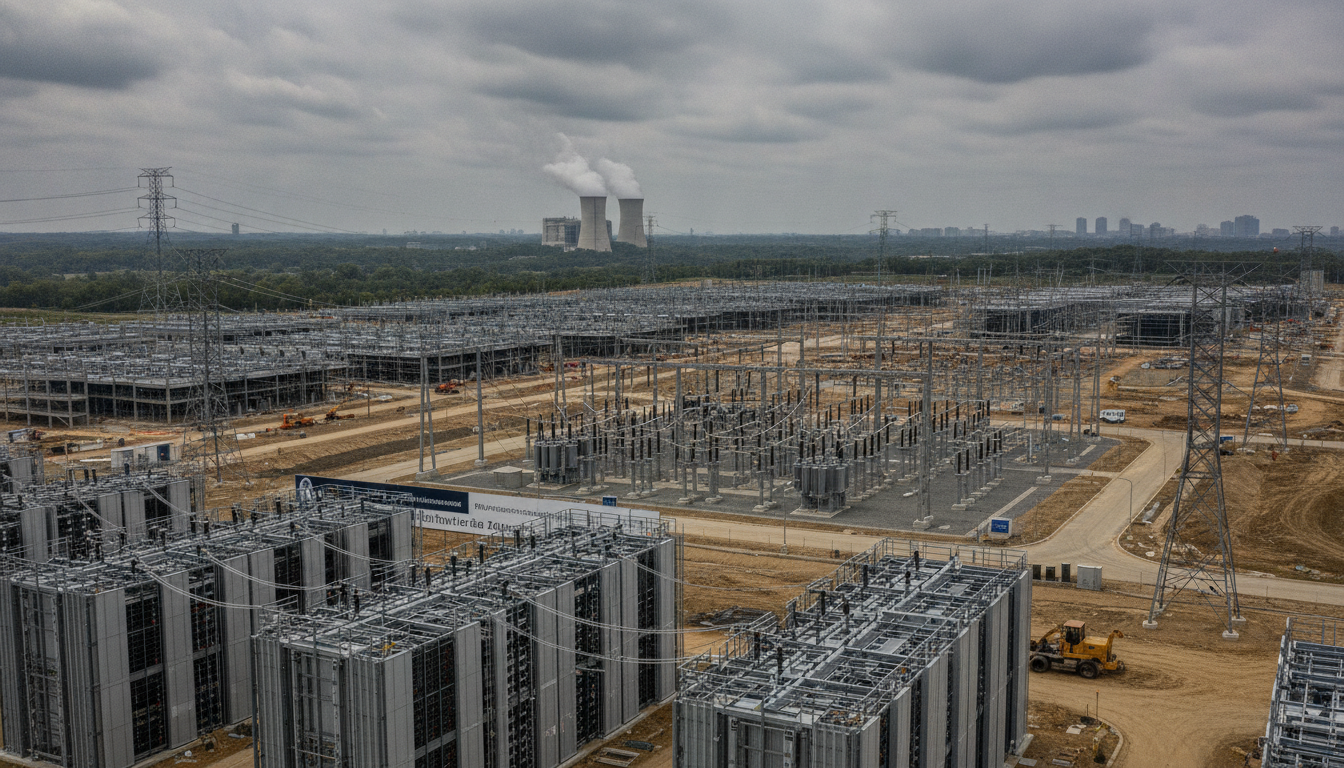
Data Centers’ Simultaneous Disconnection After Downed Line Triggers 3.5 GW Surge on PJM Grid
Downed line near Washington forced data centers to switch to backup, removing ~3.5 GW and causing an 11-min PJM voltage disruption that flickered lights.
Mass disconnection after Northern Virginia power line outage
When a high-voltage transmission line outside Washington, D.C., failed this week, the event briefly cascaded through the PJM Interconnection as dozens of data centers in Northern Virginia switched to backup power. The initial line fault was followed within seconds by an abrupt loss of roughly 3.1 gigawatts of load as data centers tripped offline. The grid experienced a peak mismatch of about 3.49 GW and took roughly 11 minutes to return to a stable operating condition.
Lights across parts of the PJM footprint—including areas as far west as Chicago—were reported to flicker during the disturbance. The incident did not produce a widespread blackout but highlighted how concentrated clusters of large electric loads can amplify a localized fault into a regional voltage excursion. PJM, which serves some 67 million customers across the Mid-Atlantic and Midwest, recorded the rapid swings in its system data.
Voltage swings and grid behavior across PJM
Data from system monitors show the grid’s voltage rose as demand suddenly fell when facilities switched to local backup supplies. Supply and demand on an electric system must remain tightly balanced; a near-instantaneous loss of gigawatts of demand shifts that balance and produces a surge in system voltage. Small deviations are tolerable, but when multiple protections act at once they can deepen the disturbance.
After the first set of disconnects, additional facilities dropped off the grid, enlarging the mismatch and extending the recovery window. The transient left the system with more generation than load at its peak, forcing operators and automated controls to take corrective actions until frequency and voltage stabilized. Engineers described the event as a rapid, large-scale load departure rather than a generation shortfall.
Why data centers tripped nearly simultaneously
Most modern data centers have protection schemes that detect voltage dips and automatically switch to uninterruptible power systems or on-site diesel generation within seconds. In this incident, many facilities neighboring one another made the same split-second decision when their internal monitors registered the dip. Independent system operators and grid-modeling specialists noted that geographically clustered, similar equipment and settings can lead to highly correlated responses.
Experts called for better sequencing and coordination so that adjacent facilities do not disconnect at the same instant. A staggered or conditional ride-through strategy would allow some loads to remain on the grid, easing the shock to system balance and giving grid operators more time to respond. Until such measures are widely adopted, concentrated pockets of large demand will remain potential stress points.
Industry and technology options to reduce risk
Operators of large computing campuses and a growing set of startups are pursuing technical solutions that allow facilities to absorb grid disturbances rather than disconnect. One approach is a campus-scale uninterruptible power system that places batteries and power-conversion hardware in front of the entire data center load. That architecture makes the grid see a single, steady load profile while the facility uses stored energy to support internal equipment during a disturbance.
Those systems can also act as flexible demand resources: when the grid has excess power they can charge batteries, and when supply falls they can inject power back to servers and cooling systems. Companies deploying this design argue it reduces simultaneous tripping and can provide milliseconds-level response to system events. Independent market changes are also underway; some grid operators are moving toward mandatory ride-through requirements for large loads to prevent abrupt disconnections.
Scale of the problem and implications for the future
The recent event was about twice the size of a similar PJM disturbance two years ago, when roughly 1.5 GW of load vanished as some 60 data centers tripped. At the time, data centers accounted for a single-digit share of PJM’s total load; projections from industry and independent analysts indicate that share could grow substantially in coming decades. One modeling study cited scenarios in which data center demand climbs from present levels to a far larger portion of regional consumption by 2040 if current trends continue.
That trajectory increases the importance of integrating data centers into grid planning and reliability protocols. Without changes to facility controls, backup strategies, or interconnection standards, recurring events of growing magnitude could present operational challenges for system operators. Regulators and grid managers are already discussing adjustments to interconnection requirements and ride-through obligations to better manage large, concentrated loads.
Efforts to deploy campus-level battery systems and to revise operating rules are advancing, but adoption varies across regions and operators. The event this week serves as a timely example for planners, suggesting that coordinated technical fixes and updated rules are needed to keep rapid load changes from undermining regional reliability.
Data centers and grid operators say they are working to reduce correlated responses, but the speed and scale of data center growth mean the window to adapt is limited. The recent PJM disturbance demonstrates that even short-lived transmission faults can produce outsized effects when many large electricity users act in unison, and engineers warn the risk will rise if facilities and regulations do not evolve in step.
