
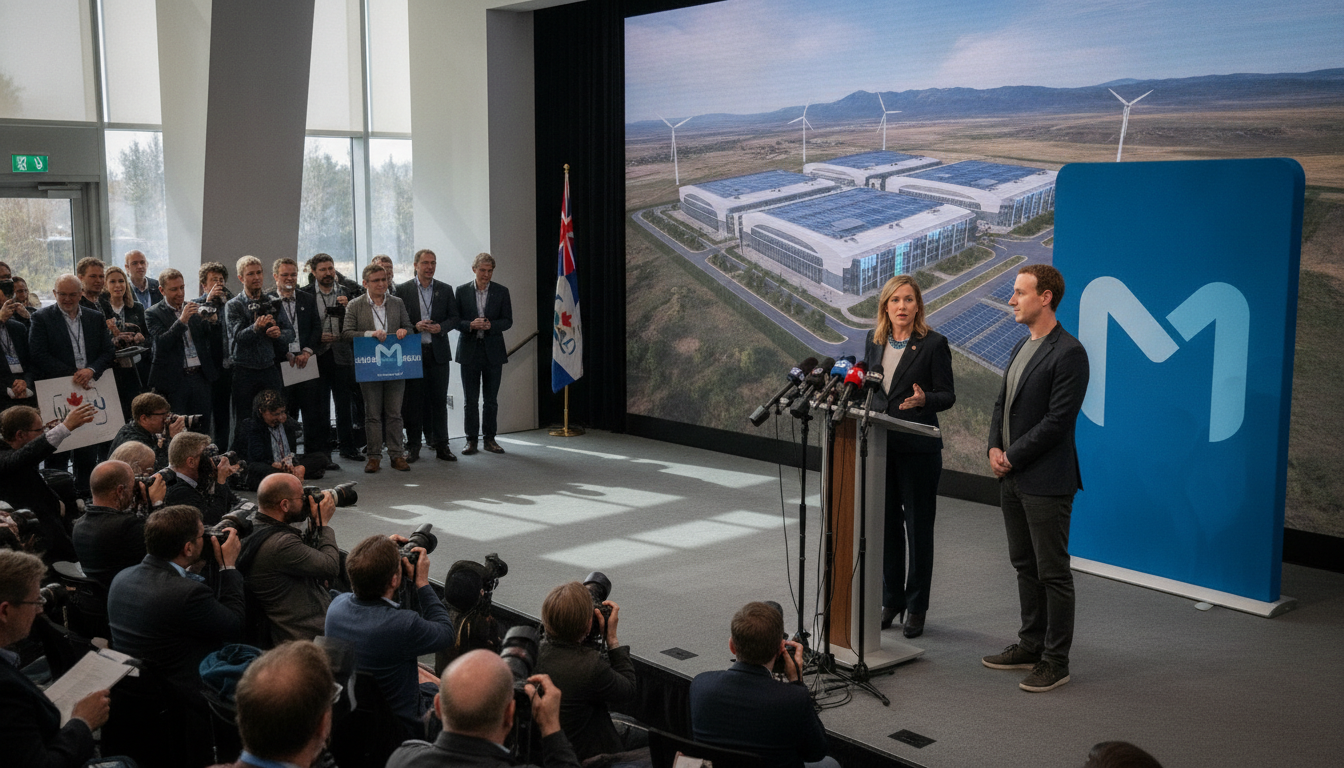
Alberta Premier’s AI data centres pitch: promises on power, water and $250M annual benefit
Premier Danielle Smith vows no higher bills and minimal water use as Alberta courts Meta’s $13-billion AI data centre in Sturgeon County.
Premier’s video outlines economic promises
Premier Danielle Smith released a video Tuesday that framed AI data centres as a major economic opportunity for Alberta, centring her remarks on the planned Meta investment in Sturgeon County.
Smith said AI data centres would not raise household electricity bills, that advances would keep water use minimal, and that the Meta project alone would deliver roughly $250 million a year to the province.
She stressed the projects would be privately financed, with companies bearing costs and risks rather than taxpayers.
The premier’s presentation sought to pre-empt local concerns and to cast Alberta as a preferred host for the rapidly expanding AI data-centre industry.
Details of the Meta project and on-site power claim
Meta has announced a proposed $13-billion campus for Sturgeon County, accompanied by a separate generation plant to power the facility.
Provincial briefings indicate the company plans to build on-site electricity generation, with a reported cost of about $4.6 billion, and that the facility would not draw power from Alberta’s grid.
The government has repeated the line that privately built generation means no upward pressure on residential rates, and that the companies will pay taxes, fees and royalties.
Officials say the projected $250 million in annual provincial revenue would come through those payments rather than subsidies or discounted power arrangements.
Industry momentum and national landscape
Around a hundred proposed AI data-centre projects are being discussed across Canada, with several already constructed and many more in various stages of planning.
Provinces are competing to attract major cloud and AI infrastructure investments, citing jobs, tax revenue and a chance to host cutting-edge technology.
Alberta’s pitch leans heavily on its energy resources and industrial infrastructure as advantages for data-centre operators.
At the same time, other provinces have seen both interest and pushback, with some governments reviewing local impacts more cautiously.
Local opposition and high-profile pushbacks
Projects in multiple provinces have encountered vocal protests and municipal resistance, driven by concerns about environmental impact and strain on local services.
Manitoba’s government last year declined to approve a major data-centre project south of Winnipeg, with its premier citing environmental and social concerns as decisive.
Community groups in British Columbia, Saskatchewan and Ontario have also mobilized in opposition to proposed centres, arguing that long-term risks to water, land and local infrastructure require deeper scrutiny.
The debate is often framed locally around immediate impacts even as it intersects with broader national conversations about the future of AI.
Public opinion and the politics of AI infrastructure
Recent polling cited by critics shows widespread public unease about governments’ ability to manage AI, with many Canadians saying they would oppose data-centre development near their communities.
A notable share of respondents also favoured taxing companies that replace workers with artificial intelligence, signalling that economic benefits alone do not settle public unease.
Smith and supporters argue that hosting AI data centres gives Canada leverage in shaping AI development and policy, and that refusing investments risks ceding influence to foreign jurisdictions.
Opponents counter that assurances from companies and provincial governments must be matched by enforceable conditions and independent oversight.
Environmental and resource-management concerns
Water use and emissions are central elements of the debate, even where companies promise technical advances to mitigate consumption and pollution.
Critics note that large-scale computing facilities require continuous cooling and power, and they press for transparent, independently verified data on resource use and emissions levels.
Proponents counter that modern designs and closed-loop cooling systems can dramatically reduce freshwater consumption, and that on-site generation can be configured to meet emissions targets.
Regulators and municipalities face pressure to demand thorough environmental assessments and to set binding conditions before approvals proceed.
Economic stakes are high for municipalities and the provincial treasury, but the projects’ long-term local footprint and governance arrangements remain under scrutiny.
Communities and advocacy groups are calling for clear agreements on emergency planning, road impacts, workforce development and the disposition of decommissioned sites.
Smith’s video frames Alberta’s strategy as a gamble with outsized upside if the province captures a meaningful share of global AI infrastructure.
The government has emphasized that these are private ventures and that shareholders — not taxpayers — will bear the financial risk of any failures.
As the province moves to negotiate terms and process approvals, the controversy is likely to play out at municipal hearings, regulatory reviews and the ballot box.
Stakeholders from industry, local governments and community groups are preparing for a prolonged debate over whether the long-term benefits touted by the premier outweigh the environmental and social concerns raised by opponents.
Public officials now face the practical task of translating broad promises into enforceable conditions, monitoring regimes and transparent reporting that will determine whether Alberta’s AI data centres deliver the benefits government officials promise.
The next months will test whether political assurances and corporate commitments can withstand the scrutiny of regulators, communities and a public that remains deeply uncertain about the rapid expansion of AI infrastructure.
