
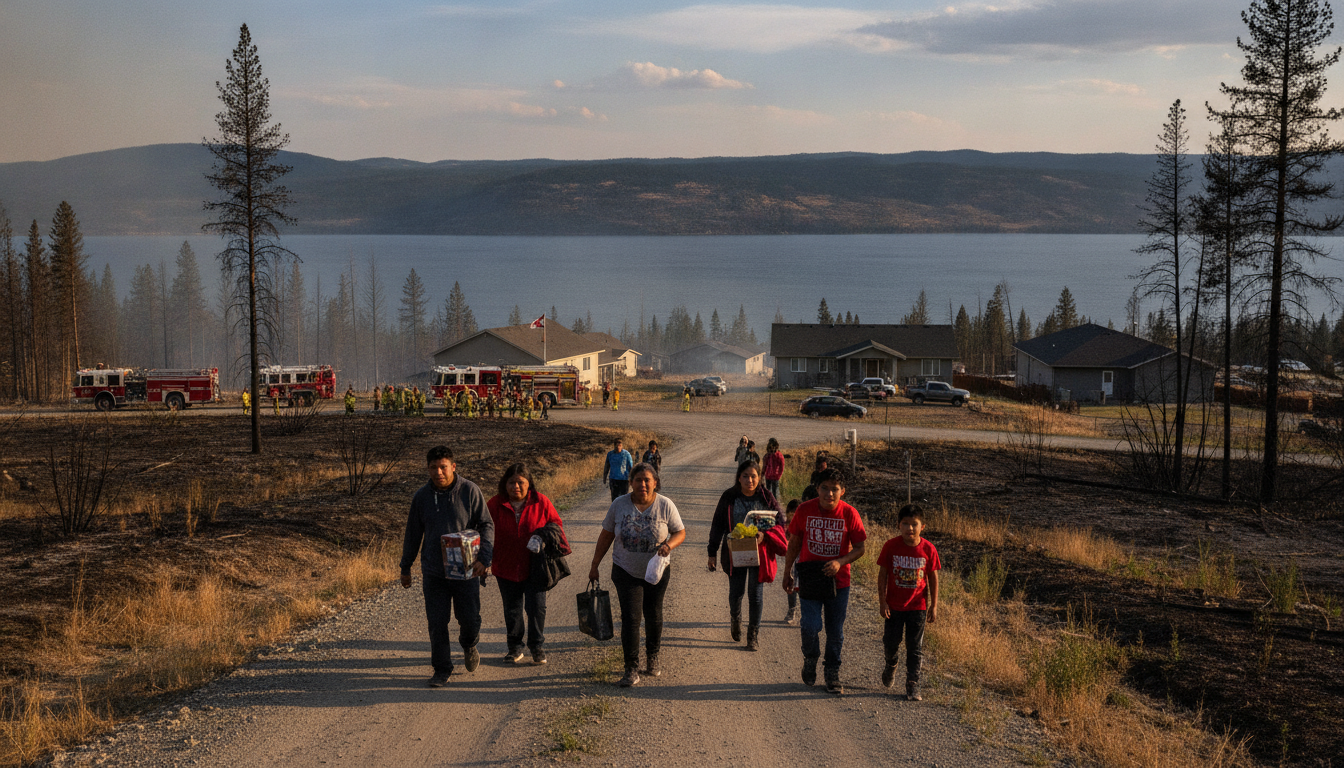
Bradley Creek wildfire forces returns and long recovery for Okanagan Indian Band members
Bradley Creek wildfire: Evacuation orders lifted for parts of the Okanagan Indian Band as residents return to assess damage, recover items and begin rebuilding.
The Bradley Creek wildfire, which erupted in early August, has prompted the partial lifting of evacuation orders and allowed some members of the Okanagan Indian Band to return to their lands to assess damage. While a portion of the community has been able to go home, others face extended displacement after dozens of homes and irreplaceable cultural items were lost. Band members and local officials describe a scene of heavy loss balanced by determined efforts to support neighbours and begin recovery work.
Evacuation orders partially lifted
Local authorities have reclassified the Bradley Creek wildfire as contained, prompting officials to lift some evacuation orders and permit limited access to affected areas. The containment determination means crews do not currently expect the fire perimeter to expand, allowing controlled returns for residents to retrieve documents, assess structural damage and gather personal effects. Despite the eased restrictions, many properties remain unsafe for full habitation and some evacuation orders remain in place.
Residents returning to the community have done so cautiously, often only for short visits to inventory losses and check on neighbours. Officials continue to coordinate access with emergency services to ensure roads and structures are safe for entry.
Scale of damage and cultural losses
Community leaders estimate roughly 230 properties were destroyed in the blaze, with about 30 of those belonging to members of the Okanagan Indian Band. Beyond homes, many families reported the loss of heirlooms and cultural items that cannot be replaced, including baskets and artifacts passed down through generations. Band members emphasized that while financial assistance can address some replacement needs, the loss of heritage items is deeply personal and enduring.
One resident said she left with only essential documents and later learned that thousands of family photos and ancestral baskets were lost to the flames. The emotional toll of losing items tied to family history has become a central concern as recovery planning begins.
Personal stories of return and loss
Residents who have returned described a mixture of relief and grief. Frederick Louis, who lost a recently renovated home to the fire, said he and his family are taking recovery “one day at a time.” He is staying in a Vernon hotel and faces the daunting task of replacing a lifetime of possessions while processing the trauma of displacement.
Others were spared physical destruction but still live under threat: Dora Louis Alexis’s house survived the flames but remains under an evacuation order, and two of her sons lost their homes. She emphasized resilience, saying that material losses can be rebuilt even as the community contends with deeper emotional wounds.
Containment, firefighting and outlook
Fire suppression crews declared the Bradley Creek wildfire contained after several days of aggressive response and favourable conditions. Containment reflects current control of the blaze’s perimeter, but officials cautioned that containment does not mean the threat has disappeared entirely. Continued monitoring and mop-up operations will be required to prevent flare-ups, particularly as hot, dry weather can change conditions rapidly.
Local fire services and provincial resources remain deployed to patrol hotspots and support community safety. Emergency managers are urging residents to follow official guidance about re-entry and to report unsafe structures or hazards.
Community ceremonies and mutual support
In Vernon, the Okanagan Indian Band organized a ceremony to honour those displaced, those who lost homes, and the crews working on the front lines. Community members gathered to pray for rain, water and the wellbeing of everyone affected, and to recognize the collective effort underway to protect and rebuild the community. The ceremony also served as a focal point for practical support, with families checking on one another and sharing information about available services.
Charitable groups, neighbours and band-run programs have mobilized to provide food, temporary lodging and essential supplies to evacuees. Local officials say coordinated relief — from hotel accommodations to counselling and cultural supports — will be necessary in the weeks ahead.
Recovery challenges and next steps
With some families permitted to return only briefly, long-term recovery will demand coordinated funding, housing solutions and cultural restoration efforts. Band leaders and residents are assessing insurance coverage, government supports and community priorities before setting a phased rebuilding plan. The complexity of replacing culturally significant items adds another layer to recovery, prompting calls for inventories of lost goods and possible cultural repair initiatives.
Officials also stressed the need for mental-health services and community-led decision-making as part of the recovery process. For many families, the immediate focus remains on securing temporary housing and salvaging what remains, while leaders begin planning for reconstruction and cultural recovery programs.
Community members have shown resilience and solidarity in the face of profound loss, but the path ahead will require sustained support and careful, culturally informed planning to ensure that rebuilt homes and restored sites reflect the needs and traditions of the Okanagan Indian Band.
