
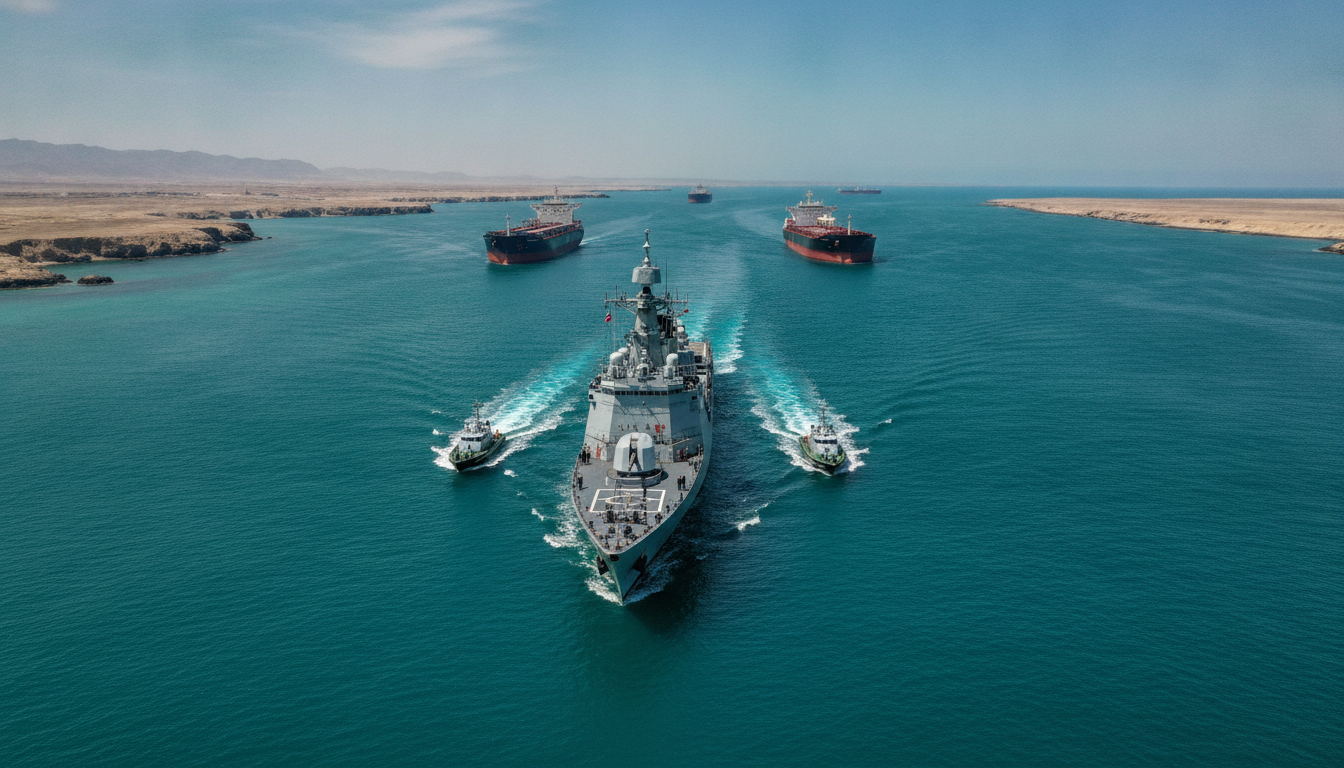
Iran’s IRGC warns ships to use Tehran‑approved routes through the Strait of Hormuz
IRGC warns commercial vessels to use Iran‑approved channels after Oman and the IMO unveiled a new corridor through the Strait of Hormuz amid US‑Iran 60‑day talks.
The Islamic Revolutionary Guard Corps has ordered commercial ships to use only transit lanes it approves in the Strait of Hormuz, escalating a dispute after Oman and the International Maritime Organization announced a coordinated new corridor through the strategic waterway. The warning comes as Washington and Tehran enter a 60‑day negotiation period under a memorandum of understanding that has temporarily reduced hostilities and allowed limited shipping to resume through the Strait of Hormuz. Shipping companies, regional governments and international observers are now watching whether Iran will insist on stricter control of vessel movements or seek fees once the temporary arrangements end.
IRGC rebuke follows Oman‑IMO corridor announcement
The IRGC said the Oman‑IM O routing was announced without prior coordination with Tehran and labelled the move unsafe and unacceptable, insisting the only authorised routes are those Iran designates. Tehran has already published its own map of preferred transit lanes that pushes traffic closer to Iranian shores, a change that unsettled operators used to the pre‑conflict shipping pattern. Oman defended its corridor as intended to restore navigation safety and said it will not impose transit fees, while urging compliance with international law.
Terms of the US‑Iran memorandum and the 60‑day window
Last week’s memorandum of understanding obliges Iran to facilitate free passage for commercial vessels for an initial 60 days, a provision designed to quickly reopen the strait and reduce economic turmoil. The agreement also foresees demining work to be carried out by Iran within 30 days before full prewar lanes can be reinstated, and it calls for trilateral talks with Oman and other Gulf states on long‑term management. Crucially, the MoU does not define the post‑60‑day arrangements, leaving open the possibility of new rules, inspections or other measures once the temporary period ends.
Dispute centres on control, fees and inspections
A central point of contention is whether Iran will seek to exert lasting authority over passage and whether it might levy charges for transits after the interim period. International law typically protects transit rights through straits used for international navigation, complicating unilateral efforts to impose fees. US and Gulf officials have rejected any attempt to monetise passage, saying the strait must remain free for global trade, while Iranian officials and hardline elements have signalled they view the postwar settlement as a reset of the status quo.
Commercial and legal implications for shipping operators
Shipowners and charterers are weighing the legal exposure of taking the Omani corridor or Iran’s preferred lanes, especially given risks such as incomplete demining, inspections and the potential for harassment at sea. Industry analysts report that many vessels continue to limit transponder signals or reroute to avoid exposure, adding friction and cost to logistics chains that depend on predictable passage. Energy markets are sensitive to any disruption; even the partial return of traffic has not yet restored confidence to prewar levels, and oil prices remain above where they stood before the conflict.
Traffic volumes, demining progress and safety concerns
Commercial traffic through the Strait of Hormuz has increased from the depths of the blockade but remains well below the 120–140 vessels a day seen before hostilities. Shipping analytics firms recorded roughly 70 confirmed crossings on a recent day as demining operations advanced and some carriers tested the Omani route. Analysts caution that until clearance operations are complete and monitoring regimes are agreed, ship operators will likely proceed cautiously, keeping some ships dark or transiting at reduced frequency to manage risk.
Regional and international responses to the standoff
The United States and Gulf partners have publicly pushed back against any attempt to treat the strait as a revenue source, stressing the principle of free passage and warning that threats to shipping would be judged by actions, not rhetoric. Regional actors, including Oman and other Gulf states, have emphasised coordination and compliance with international maritime norms, while multilateral bodies are positioned to help mediate technical issues such as lane demarcation and mine clearance. Observers note that effective implementation of the MoU will require visible and verifiable steps on several fronts to sustain momentum in broader peace talks.
The coming weeks will test whether the temporary reopening of the Strait of Hormuz can be transformed into a durable arrangement that secures commerce without conceding unilateral control. If demining proceeds, inspections are clarified, and negotiators produce tangible confidence‑building measures, shipping may normalize; if not, disputes over routes, oversight and potential fees could undermine the fragile truce and reignite regional tensions.
