
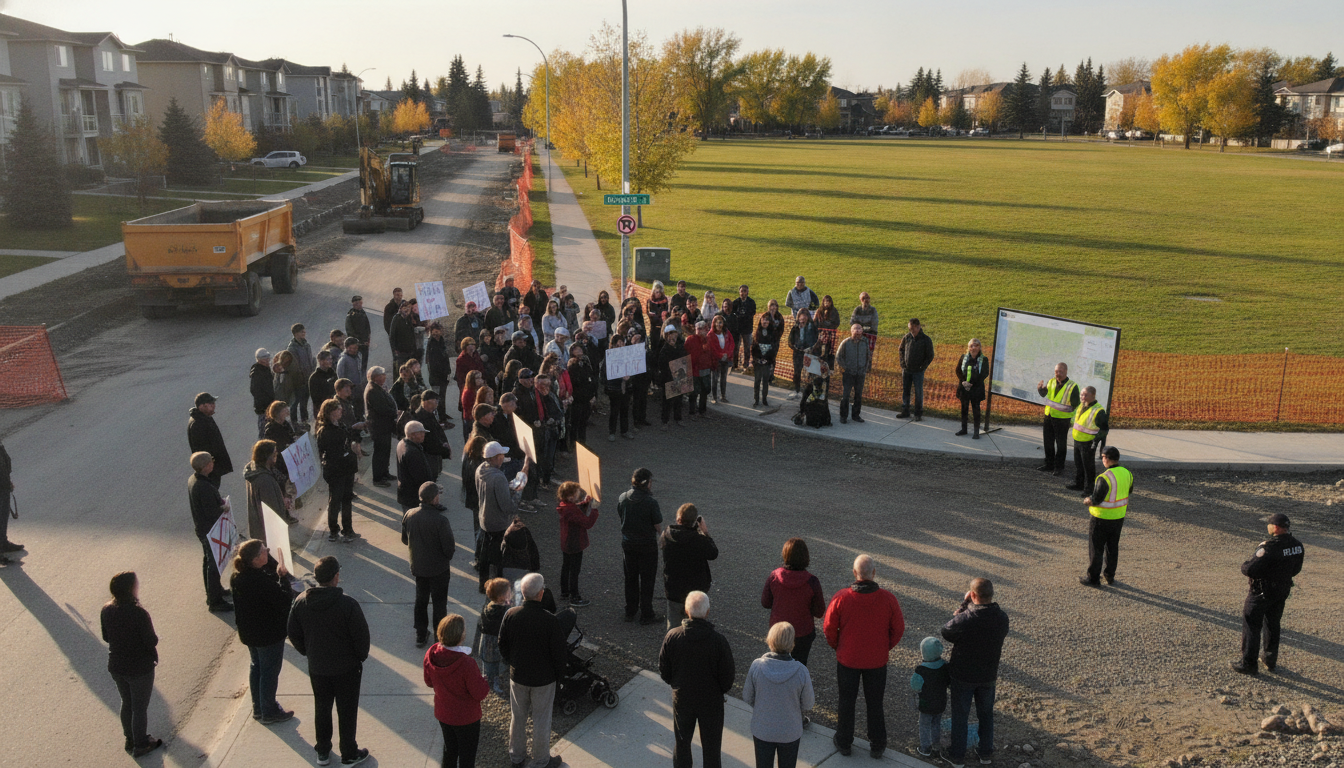
Riverstone Road widening in Calgary ignites resident opposition as transit project advances
Riverstone Road widening in Calgary draws resident opposition as a 500-unit transit-oriented project near South Hill Green Line advances, raising parking risk.
Riverstone Road residents in southeast Calgary are intensifying objections to the city’s plan to widen and re-open their street to connect with a new transit-oriented development and the future South Hill Green Line station. The redevelopment east of Riverbend proposes roughly 500 housing units on brownfield land and is being built within walking distance of the planned LRT stop. Neighbours fear increased traffic, loss of on-street parking and the partial loss of private front-yard space if the city proceeds as planned.
Residents mobilize over traffic and access
Calista Wintrip, a Riverbend resident who lives on a cul-de-sac adjacent to Riverstone Road, said neighbours would prefer the route be restricted to buses and emergency vehicles rather than opened to general traffic. She and others have pushed council and city staff for a redesign that limits vehicle types, citing concerns the narrow street will not accommodate heavy traffic. City figures conveyed to residents estimate the road could see thousands of vehicles daily once the connection is active, fuelling anxiety about noise and safety.
Some homeowners on the north side of Riverstone Road were told they will lose small portions of their front yards and in some cases mature trees to make way for the widening. Those affected say the loss of on-street parking will put extra strain on households with multiple vehicles and change the character of the quiet residential street.
Transit-oriented development and housing goals
The city’s redevelopment plan envisions a mixed-use, transit-oriented community on previously underused land just east of Riverstone Road. Plans call for a mix of two- to three-storey townhouses and four- to six-storey apartment buildings intended to deliver about 500 housing units and accommodate more than 1,000 residents. The project also includes public amenities such as a one-acre park and pedestrian connections to nearby pathways and services.
City planners argue the site represents a rare opportunity to provide multi-family housing close to an LRT station, supporting broader municipal goals for higher-density, transit-adjacent growth. Officials have framed the project as an efficient use of city-owned land to help address housing demand across Calgary.
Homeowner impacts and parking losses
Donna Istace, a Riverstone Road homeowner for 24 years, said she was notified the front few metres of her yard and a tree would be removed to permit the road expansion. Istace said her garage handles two vehicles but her household owns three, meaning the family will have to reconfigure long-standing parking arrangements. While she expressed frustration at the disruption and construction, she acknowledged the need for more housing in the city.
Other neighbours say the removal of on-street parking on the north side of Riverstone Road will displace vehicles and create parking pressure on adjacent streets. Residents also warned that a widened link could invite cut-through traffic that would otherwise use arterial roads designed for higher volumes.
Council history and political response
A previous city council approved a revised plan for the Riverbend redevelopment at a public hearing in July 2024, a decision that included provisions to ultimately allow all vehicle types to access Riverstone Road. Councillors at the time also asked staff to refine the road design to minimize impacts on existing homes and to weigh options that could limit through-traffic.
Ward 11 Coun. Rob Ward said he sympathizes with residents and questions whether Riverstone Road was intended to serve as a connector for heavy traffic and regular bus operations. Ward said he would like to see a re-evaluation of the design but noted there appears to be limited appetite among council colleagues to overturn the near‑unanimous 2024 decision. He described the challenge of reconciling new infrastructure with prior council choices.
Engineering and transit access considerations
City planners say the Riverstone Road link is needed to provide a direct bus connection to the future South Hill Green Line station and to support a higher-occupancy transit network. Widening the road would also allow emergency vehicles to access the redevelopment and surrounding areas more efficiently, planners contend. Those technical rationales, however, are at odds with the lived experience of residents who see their narrow residential street as incompatible with higher traffic loads.
Design teams have been directed to explore configurations that reduce the footprint on private property and preserve as much on-street parking as practicable. Yet affected householders say the proposals seen so far still involve property impacts and tree removals that would alter front yards and streetscape character.
Next steps and possible compromises
The city has indicated the project will proceed while staff continue to refine the road design and consult with residents, although a city spokesperson was not available for further comment this week. Municipal staff face pressure to balance housing targets and transit connectivity with neighbourhood preservation and resident safety concerns. Potential compromises under consideration include limiting some vehicle movements, designating one-way bus lanes, or adding traffic-calming measures to mitigate speed and volume.
As work on the transit-oriented development moves forward, residents say they will continue to press elected officials to seek alternatives that reduce disruption along Riverstone Road. The coming months are likely to determine whether design adjustments can meaningfully address parking, property and traffic worries while keeping the broader redevelopment on track.
The debate over Riverstone Road highlights the tensions that often accompany infill and transit projects in established neighbourhoods, as Calgary grapples with growth, housing supply and the trade-offs of expanding transit access.
