
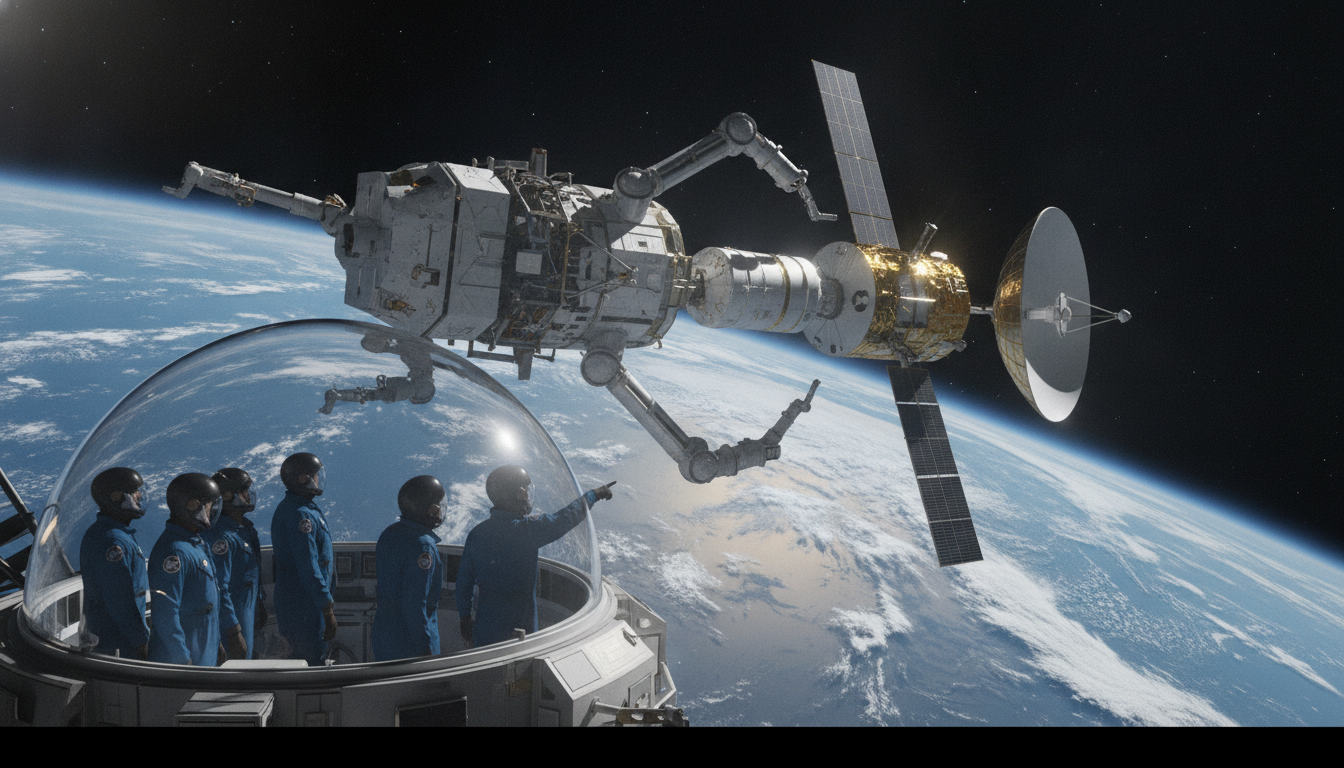
Satellite life extension advances as Northrop’s MRV and MEPs head to GEO
Northrop Grumman’s Mission Robotic Vehicle and three Mission Extension Pods launched July 21, 2026, ushering a new phase in satellite life extension as older servicers make way for modular “jetpacks.” (northropgrumman.com)
Northrop MEV unplugs from Optus D3
Northrop’s older Mission Extension Vehicle that had been holding position on Optus’s D3 communications satellite has begun to clear space in geostationary orbit to allow for next-generation servicing hardware. (spacescout.info)
The MEV family provided years of life extension to customers by physically docking and using its own propulsion to maintain target satellites’ orbital position. Those earlier MEVs are now making room for the Mission Robotic Vehicle and the modular pods that can be permanently attached to client spacecraft. (northropgrumman.com)
MRV and MEPs launched to geostationary transfer orbit
A SpaceX Falcon 9 lifted Northrop’s MRV and three Mission Extension Pods into a transfer trajectory on July 21, 2026, beginning a yearlong series of orbit-raising and rendezvous maneuvers before work in GEO is scheduled to start. (northropgrumman.com)
The mission architecture separates the robotic servicer from the propulsion pods so the MRV can install pods on multiple satellites, then depart to its next assignments. Northrop calls the pods “MEPs” and markets them as customer-owned jetpacks that take over orbit control once installed. (northropgrumman.com)
How the MEP “jetpack” system extends satellite life
The Mission Extension Pods are compact propulsion units that carry electric thrusters, xenon propellant and avionics to assume stationkeeping and momentum management for a host satellite. Once attached, the MEP performs the orbit-control functions that otherwise would drain a satellite’s onboard fuel tank. (space.com)
Optus booked a MEP for its D3 spacecraft, a Ku-band satellite launched in 2009 and originally designed for a roughly 15-year life. Attaching a pod can add several years of operational service and revenue to aging assets that are otherwise healthy electrically and functionally. (space.com)
Technical choreography and refueling capability
Attaching a MEP requires precise rendezvous and robotics: the MRV will use two long robotic arms — technology developed under DARPA and the U.S. Naval Research Laboratory — to pick up a pod and plug it onto a client satellite. That work demands autonomous proximity operations, high-fidelity guidance, and meticulous control of relative motion in GEO. (space.com)
The MRV is also designed with an in-orbit refueling concept and includes the Passive Refueling Module, a refueling interface cleared by the U.S. Space Force, so the servicer itself can be replenished and continue multiple missions. That refuelable design is a deliberate step toward making on-orbit servicing sustainable and repeatable. (space.com)
Commercial customers and strategic implications
Northrop’s MEV program proved the commercial case for life extension after successful missions beginning in 2019 and 2020 that preserved revenue-generating capacity for major satellite operators. The MRV/MEP model shifts some cost and complexity onto customer-owned pods, allowing a single robotic servicer to service multiple clients and lower per-satellite costs. (intelsat.com)
That success is spurring interest from both commercial operators and defense customers, because the ability to refuel, reposition, inspect or upgrade a satellite can protect high-value assets and delay costly replacements. At the same time, officials and analysts have noted that on-orbit grappling and propulsion capabilities are inherently dual-use, prompting discussion of risk, norms and safeguards. (intelsat.com)
Precedents and parallel efforts in orbit
The MRV-MEP launch follows other recent servicing attempts that show both opportunity and complexity for in-orbit rescue operations. Earlier in July, another commercial servicer headed to raise NASA’s Swift Observatory after pointing and communication issues; controllers applied fixes while the rescuer conducted in-orbit checkouts. Those missions underscore how robotics, software patches and flexible mission planning are becoming part of standard satellite sustainment. (apnews.com)
Northrop’s approach intentionally complements a market trend toward many replaceable LEO satellites while offering a clear value proposition for large, costly GEO craft whose electronics remain viable but whose fuel is exhausted. Operators see life extension as a way to stretch capital investments without sacrificing capability. (space.com)
Timeline and next steps for Optus D3 and other clients
The MRV and MEPs will spend the next several months raising and phasing their orbits, with in-orbit installation operations targeted in 2027 for the Optus D3 spacecraft. After installing a pod on D3, Northrop plans to use the MRV to ferry and attach the remaining pods to other contracted satellites. (northropgrumman.com)
If the installations proceed as planned, the Optus satellite — launched in 2009 and originally cleared for a 15-year mission — could remain operational and revenue-generating for multiple additional years. That outcome would illustrate the commercial and operational upside of satellite life extension as routine infrastructure for orbital sustainability. (en.wikipedia.org)
Satellite life extension is evolving from a niche technical demonstration into a mainstream tool for satellite fleet managers, with robotics, modular propulsion and refueling forming the core of a service economy that could reshape how operators plan, insure and sustain space assets.
