
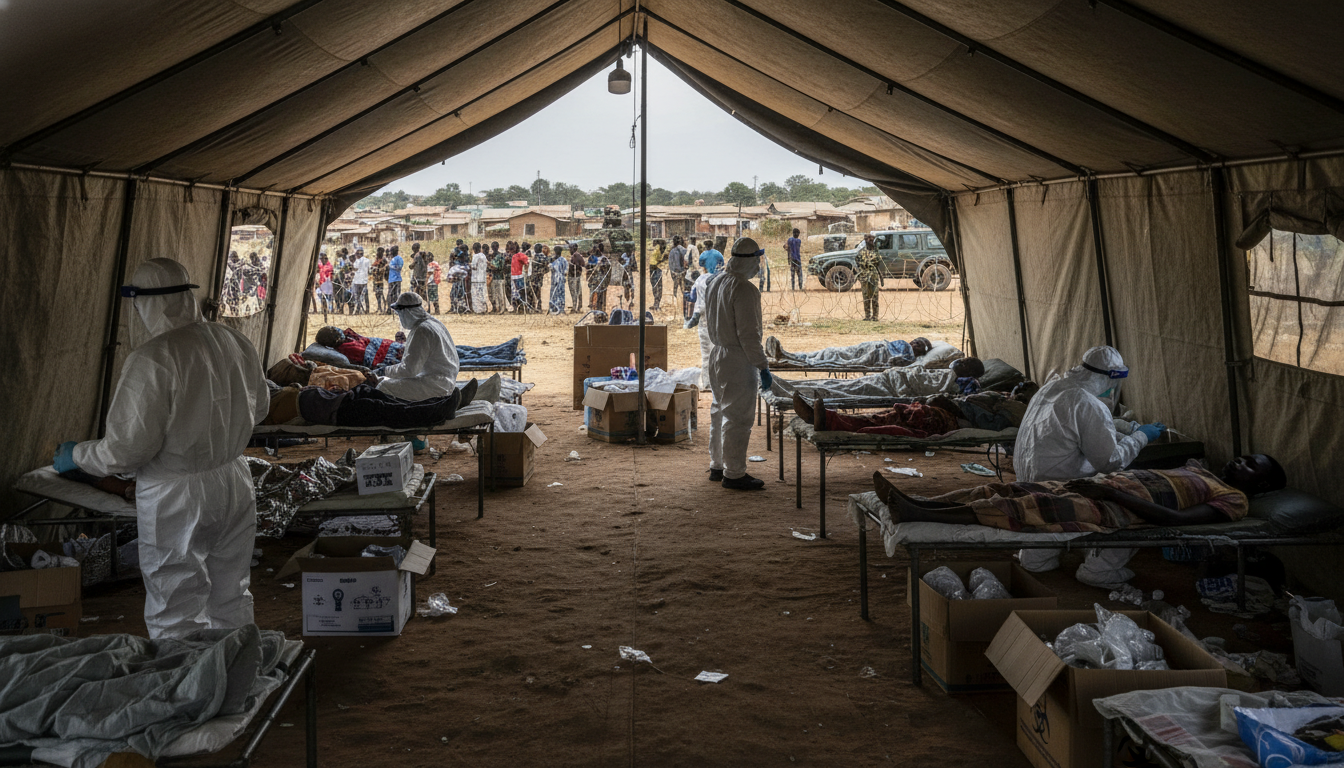
Ebola Bundibugyo outbreak in DRC’s Ituri Province deepens as testing gaps and conflict hinder containment
Ebola Bundibugyo outbreak in eastern DRC’s Ituri Province has spread amid violent displacement and limited local testing, raising concerns about regional transmission as of May 21, 2026.
The Ebola Bundibugyo outbreak that health officials say began in Mongwalu, Ituri Province, has evolved into one of the deadliest recent episodes in the Democratic Republic of Congo, with suspected and confirmed deaths already among the highest in the country’s history. The virus circulated undetected for weeks in a region battered by years of conflict that has displaced more than a million people and crippled local health capacity. Authorities and international agencies warn that containment is being obstructed by population movement tied to seasonal labor in gold mines and ongoing insecurity.
Virus traced to Mongwalu in Ituri Province
Ituri Province, where health officials believe the outbreak began in Mongwalu, sits near porous borders with Uganda and South Sudan. Heavy population movement — both forced displacement and seasonal work in mining areas — has complicated efforts to establish transmission chains and identify contacts. Local officials say case counts reported as of May 21, 2026, include many suspected infections and that the toll is expected to rise as testing and surveillance expand.
Contact tracing teams face operational challenges because communities are mobile and health systems run at reduced capacity after years of conflict. The absence of robust surveillance in many parts of Ituri has meant that infections likely went unrecorded for days or weeks, allowing the rare virus to move through families and healthcare settings before a coordinated response could be mounted.
Rare Bundibugyo species identified after initial false negatives
Laboratory analysis completed in Kinshasa identified the outbreak strain as Ebola Bundibugyo, a less common species of the virus that has been recorded only twice previously — in Uganda in 2007 and in Congo in 2012. Initial tests conducted in Ituri returned negative results because local equipment was calibrated to detect the more common Ebola strains, not Bundibugyo. Samples sent to the national reference laboratory in the capital confirmed the rare species, triggering alerts among national and international health authorities.
Because Ebola Bundibugyo is not well characterized compared with other species, clinicians face additional uncertainty about clinical progression and optimal management. There are currently no approved vaccines or therapeutics specific to this species, increasing reliance on supportive care, isolation, and classical infection-control measures to reduce transmission.
Testing and logistics shortfalls delayed outbreak response
Officials have pointed to a lack of diagnostic capacity in the field as a major factor that slowed early detection and response. Testing equipment capable of identifying the Bundibugyo species was not available locally, and samples had to be transported over long distances to Kinshasa for confirmation. That delay contributed to an underestimation of cases in the outbreak’s crucial early days and hampered rapid deployment of targeted control measures.
Beyond diagnostics, shortages of trained personnel, personal protective equipment and functioning healthcare facilities in conflict-affected zones have limited the ability to isolate patients and conduct effective contact tracing. Observers say these logistical gaps are exacerbated by the sheer scale of displacement and the movement of miners and traders across informal routes.
Conflict, displacement and strained health services
Ituri’s protracted insecurity has displaced more than one million people, according to local authorities, stretching humanitarian and health resources thin. Displaced populations often live in crowded, informal settlements with limited access to clean water and sanitation, conditions that increase the difficulty of interrupting transmission. Healthcare facilities that remain open are operating under immense strain and can become sites of spread when infection-control measures are insufficient.
The long containment effort required during the 2018 outbreak — which became the second-deadliest in DRC and took two years to control — underscores the risks posed by weak local infrastructure. Lessons from that epidemic are informing current strategies, but the combination of a rare viral species and a fragmented response landscape is prompting urgent appeals for support.
Cross-border cases reported and regional transmission risk
Ituri’s border with Uganda and proximity to South Sudan have raised alarms about cross-border transmission. Uganda has reported two cases in its capital city, including one death, heightening concerns that population movement could spread the virus across national lines. The Bundibugyo species spreads through direct contact with bodily fluids and can be transmitted in healthcare settings when infection prevention is inadequate.
Regional health ministries and agencies are being urged to increase surveillance at border crossings, share information rapidly, and scale up screening and referral systems. Public health officials emphasize the need for community engagement to reduce stigma and encourage early reporting of symptoms.
International response and World Health Organization guidance
The World Health Organization has assessed the outbreak as posing a high risk of regional spread but not, at present, a global threat. Local leaders and international partners are mobilizing resources for case finding, isolation, and safe burials, though responders note that funding and personnel shortfalls have constrained operations. Authorities have also flagged the reduced presence of bilateral partners who previously supported disease surveillance and emergency teams in the region as a complicating factor.
With no approved vaccines or treatments for Bundibugyo, response efforts focus on classic public health interventions: rapid case detection, isolation of confirmed and suspected patients, contact tracing, and community education. Coordination between provincial health services, the national government and international agencies will be crucial as the outbreak evolves.
The coming days will test the capacity of under-resourced health systems and the effectiveness of cross-border cooperation, as health officials work to expand testing, scale contact tracing and reach displaced and mobile populations. As investigations continue and data are updated, authorities warn that the death toll and case counts reported on May 21, 2026, are likely conservative estimates and that intensified surveillance is essential to control further spread.
