
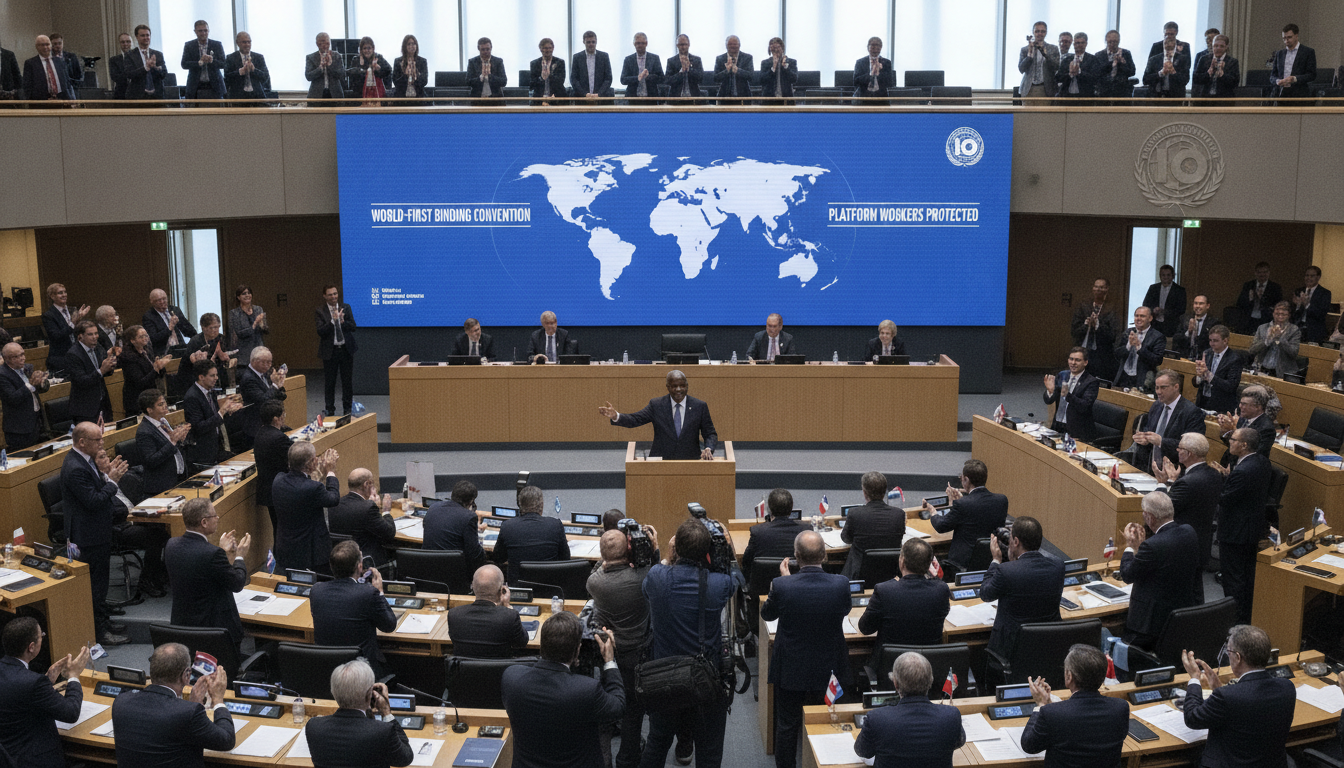
ILO adopts Decent Work in the Platform Economy Convention to protect platform workers
ILO adoption on June 12, 2026 of the Decent Work in the Platform Economy Convention sets binding labour standards and protections for platform workers globally.
The International Labour Organization adopted the Decent Work in the Platform Economy Convention on June 12, 2026, establishing the first binding international labour standard for platform workers. The convention aims to extend wage, social security and health protections to people who perform work through digital apps, including delivery couriers and ride-hail drivers. The move marks a significant shift in global labour policy after years of debate over how to classify and protect app-based workers.
Landmark vote in Geneva
A total of 406 ILO members voted in favour of the convention, with eight opposing and 36 abstentions, the organisation said at the closing session of the 114th International Labour Conference in Geneva. The ILO’s tripartite membership comprises governments, employers and workers, and the vote reflected broad international support alongside a small number of dissenting voices. Delegates described the adoption as the culmination of multi-year negotiations over how to regulate a fast-growing sector of the global economy.
Minimum standards and worker protections
The convention requires enforcement of minimum wage rules and obliges member states to ensure access to social protections such as health care, sick leave and social security contributions. It targets measures that prevent the routine misclassification of platform workers as independent contractors when the operation of apps effectively controls key elements of work. The text also directs governments to adopt safeguards that protect workers’ occupational safety and working time rights.
Scope covers all digital labour platforms
The agreement explicitly applies to “all digital labour platforms” and to platform workers whether they operate in the formal or informal economy, according to the adopted text. That broad framing is intended to capture a wide range of services delivered through apps, from food and grocery delivery to home care and transport. By design, the convention seeks to avoid loopholes that would allow companies to sidestep obligations by altering contractual labels.
Ratification and enforcement mechanisms
The ILO itself does not have direct enforcement powers, but ratification of the convention will oblige countries to bring national law into line with the new standard. Once a country ratifies an ILO convention and implements it domestically, workers may gain avenues for legal redress against platforms that fail to meet statutory obligations. In addition, ILO complaint procedures and subsequent investigations can increase international scrutiny and pressure on governments and employers.
Responses from labour and employer representatives
Labour representatives called the convention a historic advance that finally recognises and protects workers who have long operated outside traditional labour law. Amanda Brown, vice chair of the ILO Workers’ Group, said the standard will ensure that people who keep cities running and provide essential care services are formally recognised and covered by protections. Employer groups welcomed built-in flexibilities, with IOE Secretary-General Roberto Suarez Santos noting the framework allows countries to determine employment status consistent with national legal systems and established criteria.
Global implications and scale of impact
The World Bank estimated in 2023 that as many as 435 million people could be classed as app-based gig workers worldwide, highlighting the potential reach of the convention. If widely ratified, the standard could reshape labour markets, compel legislative reforms and alter business models that rely on flexible, contract-based arrangements. Governments will now face practical questions about enforcement, administrative capacity and the costs of extending universal protections to a dispersed and often mobile workforce.
The convention’s passage leaves the next phase to national parliaments and regulators, which must decide whether and how to ratify the treaty and translate its commitments into domestic law. The coming months are likely to produce intense policy discussions in capitals, court challenges from platforms in some jurisdictions, and renewed organising among workers and unions seeking to secure the new rights.
