
Ultra-Orthodox conscription ignites mass protests and deepens Israel’s political crisis
Ultra-Orthodox conscription ignites mass protests across central Israel as arrests, parliamentary maneuvers and court rulings heighten a national debate over draft exemptions.
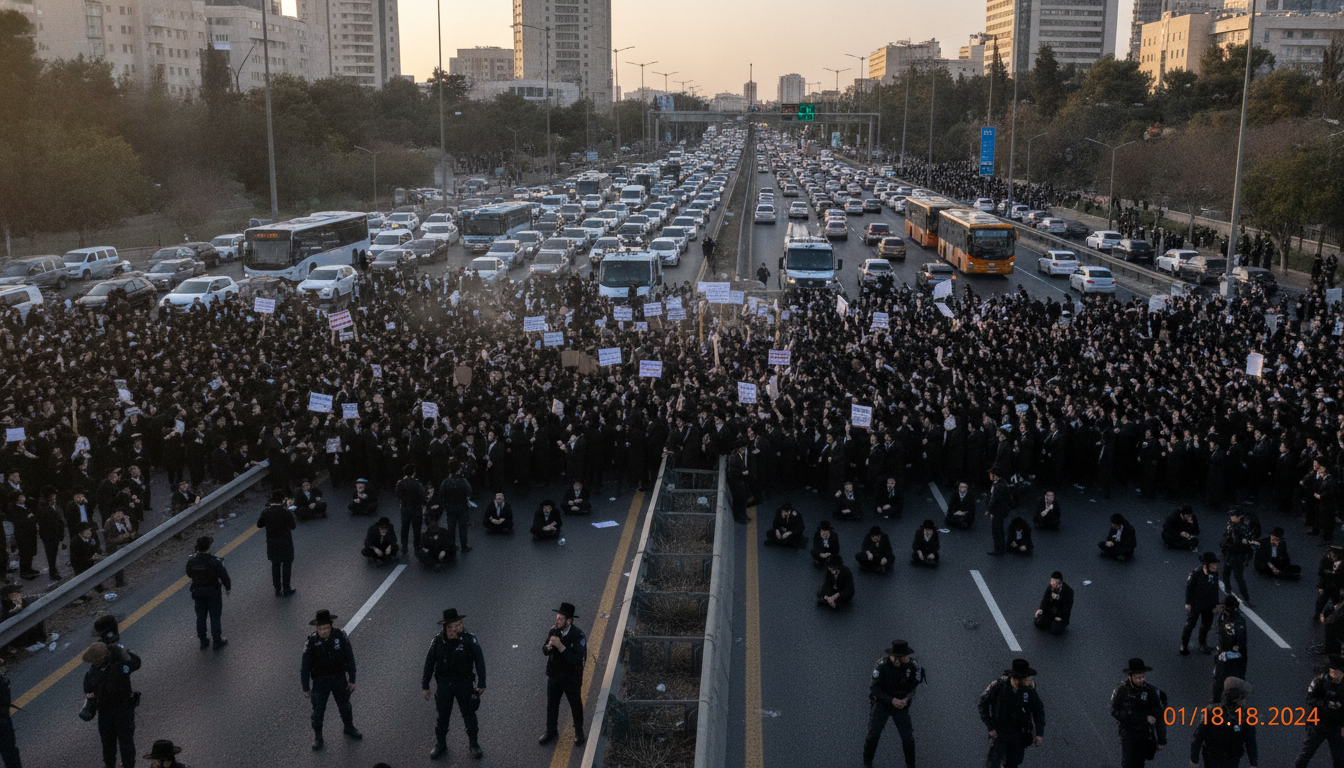
Israel saw thousands of ultra-Orthodox men bring city centres to a standstill this week in protests after fellow community members were detained for refusing military service. The demonstrations, which repeatedly disrupted traffic in Tel Aviv, Jerusalem and other urban centres, have exacerbated an already fraught political crisis over the draft exemption for yeshiva students. The issue — referred to broadly as ultra-Orthodox conscription — has reverberated through parliament, the courts and across Israeli society ahead of national elections.
Mass demonstrations and arrests
Thousands of ultra-Orthodox protesters rallied in central Israel, blocking main roads and closing parts of city centres as police moved to disperse them. Demonstrations intensified after a series of arrests of men accused of refusing conscription, prompting chants and large gatherings that lasted into the night.
Authorities reported dozens of injuries among officers and demonstrators and said scores were detained during clashes. Organisers framed the unrest as a defence of study and religious life, while police emphasised public order and the enforcement of the law.
Clashes and urban disruption
Street-level confrontations have become routine in recent months, with protesters frequently obstructing transport arteries and commuters caught off guard. Business owners and local residents described the disruptions as more than sporadic disturbances, noting repeated blockades in major commercial districts.
Municipal authorities have deployed additional resources to manage traffic and security, and several neighbourhoods experienced temporary closures as police cleared protest sites. The disruptions have added pressure on municipal services already strained by other security concerns.
Coalition manoeuvres and a controversial bill
The political crisis over the draft exemption has prompted urgent action inside the Knesset, where the governing coalition moved to fast-track legislation that would formalise exemptions for ultra-Orthodox students. Party leaders from Shas and United Torah Judaism pressed the government for protections, leveraging their parliamentary blocs to influence the bill’s timetable.
Members of the ultra-Orthodox factions defended the proposal in sharply worded terms, portraying opposition to the exemptions as hostile to religious study. Some lawmakers used incendiary language, accusing critics of persecuting Torah scholars, comments that have deepened divisions in an already polarised political environment.
Supreme Court rulings and legal history
Legal battles over the draft exemption date back more than a decade, with Israel’s Supreme Court repeatedly striking down statutes that granted broad immunity to yeshiva students. In June 2024 the court declared the existing exemption system unlawful and ordered that eligible ultra-Orthodox men be conscripted, a ruling that intensified confrontation between the judiciary, the state and religious authorities.
The number of students holding exemptions has grown dramatically since Israel’s founding, from a few hundred in 1948 to tens of thousands today. That expansion has been a central element in the legal and political debate, with opponents arguing exemptions violate the principle of equality under the law and supporters defending religious study as a form of national service.
Public opinion and demographic pressures
Public sentiment appears to be shifting decisively in favour of drafting ultra-Orthodox men or penalising those who refuse service. Recent surveys indicate roughly four in five Israelis support conscription or sanctions for draft refusal, and a poll by the Israel Democracy Institute found about 85 percent back punitive measures for those who refuse to serve.
Demographic trends are a key part of the controversy. Analysts note the ultra-Orthodox population, currently about 12 percent of the Jewish population, has significantly higher birthrates — commonly reported at eight to 10 children per family — and that share is expected to rise in the coming one to two decades. Critics say that growth will amplify the economic and civic consequences of a large, largely non-serving cohort.
Analysts on politics and religious framing
Scholars and political analysts describe ultra-Orthodox politics as largely reactive, with decisions often taken in response to immediate threats rather than as part of a long-term strategy. Some analysts warn the draft exemption could become a central issue in the impending election, forcing political parties to balance public pressure with coalition arithmetic.
Religious leaders and thinkers within the Haredi community frame full-time Torah study as a communal service that provides spiritual protection for the nation, and some describe state pressure as a form of religious persecution. Legal scholars note that such framings can justify civil disobedience in the eyes of adherents, complicating efforts by the state to apply uniform conscription rules.
The protests and the legislative response illustrate how a single policy — the status of military exemptions for ultra-Orthodox students — has the capacity to reshape campaign dynamics, inflame social tensions and challenge institutions. As parliament debates the bill and the courts remain a focal point of contention, the standoff over ultra-Orthodox conscription is likely to remain a defining fault line in Israeli politics in the run-up to the national election.
