
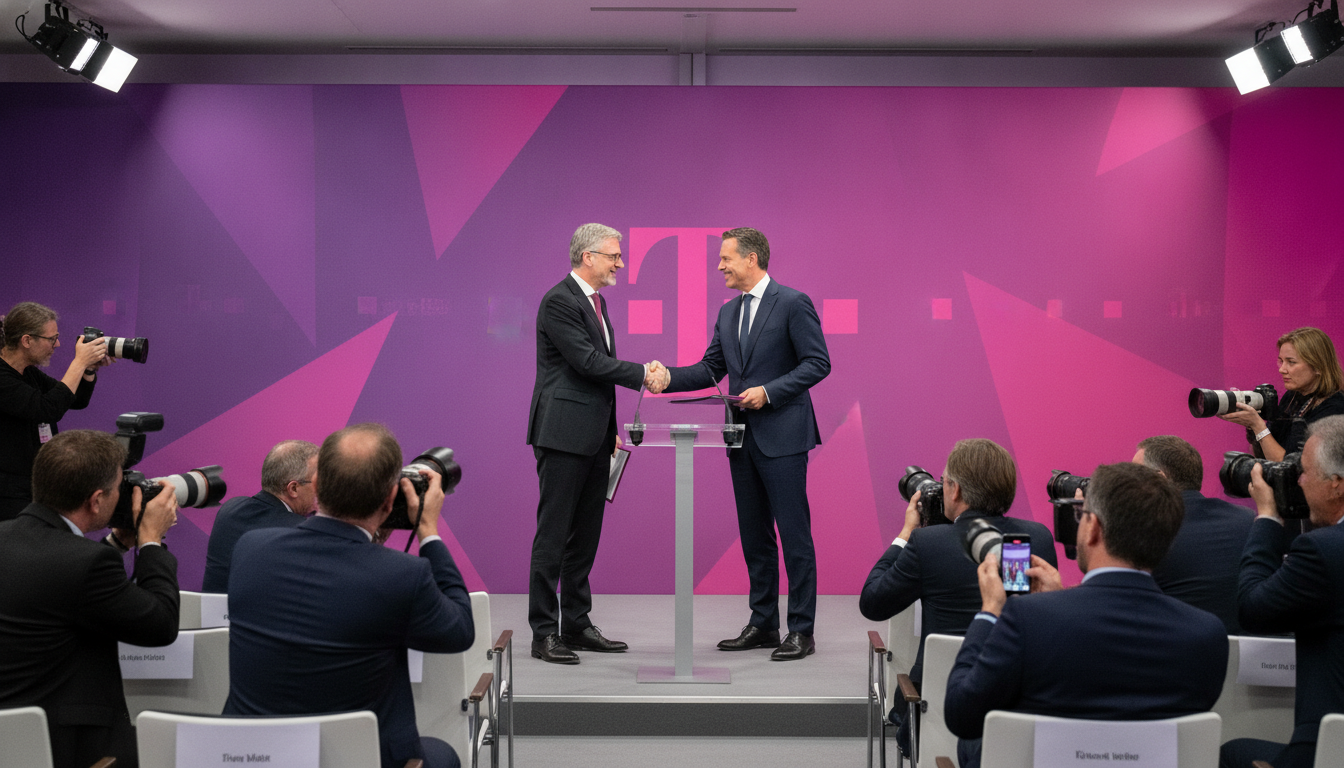
Deutsche Telekom holding plan advances as Timotheus Höttges pilots small specialist team
Deutsche Telekom holding plan: CEO Timotheus Höttges is assembling a specialist team to explore a structure that would unite Deutsche Telekom and T‑Mobile, according to four insiders cited by Handelsblatt.
The company’s CEO has tasked a compact group with evaluating a potential holding vehicle that would bring the German parent and its U.S. subsidiary under a single corporate umbrella. Insiders say the initiative is in an early but active stage and is being prepared with legal, tax and corporate-governance workstreams.
Höttges directs a compact advisory team
The CEO has ordered a small, specialist team to craft the proposal, according to reporting by Handelsblatt and multiple people with knowledge of the matter.
Those involved are reportedly focused on technical structuring rather than immediate public announcements, suggesting the initiative remains confidential within senior management.
Proposal would create a single holding for Deutsche Telekom and T‑Mobile
The model under consideration would place Deutsche Telekom and its U.S. unit, T‑Mobile, beneath one holding company to unify governance and strategic decision-making.
Proponents say a holding could streamline capital allocation between the two operating groups and provide a clearer framework for cross-border investment and corporate strategy.
Strategic motivations behind the holding move
Executives see several potential advantages from a holding arrangement, including simplified oversight of the U.S. business and greater flexibility in deploying capital across markets.
A unified holding could also change how investors value the combined entity, possibly narrowing the discount between the parent and subsidiary share prices by presenting consolidated financials and a singular strategy.
Financial and tax engineering under review
Advisers working on the plan are reportedly examining tax implications, balance-sheet effects and the mechanics of consolidating financial reporting.
Any structure would need to address cross-border tax rules and accounting treatment in both Germany and the United States, and must weigh the impact on debt, credit ratings and dividend policies.
Regulatory and antitrust considerations in two jurisdictions
A combined holding spanning large European and U.S. telecom assets would attract scrutiny from regulators on both sides of the Atlantic.
Officials in Germany, the EU and U.S. agencies would likely evaluate the plan for competition implications, national-security considerations and compliance with telecommunications rules. Early regulatory outreach is expected to be a vital element of the process.
Investor and market implications being assessed
Large institutional investors and minority shareholders will play a pivotal role in any transaction, analysts and advisers say, because changes to corporate form can shift voting rights and distributions.
Market reaction could hinge on perceived clarity of governance, the prospect of improved returns and any transitional costs associated with reorganizing the companies. Share-price moves will likely reflect evolving expectations as more detail emerges.
Next steps and possible timeline for the initiative
Insiders emphasize that the initiative is exploratory and that no final decision has been made, with management still evaluating legal, tax and regulatory pathways.
If the proposal advances, the company would likely present options to its supervisory board, engage external advisers and begin preliminary regulatory consultations before any public disclosure or shareholder vote.
This exercise signals Deutsche Telekom’s willingness to consider material changes to its corporate architecture as it seeks to optimize value between its German operations and the U.S. business.
