
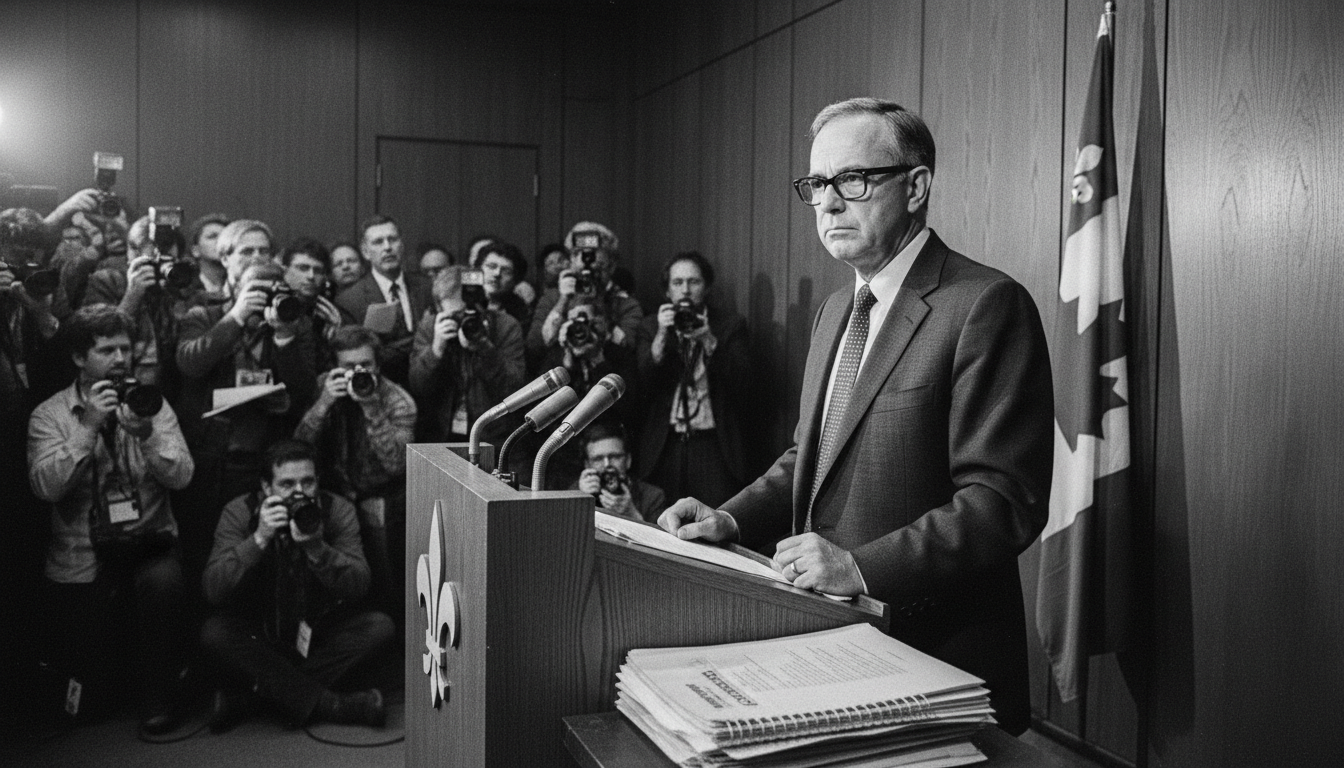
Claude Morin, Quiet Revolution organizer, dies at 96
Claude Morin, Quiet Revolution figure, has died at 96. His public service, role in nationalization and Parti Québécois strategy reshaped Quebec politics.
Claude Morin, a central actor of Quebec’s Quiet Revolution who served five premiers and helped reshape provincial policy and international outreach, has died at the age of 96. Known for his transition from academic to senior public servant and later as a Parti Québécois strategist, Morin left a record of major reforms and polarizing controversies. His death prompts renewed assessment of a career that combined institutional building, policy craftsmanship and long-running political disputes.
A leading figure of the Quiet Revolution
Claude Morin emerged from the postwar generation that transformed Quebec institutions and public life. Trained as an academic in economics and social welfare, he moved from the university lecture hall into the machinery of government as Quebec sought greater control over its affairs. Across the 1960s and 1970s he became closely associated with efforts to expand provincial authority and modernize the province’s social and economic infrastructure.
From professor to senior civil servant
Morin studied at Université Laval and furthered his training in New York before returning to Quebec to teach and, eventually, advise senior politicians. He began drafting speeches and policy texts for Jean Lesage’s government and was appointed under-secretary for federal-provincial affairs in the early 1960s. For more than eight years he worked at the centre of intergovernmental negotiations, developing the administrative capacity that would underpin later reforms.
Championing provincial powers and nationalization
In government circles Morin was an ardent defender of provincial jurisdiction and played a role in the broader campaign that led to major structural changes, including the nationalization of electricity. He worked to recover powers from Ottawa and to build Quebec’s external relations, arguing that stronger provincial institutions were essential for the province’s economic and political autonomy. His efforts put him at odds with federal ministers and at times provoked direct interventions from Ottawa.
Parti Québécois strategist and the referendum plan
Morin joined the Parti Québécois in the early 1970s and became a key strategist within a party that combined moderates and hardliners. He is often credited with promoting a staged approach to sovereignty — favoring incremental steps and a referendum only after consolidating electoral support. That strategy helped the PQ win government in 1976 and shaped the party’s conduct leading into the 1980 referendum on sovereignty-association.
The 1981 constitutional rupture and its aftermath
Morin was among the Quebec ministers who travelled to Ottawa for federal-provincial talks that culminated in the November 1981 agreement to patriate the Canadian Constitution without Quebec’s consent. The “night of the long knives,” as it became known, left deep scars in Quebec politics and hardened Morin’s opposition to the federal handling of constitutional reform. He resigned his seat in late 1981 and returned to academia in the following months, but the constitutional rupture remained a defining episode of his public life.
Allegations of collaboration and a divided legacy
A persistent controversy shadowed Morin’s career: allegations that he had provided information to the Royal Canadian Mounted Police in the 1970s. The claims, widely chronicled in books and press reports, split opinion within political circles and among historians, with some seeing him as an intermediary safeguarding Quebec interests and others condemning the contacts as an unacceptable compromise. Morin maintained he acted in the province’s interest, and he spent later decades defending his record in a series of memoirs and essays.
Morin returned to teaching at the École nationale d’administration publique in the 1980s and published numerous books reflecting on his years in public life, offering both explanatory accounts and polemical defenses. Colleagues and successors from across the political spectrum acknowledged his role in shaping Quebec institutions, even as debate continued over his methods and choices. Quebec’s current premier, Christine Fréchette, released a statement praising his role during a formative period in the province’s history and marking the end of a long public career.
Claude Morin’s life combined intellectual curiosity, administrative skill and political audacity, and his death renews public conversation about a generation that remade Quebec’s relationship with Canada and the wider world.
