
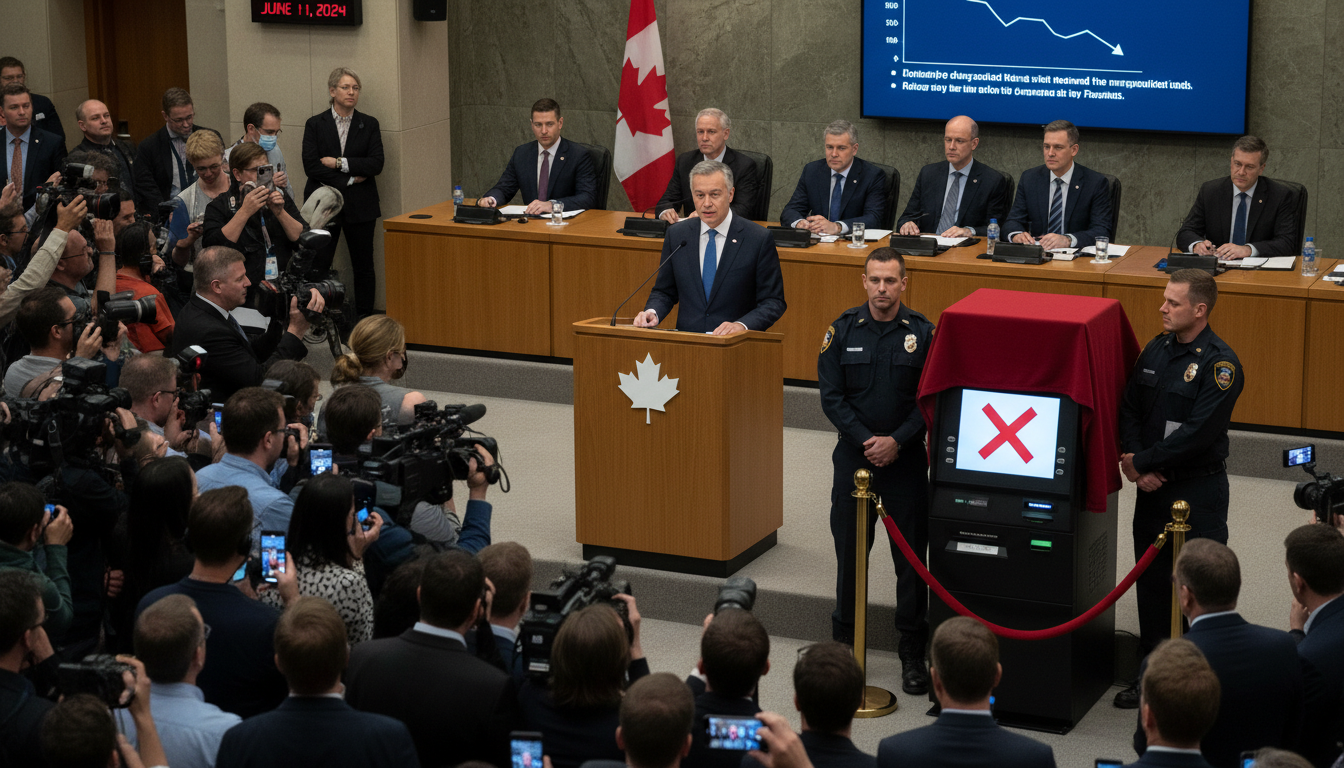
Federal government to ban cryptocurrency ATMs, citing spike in fraud and money‑laundering
Ottawa to ban cryptocurrency ATMs, calling them a primary conduit for fraud and money‑laundering while tightening oversight of money services providers.
Federal government announces ban on cryptocurrency ATMs
The federal government announced in its economic statement that it will ban cryptocurrency ATMs across Canada, describing the machines as a key tool used by fraudsters and criminals to launder cash. The statement said the measure aims to disrupt a prevalent channel for scams and to strengthen protections for Canadians who use virtual currencies. Finance officials signalled that existing money services businesses will remain able to serve customers in person but will face stricter safeguards.
The announcement underscores growing concern from federal regulators about how quickly cash deposited at these machines can be converted into untraceable digital assets. Officials cited analyses by the Financial Transactions and Reports Analysis Centre of Canada (FINTRAC) indicating the machines have become a primary mechanism for extracting funds from victims of scams.
How cryptocurrency ATMs are used in scams
Crypto ATMs allow users to insert cash and convert it into cryptocurrencies that can be sent instantly to digital wallets anywhere in the world. That speed and the low identity requirements make the machines attractive to fraudsters who pressure victims to pay in cash and then transfer funds via crypto.
Industry investigators and media reports have documented numerous cases in which victims were directed to purchase cryptocurrency at ATMs and send funds to accounts controlled by scammers. Because many transactions under specified thresholds require only a phone number and not a full identity check, tracing and recovering stolen funds is often difficult or impossible.
Scale of the network and Canada’s position
Canada hosts nearly 4,000 cryptocurrency ATMs, data cited by the government show, giving the country the highest number of these machines per capita in the world. Globally, regulators estimate there are more than 39,000 crypto ATMs, but the concentration in Canadian cities has drawn particular scrutiny.
Operators have installed machines in shopping centres, convenience stores and other public locations, advertising ease and anonymity for buyers. That ubiquity, officials say, has turned what was once a niche service into a widespread vector for financial crime.
Regulatory gap under existing money‑services rules
Until now, crypto ATM operators in Canada were regulated under the country’s broader money services business framework, which covers currency exchange, cash services and wire transfers. The government said those rules did not adequately address the speed and anonymity of ATM-based crypto transactions.
The economic statement said Ottawa will move to amend the regulatory regime so that money services businesses — including those offering virtual currencies in physical locations — are subject to stronger anti‑money‑laundering and counter‑terrorist-financing obligations. The changes are intended to give authorities better tools to detect suspicious activity and to protect legitimate businesses from exploitation.
International responses to crypto ATMs
Other jurisdictions have taken a range of approaches to the machines. The United Kingdom implemented a licensing system in 2021 that has effectively prevented new crypto ATM operators from obtaining approvals. New Zealand has proposed an outright ban, while Australia recently imposed daily transaction limits at many machines.
In the United States, roughly half of states have considered or enacted laws requiring controls such as daily transaction ceilings, fee caps and obligations for operators to reimburse victims of fraud. Policymakers abroad have increasingly viewed physical crypto kiosks as higher‑risk points of entry for illicit finance compared with regulated digital exchanges.
Impact on consumers, retailers and operators
The federal ban will remove a readily accessible option for Canadians who use cash to buy cryptocurrencies, pushing some transactions toward regulated online exchanges and in‑person services at licensed money services businesses. The government said consumers will still be able to obtain virtual currencies through ESM locations that comply with heightened protections.
Retailers that host ATMs and companies that install and operate the kiosks will need to wind down services or transition to other permitted activities, which could include offering education about regulated channels for buying crypto. Enforcement details, timelines and potential compliance assistance for small businesses were not laid out in full in the initial statement.
The government also indicated it will consult with provincial regulators, law enforcement and industry stakeholders to design practical implementation and to limit unintended consequences for legitimate users.
Recent statements from the Finance Minister stressed the government’s intent to balance innovation with public safety, while acknowledging that swift action is necessary given the rising number of reported scams. Media investigations by CBC and Radio‑Canada that documented patterns of abuse were cited by officials as part of the evidence base for the policy shift.
The ban marks a significant step in Canada’s approach to emergent financial technologies and follows international trends toward tighter controls on physical access points for cryptocurrency purchases.
The coming weeks are expected to clarify when the ban will take effect, how operators must comply, and what remedies will be available for victims of crypto ATM fraud.
