
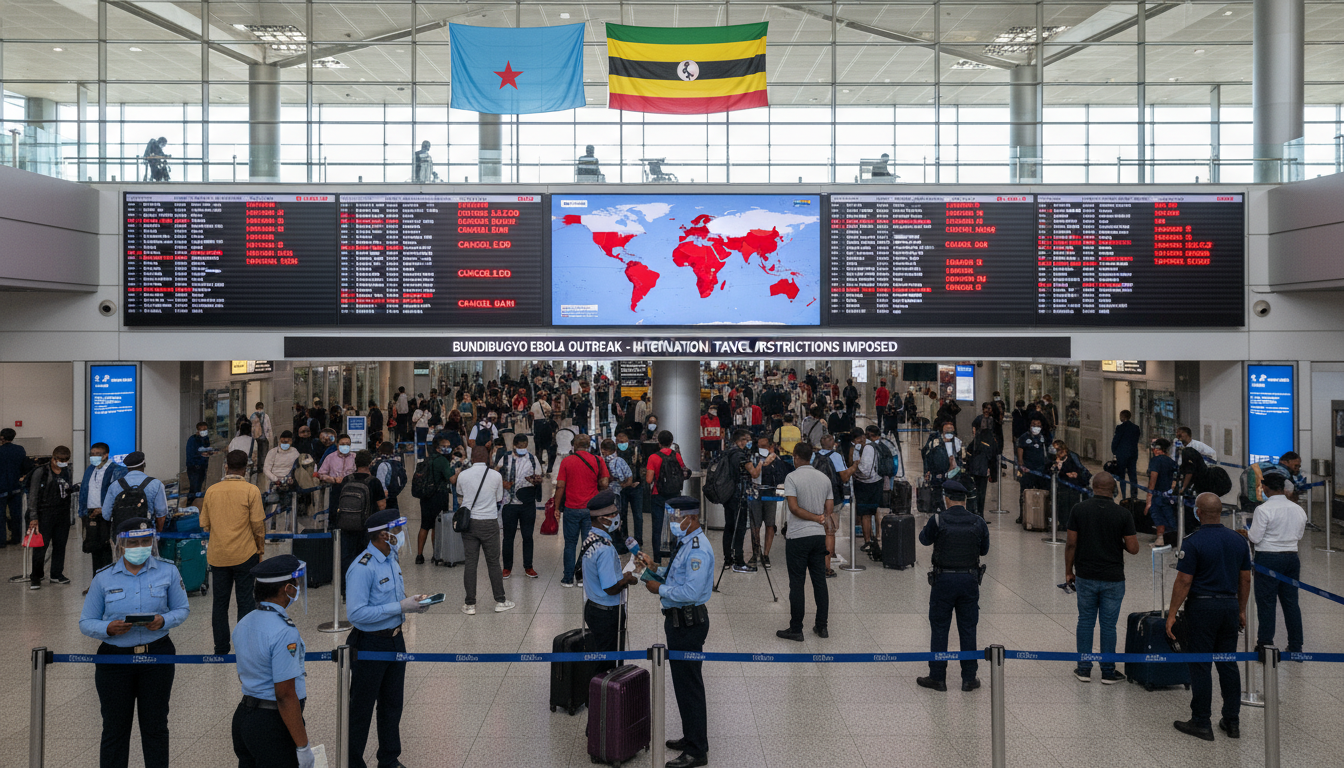
Canada imposes travel bans as Bundibugyo strain of Ebola spreads in DRC and Uganda
Canada imposes travel bans and quarantines as the Bundibugyo strain of Ebola spreads in DRC and Uganda; WHO raises national risk and scales up response.
The World Health Organization reports a widening outbreak of the Bundibugyo strain of Ebola across eastern Democratic Republic of the Congo and into Uganda, prompting travel bans and quarantine rules from multiple governments. Kinshasa declared the outbreak on May 15, and the WHO has since recorded confirmed and suspected cases that have led national authorities to enact movement restrictions. Canada announced a 90-day travel ban on residents from the DRC, Uganda and South Sudan and ordered a 21-day quarantine for travellers arriving from affected areas beginning May 30.
Outbreak overview and case figures
The current outbreak centres on the Bundibugyo (BVD) strain, a less common but highly lethal species of Ebola virus that causes severe haemorrhagic fever. In the DRC authorities have logged dozens of confirmed deaths and hundreds of suspected fatalities and cases since mid-May, with the WHO raising its national risk assessment to very high. Uganda has confirmed several cases and at least one death linked to the same strain, signalling cross-border transmission.
The WHO continues to assess the global risk from the outbreak as low, but its decision to elevate national-level risk has driven intensified surveillance and response activities by affected countries. Health officials stress that delays in detection have allowed the epidemic to accelerate, complicating efforts to contain it in the early weeks.
Domestic movement and border measures in the DRC and Uganda
In the DRC the Ministry of Transport and Communications suspended flights to and from Bunia in eastern provinces to limit spread inside the country, while allowing humanitarian and medical flights under strict approval. Eleven Congolese health zones are affected, and authorities say movement curbs and local market suspensions are among the tactics being used to reduce transmission.
Uganda has halted direct flights from the DRC and paused bus and boat crossings for four weeks, also suspending weekly cross-border markets in districts along the frontier. Essential cargo, food and freight are exempted to protect supply chains, but travel restrictions are intended to reduce the frequent close contact that drives Ebola transmission.
International travel bans and quarantine orders
Several countries outside the region have adopted temporary entry restrictions this month. Canada announced residents of the DRC, Uganda and South Sudan will be barred from entry for 90 days, and that Canadian citizens, permanent residents and other foreign nationals who have been in affected areas must quarantine for 21 days starting May 30. The Bahamas put in place a 30-day restriction on arrivals from the same list of countries, subject to review by its health ministry.
The United States earlier prohibited non-citizens who had travelled to the DRC, Uganda or South Sudan in the previous 21 days and subsequently extended that bar to certain lawful permanent residents. The U.S. also designated a limited set of airports for enhanced screening of returning citizens and residents as part of its containment strategy.
U.S. screening protocols and planned quarantine capacity
U.S. authorities have directed travellers from affected areas to return through specified hubs equipped for heightened health screening. Those airports were identified for flights departing after specific May dates to concentrate screening resources and reduce the chance of undetected cases entering the general travel network. Reports indicate U.S. public health personnel may be positioned in nearby countries to staff quarantine facilities for exposed or symptomatic Americans, reflecting contingency planning beyond immediate border controls.
Officials emphasize that these measures are precautionary and that no cases have been recorded in Canada, the Bahamas or the United States to date. Governments stress vigilance at points of departure and arrival while balancing the need to maintain essential travel and supply routes.
WHO and local public health response in affected countries
The WHO and national ministries report expanding operations on contact tracing, establishing treatment centres, and reinforcing infection prevention and control in health facilities. WHO leadership has said teams are scaling up rapidly but acknowledged that delayed detection has meant responders must accelerate efforts to stay ahead of transmission chains. Local partners and international agencies are mobilizing diagnostics, personal protective equipment and clinical care capacity.
Containment hinges on rapid identification of cases and safe management of patients and burials, public-health officials say. Because Bundibugyo spreads through close contact with bodily fluids and contaminated surfaces, limiting direct contact and improving hygiene in communities and health facilities remain pillars of the response.
Aviation guidance and assessment of travel risk
The International Civil Aviation Organization and U.N. agencies have urged adherence to pandemic-era aviation protocols designed to reduce disease spread, including electronic health declarations and contactless border procedures. ICAO has indicated that, at present, international flights can continue but recommended exit screening in affected countries as a more effective approach than broad entry bans.
Airlines and governments were encouraged to follow established public health practices developed during previous outbreaks, focusing on identifying unwell departing passengers rather than blanket border closures that can hinder the delivery of humanitarian aid and medical supplies.
The Bundibugyo strain has prompted a coordinated mix of local containment efforts and international precautionary measures. Health authorities in the DRC and Uganda continue active case-finding and community outreach while WHO and partner organisations provide technical support and resources to slow transmission. By concentrating screening at points of departure and sustaining essential freight routes, officials aim to limit spread without severing critical aid lines to affected populations.
