
Ardley Reservoir plan draws sharp local criticism at Red Deer consultation
Ardley Reservoir consultation in Red Deer sparks concerns over land loss, water security and transparency as Alberta advances a scoping and feasibility study.
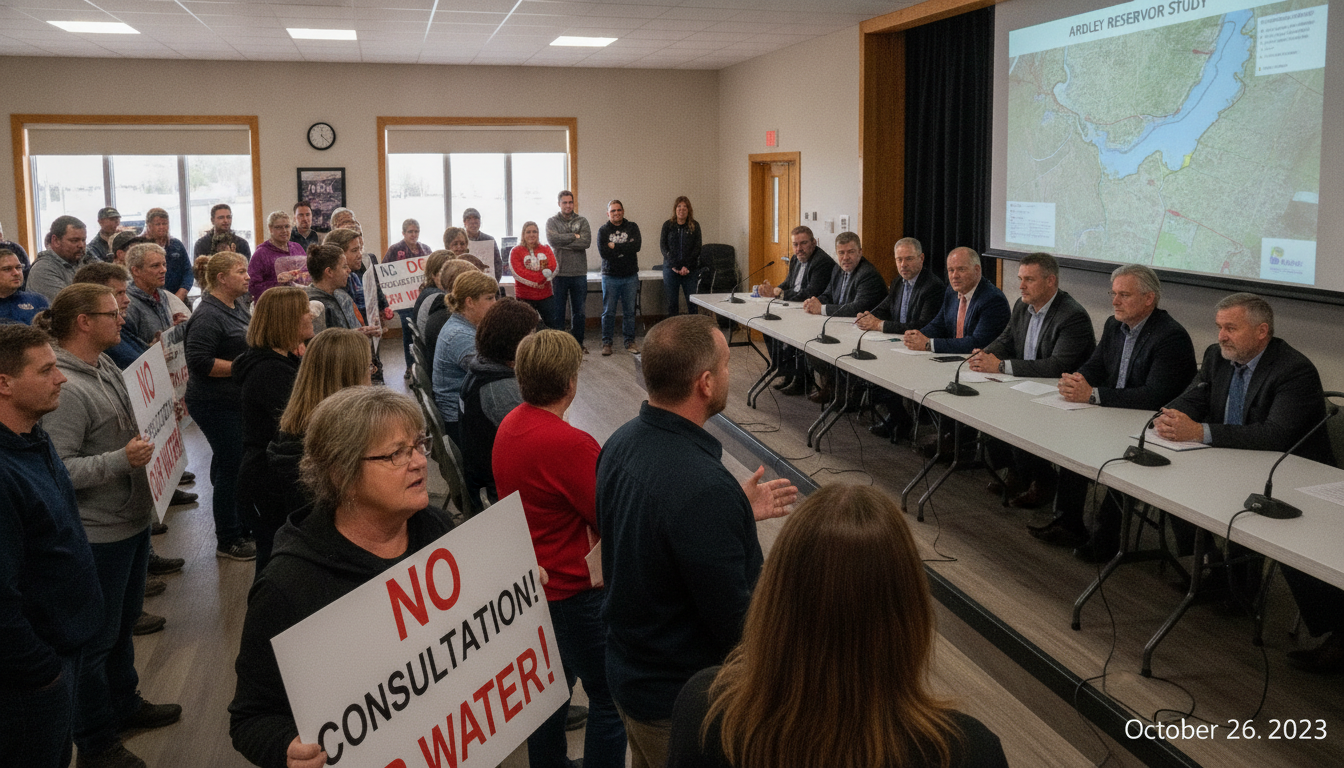
The Alberta government’s scoping and feasibility study for the Ardley Reservoir drew dozens of residents to a public session in Red Deer on July 14, 2026, where many said they left unconvinced and unheard.
The proposed Ardley Reservoir, sited near the hamlet of Ardley roughly 40 kilometres east of Red Deer, is being evaluated by the province as a potential way to boost water storage and resilience in the Red Deer River basin.
Attendees raised questions ranging from potential flooding and property loss to environmental impacts and what the stored water would be used for, while some criticized the format and transparency of the consultation.
Public consultation in Red Deer drew dozens to Gasoline Alley
The province hosted a presentation and small-group discussions at a hotel in Red Deer’s Gasoline Alley that attracted a cross-section of local residents, municipal leaders and community groups.
Organizers opened with a slideshow outlining three proposed reservoir configurations and then directed participants into corner stations where they could speak with government staff and leave written feedback.
Officials said the session was one element of broader public engagement tied to the scoping and feasibility study, but several attendees told reporters they felt key information was missing and their concerns were not adequately addressed.
Residents raise fears about land loss and flooding
Several property owners who live along the proposed river valley said they would lose significant portions, or the entirety, of their land under each of the three options being considered.
One resident who reviewed the materials before the meeting said she discovered her property sits within the footprint common to all scenarios and described the prospect of displacement as devastating.
Others warned a new dam could inundate agricultural ground and homesteads, erode riverbanks and change local flooding patterns in ways that are not yet fully modelled by the study team.
Consultation format and transparency come under fire
Some attendees criticized the use of sticky notes and small corner conversations as inadequate for a project with major local consequences.
Citizens and accountability groups said the lack of an open-mic question period and the absence of elected officials at the event reduced opportunities for substantive public exchange.
A local transparency advocate highlighted concerns about follow-up: participants wanted clear information on how feedback would be compiled, who would see it and how it would influence the next steps of the study.
Officials describe the study and next procedural steps
The provincial government described the exercise as part of a scoping and feasibility study intended to evaluate whether the proposed project could deliver economic and environmental value.
Officials say the study includes fieldwork, environmental assessment scoping and consultations with Indigenous communities, municipalities, property owners and other potentially affected stakeholders.
Government communications note that if the project advances, it would be subject to more detailed regulatory processes, including a formal environmental impact assessment and further public engagement.
Questions about water supply, drought resilience and proposed uses
A key line of debate at the sessions focused on the basic hydrology of the Red Deer River and whether there is sufficient inflow to sustain a reservoir without harming downstream ecosystems.
Some local landowners and ranchers warned that declining groundwater and surface flows could leave a constructed reservoir with limited supply during extended dry periods.
Concerns were also raised about potential end users of stored water, with participants asking if allocations would favour irrigation, municipal supply, industrial users or new projects such as proposed data centres.
Environmental advocates warn of habitat and ecological impacts
Environmentalists at the consultation stressed that the river valley supports wildlife including deer, moose and raptors and contains biologically significant habitat that could be fragmented or lost by inundation.
Speakers asked for comprehensive ecological baseline studies before any decision and pointed to possible impacts on bird migration, riparian vegetation and wetland function.
Local conservation advocates said the benefits of irrigation for a small number of users must be weighed against long-term losses to biodiversity and public access to the valley.
Municipal leaders and nearby counties seek clarity and data
Elected officials from Red Deer County and Lacombe County attended the session and described it as an early opportunity to understand the project’s scope and potential municipal impacts.
County leaders who live along the river said the consultation highlighted the need for detailed reports that explain who stands to gain, who will be affected and what mitigation measures the province would consider.
Municipal officials signalled they may intensify advocacy efforts depending on the study’s findings and the degree of impact to roads, services and municipal lands.
Indigenous and stakeholder engagement flagged as essential by government
The province’s statement on the process indicates consultations are being held with Indigenous communities and organizations alongside other stakeholders.
Officials emphasised that feedback from these discussions will be considered when evaluating whether to advance the project to a subsequent development stage.
Local groups, however, urged that Indigenous engagement be early, sustained and transparent, with clear mechanisms for incorporating Indigenous knowledge and priorities into environmental assessment work.
Data centres and industrial demand fuel community questions
Several participants raised the prospect that new industrial or data centre developments could be a driver for increased water storage capacity in the region.
Community members asked for explicit figures on potential future water demand from proposed facilities, and whether the reservoir would primarily support private or public interests.
Those opposed or sceptical called for a demand analysis that lists projected users, volumes and allocation rules before any land-use decisions are finalized.
Residents report limited direct contact with surveyors and planners
Some property owners said they had not been contacted directly by provincial engineers or planners about on-site surveying, despite living within the potential footprint of the reservoir options.
Those who would be affected asked for one-on-one consultations that address compensation, relocation and the timeline for any acquisition of land rights.
Residents requested clear points of contact at the ministry overseeing the study and regular updates so they are not left uncertain about possible next moves.
Health services minister and local MLA say elected officials need to be present
A local MLA who also serves in cabinet told a separate event she had not been aware of the consultation until after it took place and said elected representatives should be present at future public sessions.
The MLA said having elected officials at consultations would help capture constituent concerns and ensure those issues are brought back to the legislative caucus and decision-makers.
She also told reporters she did not believe there was ill intent behind the setup of the event and urged that future engagement be arranged so that public questions can be addressed directly.
Study scope includes environmental fieldwork and regulatory screening
According to the provincial briefing, the feasibility study has already included environmental fieldwork and initial assessments of likely regulatory requirements.
Government statements stress that any project advanced by the province must comply with the same environmental rules and processes that apply to third-party developments.
If the project moves forward, officials say a more detailed environmental impact assessment would be launched, providing opportunities for technical review and further public input.
Local advocacy groups demand stronger accountability mechanisms
Citizen-led initiatives present at the session said they will continue to press for transparent documentation of what was heard at the consultation and how it was used.
Advocates asked for the province to publish a compiled report of consultation feedback, timelines for when survey data will be analyzed and clear commitments on follow-up engagement.
They also called for accessible technical data — including hydrological models and environmental baseline reports — to be released so community members and independent experts can review assumptions.
Potential social and economic trade-offs get front-and-centre attention
Speakers at the meeting debated the balance between enhancing drought resilience and the socioeconomic costs to those who live in the river valley.
Farmers, recreational users and conservationists described the valley as a shared public and private resource whose value extends beyond immediate economic metrics.
County officials said any cost-benefit analysis should account for long-term ecological services, tourism and local livelihoods in addition to projected agricultural or municipal gains.
Next steps and timelines remain dependent on the study’s findings
The province has not announced a firm timeline for a decision on whether to proceed beyond the scoping phase, saying that further work would follow if the feasibility study indicates net benefits.
Observers at the consultation said they will watch for a written summary of engagement outcomes and for the release of more detailed study components in the coming months.
Stakeholders expressed the expectation that any advancement to design or construction stages would trigger formal environmental assessment processes and separate rounds of public consultation.
While the Ardley Reservoir scoping exercise is positioned by the province as an early-stage assessment of water-security options in the Red Deer River basin, local reaction at the July 14 session made clear the project’s social, environmental and governance implications are a source of deep concern.
Residents who could be displaced, municipal leaders, environmentalists and accountability groups said they need more detailed hydrological data, clearer disclosure of potential water users and a transparent mechanism for compiling and responding to public input.
Provincial officials maintain the study includes environmental fieldwork and stakeholder engagement and that statutory assessments would follow if the project advances, but many in the room called for elected officials and technical experts to be more present and for follow-up reports to be published promptly.
As the feasibility process continues, the debate over the Ardley Reservoir will likely hinge on how well the province can demonstrate that the proposed benefits outweigh the costs to landowners, ecosystems and local communities, and on whether the public process evolves to satisfy demands for clarity and accountability.
