
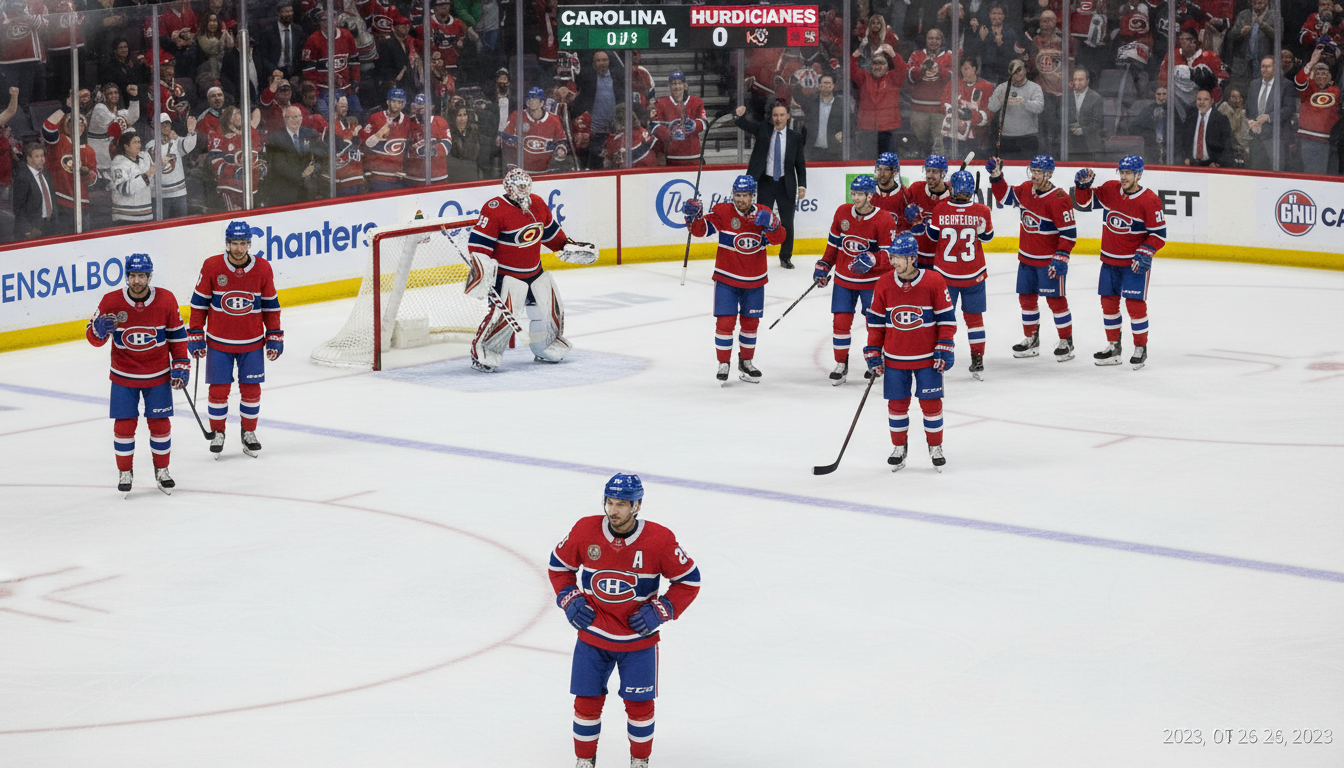
Montreal Canadiens Stifled by Hurricanes’ High Pressure in 4-0 Game 4 Loss, Now Trail 3-1
Montreal Canadiens shut out 4-0 by Carolina Hurricanes in Game 4, trailing 3-1 in the East Final; coach and players point to turnovers, fatigue and pressure.
The Montreal Canadiens were thoroughly outplayed in Game 4, falling 4-0 at the Bell Centre and dropping to a 3-1 deficit in the Eastern Conference Final. The loss exposed recurring turnovers, an inability to sustain possession and what coach Martin St. Louis described as crushing, man-on-man pressure from the Carolina Hurricanes. Goaltender Jakub Dobes made 39 saves while his teammates struggled to generate consistent offense, and the Canadiens’ post-season home record slipped to a troubling mark. With the series shifting to Carolina, Montreal faces a steep task to regain momentum and a fragile locker-room psyche.
Game 4 scoreline and immediate fallout
The Canadiens never recovered from an early three-goal deficit and managed only a final flurry that produced their first legitimate shot in the closing minutes. Carolina’s structure and stick work turned routine entries into turnovers and created multiple high-danger chances off mistakes. St. Louis acknowledged adjustments were made during the middle period that improved chances, but the team unraveled again in the third. The result left Montreal searching for answers as the series moves to Raleigh.
Turnovers and pressure defined the night
From the opening minutes, Montreal’s puck management broke down under Carolina’s pressure, gifting the Hurricanes sustained momentum. The visitors engineered a series of turnovers that led directly to nearly double-digit quality scoring opportunities in the first period alone. Players repeatedly failed to complete two passes in sequence, allowing Carolina to smother support options and capitalize on mistakes. That pattern—errant plays under duress—became the dominant narrative of the game.
Coaching moves, brief response, then collapse
Martin St. Louis said he made tactical changes in the second period intended to counter the Hurricanes’ forecheck, and those moves momentarily produced more Montreal chances. For a stretch the Canadiens pressed higher and showed improved puck retrieval, suggesting some of the issues were correctable within a period. However, the third period saw the team lapse in all three zones, with chances evaporating and urgency replaced by caution. The split between tactical intent and execution left the coaching staff with limited options ahead of Game 5.
Rest, fatigue and the broader playoff context
The physical and mental toll of two consecutive seven-game series appeared to surface against a Carolina club that arrived with more rest. The Hurricanes enjoyed an extended break after sweeping their earlier opponents, while Montreal had to exhaust itself through lengthy series. That contrast translated into sharper forechecking and quicker recovery on the puck for Carolina, advantages that compounded late in the game. Montreal veterans and coaches both referenced the cumulative wear as a factor, though they emphasized it does not excuse the turnovers.
Player perspectives and the psychological battle
Captain Nick Suzuki and other players stressed belief and desperation as necessary ingredients for a comeback, recalling past postseason rallies as proof that momentum can shift. Suzuki said the team must adopt a desperate mindset to force doubt into Carolina’s game, and Alex Newhook insisted Montreal still possesses the skill to break through tight coverage. Dobes, despite the shutout loss, framed the night as a closed chapter and focused attention on preparation for the road. Those remarks underscore the dual task ahead: tactical corrections and mental reset.
Path forward before Game 5
To have a chance in Raleigh, the Canadiens must simplify decisions with the puck, use skating to create space and re-establish quick support to break the Hurricanes’ pressure. St. Louis emphasized that the player with the most ice must be willing to take it and that quicker feet and off-puck movement are necessary to bypass opposing sticks. Practical adjustments include earlier, cleaner exits from the defensive zone, more direct shooting when lanes appear and limiting low-value passes that invite turnovers. Above all, Montreal must stitch together a full 60 minutes of cohesive structure to swing the series.
The challenge is both practical and psychological: Montreal must stop producing self-inflicted errors and rebuild confidence while facing a team that has matched its physical identity with clinical execution. If the Canadiens can address the fundamentals outlined by their coach and players, they can at least force Carolina to play under pressure of its own in front of a partisan crowd. The upcoming Game 5 will reveal whether Montreal’s response is tactical, emotional—or decisive.
