
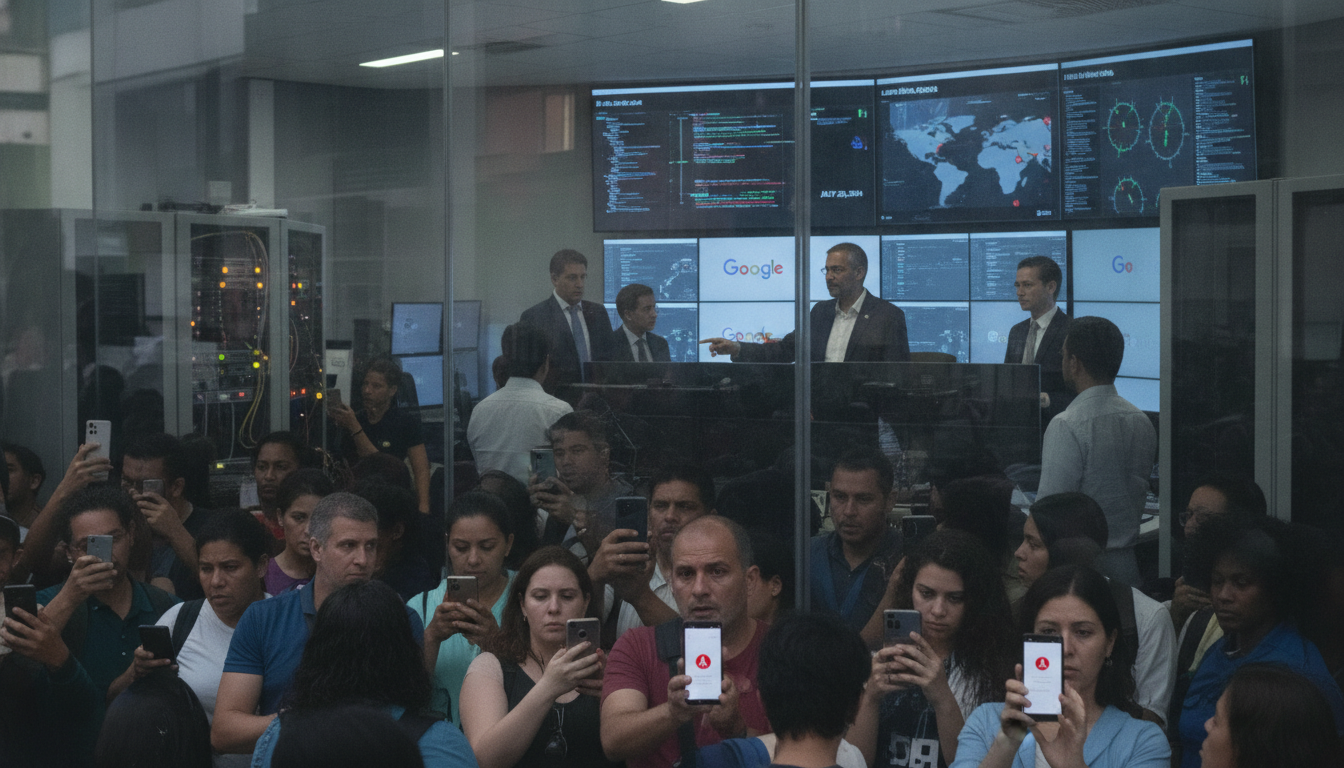
Android earthquake alerts warn 11.4 million as two powerful quakes hit Venezuela
Android earthquake alerts warned 11.4 million people in Venezuela on Wednesday, giving many seconds of advance notice before two powerful quakes struck and relying on phone accelerometers to detect early P‑wave signals.
Android earthquake alerts reached millions within seconds
Google’s Android earthquake alerts reached an estimated 11.4 million users on Wednesday as seismic activity rattled populated areas of Venezuela. The company said its system pushed a range of warnings, including about 1.4 million of its most severe “Take Action” alerts to people in zones expected to experience the strongest shaking. The alerts are delivered automatically to Android phones in affected regions when the system’s servers determine there is sufficient data indicating a quake.
The alerts came in a country that does not have a national government-operated early warning network, highlighting how smartphone-based detection can extend alerts into areas without traditional sensor arrays. Google attributes the system’s reach to the global prevalence of Android devices, which run on roughly 70 percent of smartphones worldwide.
How phone accelerometers detect P‑waves
Android earthquake alerts use the tiny motion sensors already built into most phones to sense the earliest seismic signals known as P‑waves. These primary waves travel faster and are typically less damaging than the subsequent S‑waves, but they provide the first detectable hint that an earthquake has begun. When stationary phones — for example, sitting on a table or in a bag on the floor — register the characteristic vibration pattern, they anonymously send short snippets of data to Google’s servers for analysis.
The system aggregates readings from many phones to confirm an event and estimate its location and magnitude. For reliability, phones must be still; motion from a person walking or a device in a pocket can mask seismic signatures. Google’s engineers have also built in continuous recalibration so the system can refine its estimate as more data arrives.
Seconds mattered: a timeline of detection and alerts
Phones in the quake zone sensed the P‑waves within seconds of the event beginning underground, according to Google engineers involved in the system. In some cases three seconds elapsed before phones detected the initial waves at the surface, and within about six to nine seconds the network had enough corroborating data to identify an earthquake and begin sending alerts. Over the next several seconds the system updated magnitudes and expanded the alert region as it processed incoming signals.
Those precious seconds translated into different warning times depending on distance from the epicenters. People farther from the source of the quake tended to receive alerts earlier, while those closest often got notifications as shaking was already starting. Google’s system is designed to keep updating its estimates and send follow-up alerts as the situation evolves.
Powerful twin quakes and the scope of the event
The two earthquakes that triggered the alerts were large, with the first measured at magnitude 7.2 and the second at magnitude 7.5. Google said the second was the most powerful quake to hit Venezuela since 1900, and its detection system classified many areas as subject to intense shaking. The company’s alerts are configured to trigger for estimated local magnitudes of 4.5 and above, and to use escalating messaging — from cautionary beeps to urgent “Take Action” alarms — based on expected intensity.
Because the epicenters lay beneath densely populated regions, phones across wide swathes of territory picked up signals and relayed them for processing, allowing the system to expand its alert footprint as the events unfolded. Google engineers noted that overlapping waves from the two quakes could make the system interpret them as a single, larger event for some recipients.
Personal accounts underscore alert impact and confusion
For some residents the alerts were the first indication of an earthquake. Jose Flores and his family, driving in Caracas to see a film, said his wife’s Android phone emitted a loud alert seconds before they felt shaking. They initially mistook the motion for the city’s frequent road bumps, only realizing the severity when streetlights and trees began to sway. Flores later said that now that he understands the alerts he will act more quickly in future events.
Not everyone immediately recognized the meaning of the notifications, and officials cautioned that having seconds of advance notice is useful only if recipients know how to respond. Emergency guidance commonly advises people to “drop, cover and hold on” before shaking starts, and specialists say even brief warnings can provide time to seek immediate protection.
Phone-based alerts supplement traditional early-warning networks
Several countries maintain government-run early warning systems that rely on regional networks of seismometers and official alert channels that reach both iPhone and Android users. Where those networks exist, they typically provide broad, government-verified warnings; where they do not, phone-based systems can plug critical gaps. Google began rolling out Android-based earthquake alerts in 2021, initially in a handful of countries, and expanded the service to dozens more in subsequent years.
Researchers published a paper in 2025 assessing the system’s performance and geographic spread, and Google says its detection capability now operates in nearly 100 countries. The company emphasizes that phone-based detection is an augmentation rather than a replacement for dedicated seismic networks, and that combining data from multiple sources yields the most robust early-warning coverage.
The tremors in Venezuela on Wednesday demonstrated both the promise and the limits of smartphone-based early warnings: they can reach millions rapidly and give people actionable seconds, but their effectiveness depends on device distribution, phones being stationary, and public preparedness to respond when an alert arrives.
Emergency responders and technology teams continue to refine messaging and algorithms to improve accuracy and reduce false alarms, while advocates urge governments to invest in traditional seismic networks alongside these newer digital tools.
Despite uncertainty about whether the warnings saved lives during this event, officials and residents said the alerts provided crucial information at an uncertain moment and could increase protection if people learn to respond promptly to the notifications.
