
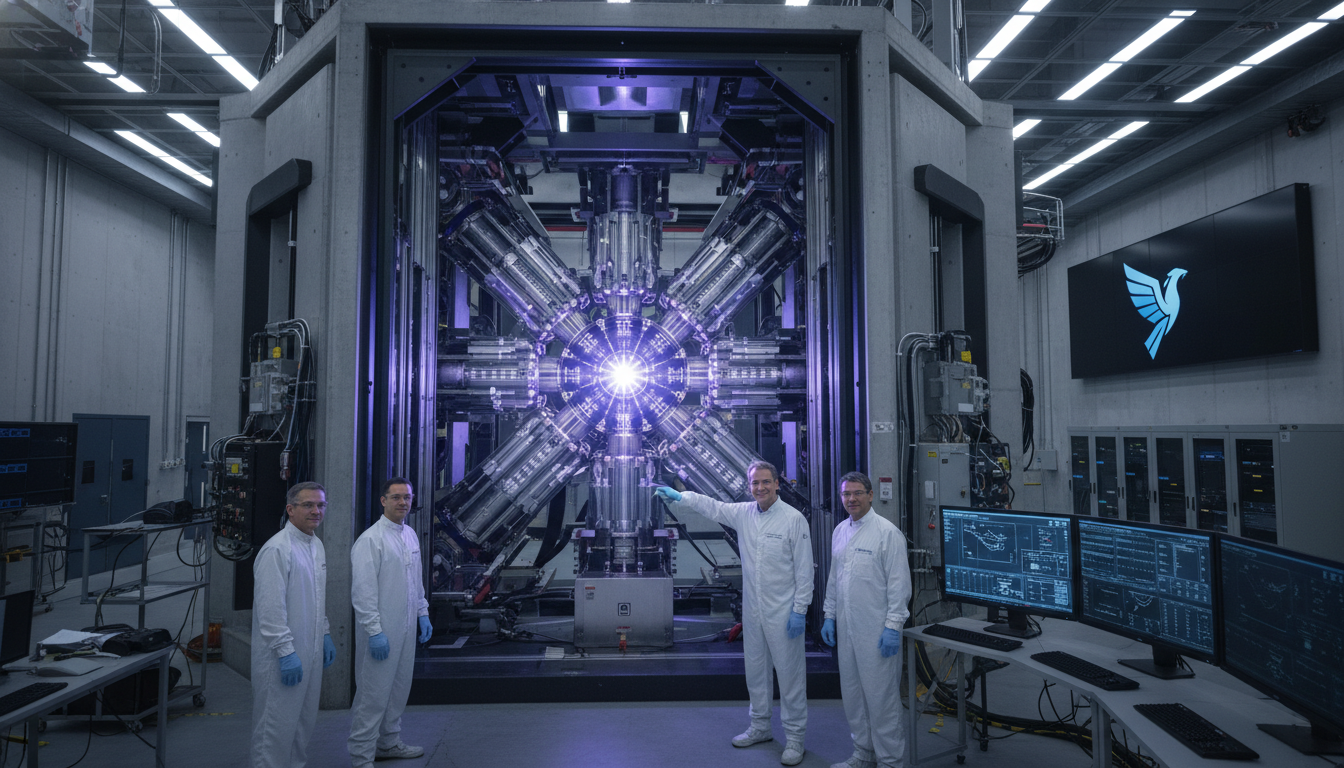
Xcimer Phoenix laser goes live as startup powers up largest private fusion laser
Xcimer Energy switches on the Phoenix laser, the largest private fusion laser, advancing scaled excimer-driven inertial fusion toward commercial power.
Xcimer Energy announced it has activated its Phoenix laser system, a major milestone for the startup’s pursuit of inertial fusion energy. The Xcimer Phoenix laser is being presented by the company as the most powerful laser privately owned anywhere, and the system will be used to test scaled excimer-driven approaches to compressing fusion fuel. Company engineers say Phoenix is a step toward building lasers capable of driving a commercial fusion power plant.
Facility startup and immediate goals
The Phoenix system was brought online to initiate a program of high-energy laser tests aimed at validating Xcimer’s compression and pulse-delivery concepts. Early runs will focus on laser stability, pulse shaping and the optics needed to convert laser light into the intense, short bursts required for fuel compression. The company intends to use the results to refine its design for larger, megajoule-class systems that would be necessary for energy-producing fusion.
Phoenix will operate as a research and development platform rather than a power-generating unit, according to Xcimer’s public statements. The system’s tests are designed to close technical gaps around timing, uniformity and the rapid energy transfer needed to trigger fusion reactions efficiently. Data from the facility will inform subsequent prototypes and scalability studies.
Design inspired by NIF ignition experiments
Xcimer’s approach draws on the conceptual blueprint proven by large inertial fusion experiments in recent years, where multiple laser beams compress a tiny fuel target until fusion conditions are reached. Rather than replicate a 192-beam architecture, Xcimer aims to achieve the required X-ray drive and implosion dynamics with fewer, more powerful pulses and a different laser technology. The company argues this route could reduce system complexity and lower the cost per shot as the concept moves toward commercial deployment.
The National Ignition Facility’s demonstration that a controlled fusion reaction could reach ignition remains a reference point for many in the field. Xcimer positions Phoenix as an experimental bridge between large government facilities and an economically viable plant by testing whether excimer-laser-driven compression can produce comparable compression and symmetry at reduced system scale.
Laser technology and system specifications
Phoenix uses excimer amplification in a krypton-fluoride configuration, a laser chemistry familiar in semiconductor processing but scaled to much higher energy. The startup reports the core amplifier chain measures roughly 38 meters in length and that individual pulses can exceed one kilojoule of energy at current settings. Those performance figures place Phoenix among the most energetic privately owned laser systems, while still far below the megajoule-class energies projected for a commercial plant.
Xcimer’s concept couples microsecond-scale pulse generation with a downstream compression stage that delivers the energy to the fuel target in nanoseconds. The company’s engineers emphasize that faster, higher-power compression increases the chance of producing usable fusion reactions by improving peak pressure and temperature within the target capsule.
Scaling from kilojoule tests to megajoule plants
Although Phoenix can generate kilojoule-level pulses, Xcimer acknowledges a commercial fusion power plant would require energies in the multiple-megajoule range per shot. The firm describes Phoenix as a necessary intermediate step to demonstrate pulse quality, repetition rate, target injection and the diagnostics required to confirm fusion burn behavior. Scaling those results to a system that can repeat at utility-relevant cadence remains the principal technical challenge.
Engineering a pathway from single-shot physics experiments to an industrial power station also involves secondary systems such as heat extraction, tritium handling, target fabrication and plant economics. Xcimer’s public roadmap places prototype completion around 2028, with a commercial demonstration expected in a subsequent phase that could occur in the early-to-mid 2030s if technical milestones are met.
Timeline and development milestones
Xcimer has laid out a multi-stage plan beginning with Phoenix verification and diagnostic campaigns, followed by a prototype demonstration in the latter half of the decade. The company’s medium-term objective is to build and test a larger system capable of producing as much energy as it consumes under controlled conditions. A successful net-energy demonstration would be a crucial inflection point for investment, regulatory engagement and broader industry interest.
The timeline remains aspirational and contingent on achieving key technical results during the Phoenix test program. Each step will need to demonstrate reproducible results at higher energy, acceptable operational durability and a route to reduce per-shot costs for any eventual power plant.
Technical and commercial hurdles ahead
Experts in fusion and laser engineering note several obstacles remain before excimer-driven inertial fusion can be commercialized. Scaling amplifier chains to megajoule energies, managing debris and damage to optical components, and developing a target supply chain capable of high cadence are major engineering problems. Economic questions about capital intensity, plant availability and cost per kilowatt-hour will also determine whether any laser-driven fusion approach can compete with other low-carbon energy sources.
Xcimer faces competition from alternative fusion architectures and large national laboratories, each pursuing different pathways to the same objective: a commercially viable source of fusion electricity. Success will depend on converting laboratory physics into robust engineering designs and demonstrating that those designs can scale affordably.
Xcimer’s activation of the Phoenix laser marks a measurable advance in its experimental program and provides researchers with a platform to gather the data necessary for next-stage engineering decisions. The coming years of testing will offer clearer signals about the technical viability and commercial prospects of excimer-driven inertial fusion.
