
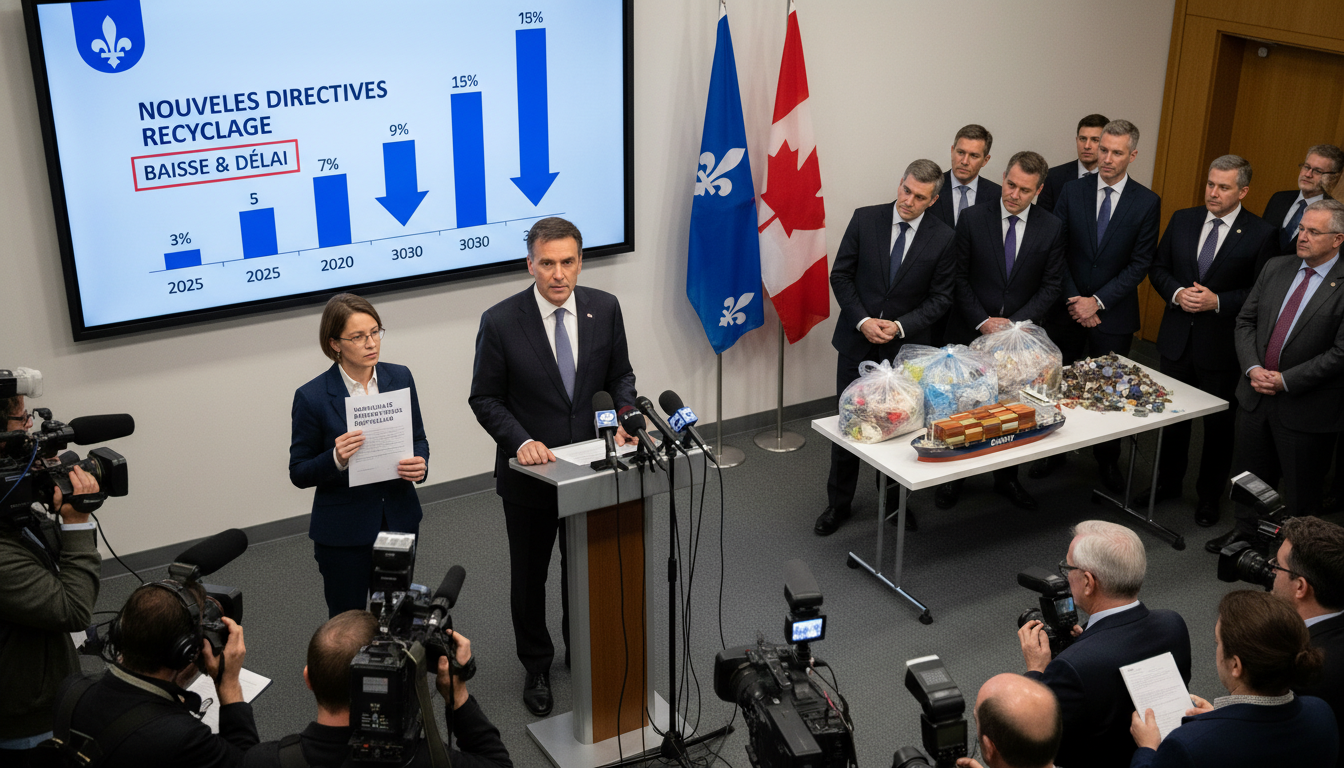
Quebec delays recycling targets to 2030, prompting industry alarm
Quebec delays recycling targets to 2030, lowering 2027 goals and prompting industry warnings about landfill exports and weakened local recycling capacity.
Quebec’s decision in March 2026 to lower and postpone the province’s recycling targets has sparked sharp concern from the recycling industry. The move — which pushed previously scheduled targets from 2027 to 2030 — follows the transfer of selective collection management to Éco Entreprises Québec in January 2025. Industry groups warn the change could reduce the volume of materials recycled within Quebec and increase exports or landfill disposal.
Government postpones 2027 targets until 2030
The Legault government formally delayed the enforcement date for several recycling performance targets in March 2026, citing a need for a more measured transition. Targets that had been set to take effect in 2027 were downgraded and given a new implementation date of 2030. Officials say the adjustment is intended to ease financial pressure on businesses and allow additional time to scale up the system.
The move included a deferral of obligations that would have extended selective collection to multi-unit residential buildings, as well as to commercial and institutional generators. The government’s written statement framed the changes as pragmatic, arguing that a revised timeline would make the objectives more achievable and predictable. Critics say the shift undermines earlier commitments to boost local recycling and reduce landfill input.
Industry groups warn of more landfill and exports
Recycling trade groups and environmental advocates immediately signalled alarm at the decision, saying lower targets will likely translate into fewer materials processed domestically. Kevin Morin, director-general of the Conseil des entreprises en technologie environnementale du Québec (CETEQ), warned the reduction in recovery and valorization rates may have a domino effect on local recycling volumes. He expressed concern that materials may be sent abroad or to landfill rather than being transformed in Quebec.
Karel Ménard of the Front commun pour une gestion écologique des déchets went further, suggesting some Quebec recyclers could face insolvency if feedstock volumes fall and commodity prices remain depressed. Industry representatives argue that predictable, ambitious targets are necessary to attract investment, modernize facilities and support circular-economy jobs across the province.
Éco Entreprises Québec defends revised, “realistic” goals
Éco Entreprises Québec (EEQ), the not-for-profit designated by government to manage and fund selective collection, supported the decision to lower and delay targets. EEQ’s chief executive, Maryse Vermette, said the original regulation contained objectives set several years earlier that now appear overly ambitious. She argued that targets must reflect the current state of local processing capacity to avoid collecting materials for which no domestic market exists.
Vermette acknowledged gaps in Quebec’s recycling infrastructure and said some materials are still processed outside the province, including aluminium. EEQ has called on the provincial government to invest in local recycling capacity so materials collected in Quebec can be given a second life within the province or country.
Businesses pressed over rising system costs
The government and EEQ said one purpose of the postponement was to relieve the financial burden on product manufacturers and other companies that contribute to the system under extended producer responsibility rules. Several businesses had raised concerns about higher costs associated with the new selective collection framework since EEQ took over management in January 2025. The cabinet of Environment Minister Pascale Déry described the timeline change as a way to align costs with a realistic ramp-up for the system.
Industry representatives counter that while cost concerns are legitimate, lowering targets risks sending mixed policy signals that could deter long-term investments in recycling technologies and eco-design. They say clear, consistent targets are necessary for manufacturers to plan product and packaging redesigns that make materials easier to recycle.
Recyclers call for targeted public investment
Recycling operators and sector advocates are urging Quebec to pair any regulatory easing with direct investments in processing infrastructure. They argue that without capital and incentives to build or upgrade plants, Quebec will remain reliant on foreign markets to absorb recyclable commodities. Several voices pointed to aluminium and certain mixed plastics as examples of materials often exported because local processing capacity is insufficient.
Calls include public funding for new facilities, loan guarantees for plant modernization and procurement policies that prioritize products made with recycled content. Proponents say such measures would help create stable demand for processed materials and attract private investment that the industry says is currently at risk.
Political and economic stakes for Quebec’s circular economy
The policy shift has reopened debate about Quebec’s wider circular-economy ambitions, with critics saying delayed targets contradict previous government promises to develop recycling capacity at home. Supporters of the change argue a phased approach will reduce disruption and allow time to build the necessary industrial base. Both sides agree that the outcome will hinge on investment decisions in the coming months.
As implementation timelines extend toward 2030, the sector faces a test: whether government, EEQ and the private sector will marshal funding and strategic planning to keep materials in the provincial economy. The next year is likely to determine whether lower near-term targets become a temporary pause or the start of a longer-term recalibration that reshapes Quebec’s recycling landscape.
