
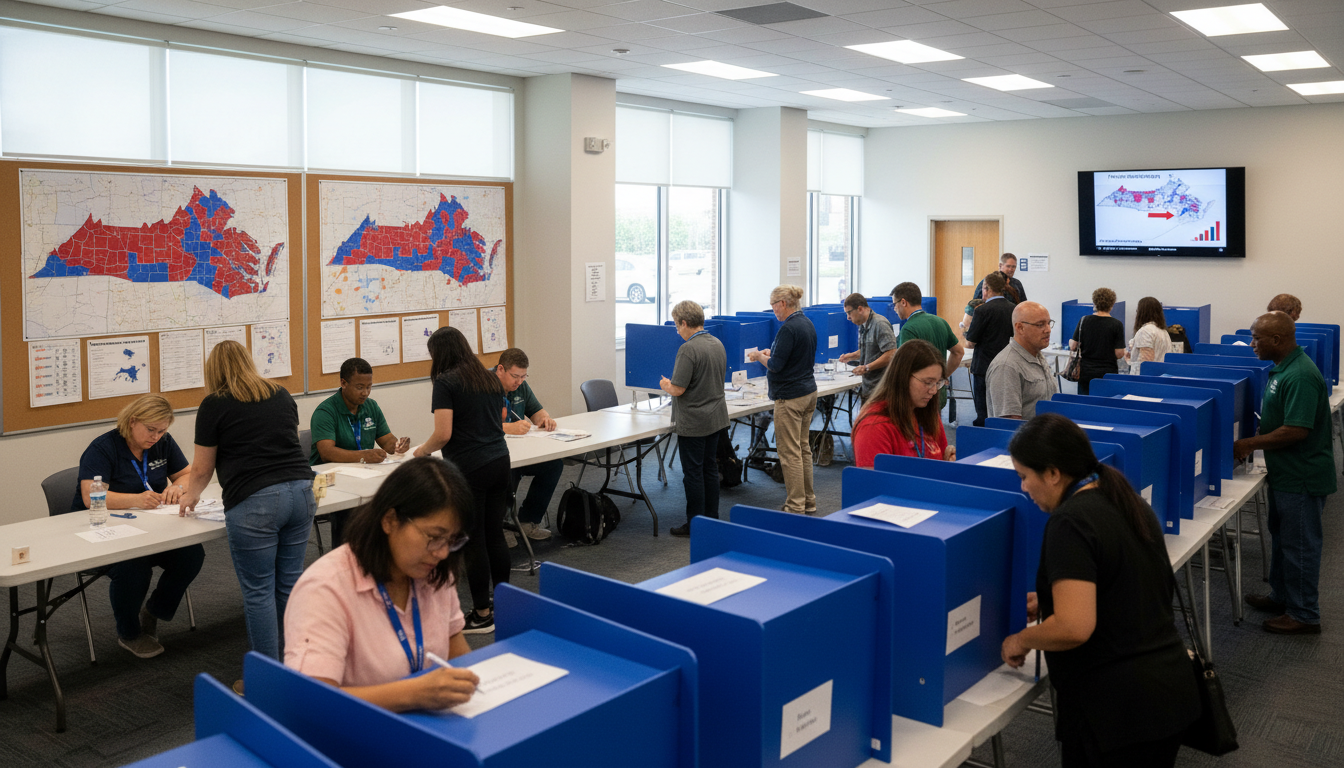
Virginia redistricting approved by voters, potentially shifting House balance
Virginia redistricting approved by voters may shift multiple House seats to Democrats, intensifying the 2026 midterm fight and prompting legal challenges.
Virginia voters approved a referendum to redraw the state’s congressional map, a move that analysts say could deliver several additional seats to Democrats and reshape the 2026 midterm landscape. The Virginia redistricting decision comes amid a burst of mid-decade map changes across the United States that party strategists say will reverberate through national politics. Legal challenges are already underway in state courts, and the outcome will determine when the new lines are finally applied.
Voters approve Virginia redistricting
The referendum passed with enough support to clear the way for a new congressional map that backers argue corrects partisan distortions. State officials say the revised boundaries aim to reflect population shifts and legal rulings, while opponents contend the change is a politically motivated effort to alter representation mid-cycle. Observers estimate the new map could net Democrats between two and four additional House seats, a range that would materially affect narrow margins in Congress.
Public reaction in Virginia was sharply divided but decisive, with advocates framing the vote as a restoration of competitive districts. Critics, including some national Republican figures, accused proponents of exploiting procedural loopholes to tilt the playing field. The implementation timetable remains uncertain while litigants press their cases through the courts.
How the map could change House math
Political forecasters say the Virginia redistricting outcome tightens an otherwise fragile pathway for Republicans to retain control of the U.S. House. Analysts point to a scenario in which several competitive districts become reliably Democratic, reducing the number of genuine toss-ups in November. That shift would force both parties to reallocate resources and revise campaign strategies in battleground states.
Current midterm models show a narrow distribution of leaning districts that leaves control up for grabs, and adding Democratic-leaning seats in Virginia would increase pressure on Republican incumbents nationwide. Party operatives warn that even modest seat swings can cascade into broader national consequences, shaping committee control and legislative agendas for the final years of the presidential term.
Legal battles and court questions
The new Virginia map is already the subject of multiple legal challenges that are being heard by the state Supreme Court, potentially delaying implementation. Plaintiffs argue procedural defects and claim the referendum violated state constitutional provisions, while defenders maintain the process complied with legal standards. A pending judicial decision will determine whether the map stands for the 2026 cycle or is put on hold pending further review.
At the same time, the U.S. Supreme Court is set to consider cases with far-reaching implications for how race and representation factor into district drawing. One high-profile case will test the application of the Voting Rights Act to majority-minority districts in the South, a decision that could open the door to more aggressive map redraws elsewhere. Those federal rulings may either constrain or embolden states considering mid-decade changes.
Republican strategy and moves in other states
Virginia’s decision shifts attention to other states where Republicans have pursued or are considering mid-decade redistricting as a way to enlarge their House numbers. Earlier actions in states such as Texas, Missouri, North Carolina and Ohio produced new maps that parties expect will add seats to their totals. Florida stands out as the next major battleground, with state leaders scheduled to discuss redistricting in a special legislative session set for April 28.
Republican leaders argue these efforts are a legitimate exercise of political authority to reflect population and partisan realities. Democrats counter that the wave of mid-decade redraws amounts to a partisan arms race that degrades voter influence. Campaign chiefs on both sides are preparing for high-stakes contests should new maps be enacted in key states.
Experts warn of norm erosion and gerrymandering risks
Political scientists and reform advocates describe the recent flurry of redistricting as a break from decades of practice, raising alarms about a new era of reciprocal gerrymandering. Critics warn that if mid-decade redraws become commonplace, competition will decline and voters will have less meaningful choice. Academics involved in mapping projects say both parties are engaging in retaliatory tactics that could institutionalize extreme partisan maps.
Some analysts emphasize the immediate impact on voter representation, noting that engineered districts can pack or crack communities to dilute opposition voices. Others stress the long-term institutional damage, arguing that repeated map fights can erode trust in democratic processes unless checked by courts or new rules.
Calls for independent commissions and federal reforms
In response to the upheaval, reformers are renewing calls for independent redistricting commissions to take line-drawing out of partisan hands. A handful of states already use such commissions, and proponents say independent bodies produce fairer, more stable maps and reduce litigation. Lawmakers on both sides have occasionally signaled openness to reforms, particularly when partisan tactics backfire electorally.
Some experts suggest Congress could enact national standards or incentives for independent commissions to curb mid-decade swings. Others say federal intervention faces political hurdles but note that mounting public frustration with partisan maps might create rare bipartisan momentum for change.
The Virginia redistricting vote has moved the battle over congressional maps from state capitols to courtrooms and national campaign headquarters, and the final outcome will hinge on litigation and strategic choices in other states. As legal decisions and follow-up sessions play out in the coming weeks, the contest over who draws the lines—and who benefits from them—will remain central to the fight for control of the U.S. House in 2026.
