
6.0 Gulf of California earthquake rattles region, USGS says
A 6.0-magnitude Gulf of California earthquake struck on Tuesday, June 30, 2026, with shaking felt across coastal and offshore areas, the United States Geological Survey reported. The quake occurred at 1:45 p.m. Mountain time approximately 47 miles (75 kilometres) southwest of El Progreso, Mexico, and seismologists continue to review data that may refine the initial magnitude. Early shake maps indicate limited severe shaking near the epicentre but show perceptible motion over a wider area.
Epicentre and timing
The United States Geological Survey located the epicentre in the central Gulf of California about 47 miles southwest of El Progreso, Mexico, with the initial reading placed at 1:45 p.m. Mountain time on June 30, 2026. That offshore position means the strongest ground motions were concentrated at sea and along nearby coastlines rather than inland population centres. Seismologists cautioned that the agency may update the magnitude and exact depth as additional seismic records are processed.
Magnitude estimate and potential revision
The USGS initially reported the event as a magnitude-6.0 earthquake, a size capable of causing damage near the epicentre but typically less destructive at that strength when centred offshore. Scientists routinely revise preliminary magnitudes as more stations report data and algorithms are refined, and officials said further adjustments remain possible. The agency noted that the shake-severity map and other outputs will be updated as aftershock information and refined analyses become available.
Shake map and observed intensity
Preliminary shake maps circulated alongside the USGS bulletin showed areas with a shake intensity of 3 or greater on the Modified Mercalli Intensity scale, which the agency classifies as “weak” shaking. Those maps incorporate population overlays and other geospatial data to estimate which communities may have felt the tremor, and they were current as of 2:02 p.m. Mountain time on June 30, 2026. Analysts warned that intensity contours can change when aftershocks are included or when local site conditions are better characterised.
Aftershocks and ongoing monitoring
USGS monitoring teams reported that aftershock sequences were being tracked within a 100-mile radius and over the subsequent seven days, with aftershock data current as of 3:01 p.m. Mountain time on June 30. Aftershock patterns following a magnitude-6 event commonly produce numerous smaller quakes in the hours and days that follow, and authorities urged residents in affected coastal regions to remain alert. Specialist networks in the United States and Mexico will continue automated and manual reviews to refine locations, magnitudes and the evolving hazard picture.
Local reports and preliminary impacts
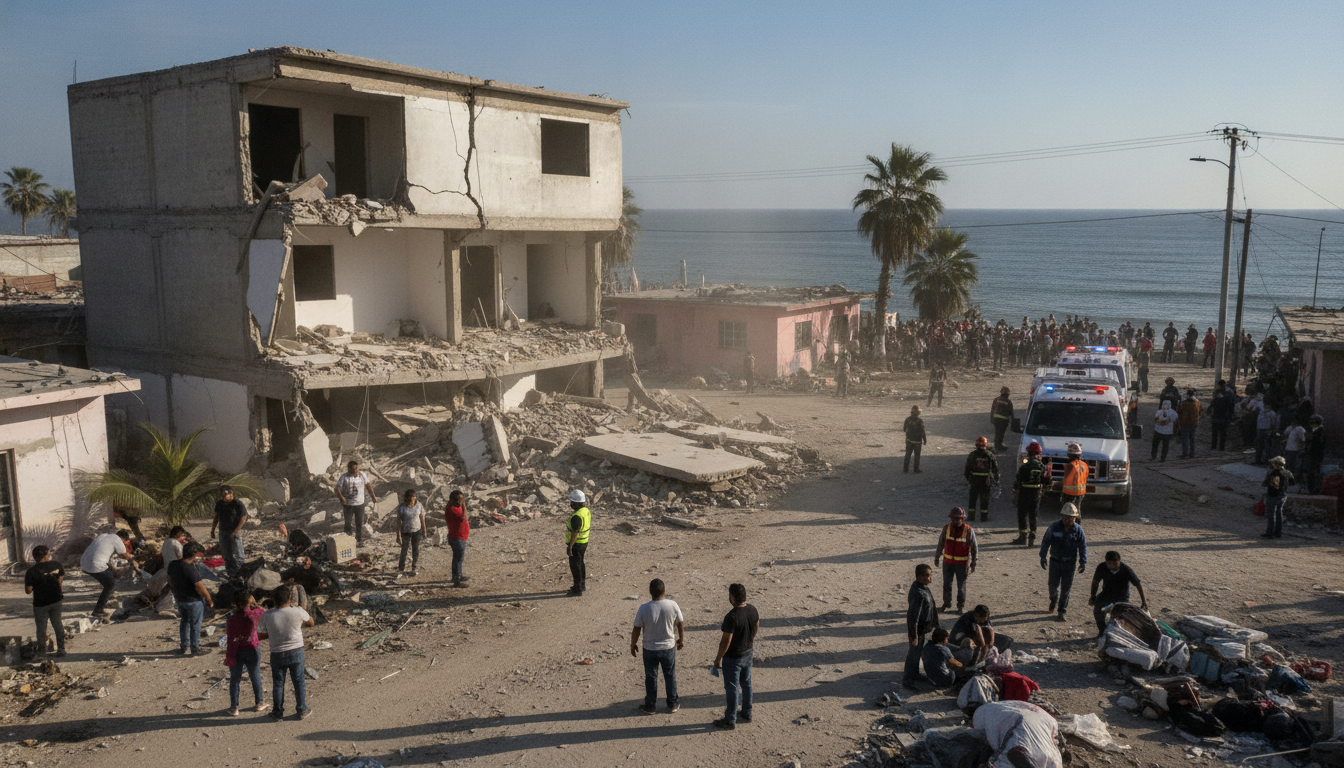
Because the epicentre was offshore, initial reports indicated limited infrastructure damage along the immediate Mexican coastline, though local authorities and community members were asked to report any structural or utility issues. Emergency management agencies in neighbouring municipalities were placed on heightened watch to assess coastal effects and to respond to any damage or service disruptions. No consolidated national damage assessment was available in the first hours after the quake, and agencies stressed that field surveys would be needed to confirm any localized impacts.
Scientific context and regional seismicity
The Gulf of California lies along active plate boundaries where the Pacific and North American plates interact, and the region has a history of moderate to strong earthquakes related to transform and spreading processes. Seismologists pointed out that offshore events of this size contribute to the region’s long-term seismic record and help refine models of stress and fault behaviour. Researchers also noted that offshore quakes typically pose different hazard profiles than inland events, with structural risk concentrated near coastlines and on vessels, while tsunami generation is less common for shallow strike-slip events unless significant vertical displacement occurs.
The USGS continues to update public bulletins and shake maps as new data arrive, and Mexican seismic authorities are coordinating local assessments to determine any necessary emergency responses. Residents in coastal and nearby communities are advised to follow local official channels for safety instructions and to report damage through established emergency hotlines.
