
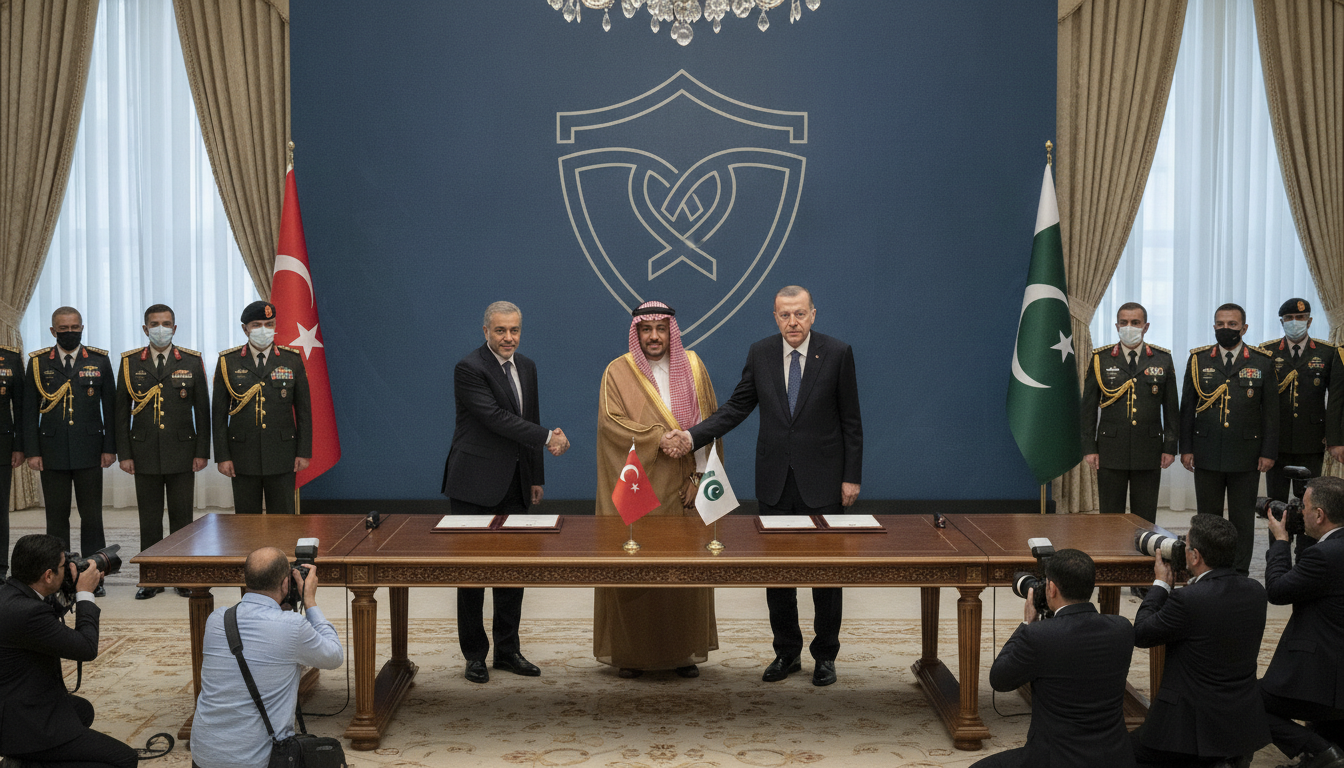
Saudi-Turkiye-Pakistan defence pact vows joint exercises, industry ties amid regional tensions
Saudi-Turkiye-Pakistan defence pact commits to collective defence, joint military exercises and defence-industry cooperation as regional tensions rise quickly.
The Saudi-Turkiye-Pakistan defence pact, signed last week, establishes a formal framework for collective security, joint military drills and closer defence-industry collaboration among the three states. Turkish officials said the agreement includes mechanisms to coordinate defence and foreign ministers as well as chiefs of staff, and Pakistan’s foreign ministry confirmed a clause treating an armed attack on any member as an attack on all. The move comes amid heightened military tensions across the Middle East and signals a new axis of security cooperation among major Muslim-majority economies.
Details from Ankara
The Turkish defence ministry disclosed on Thursday that the pact will create institutional channels for sustained military cooperation, elevating talks beyond episodic consultations. Defence ministers, foreign ministers and the heads of armed forces are to meet under planned strategic political and military mechanisms intended to coordinate policy at the highest levels. Officials also outlined plans for regular joint exercises and exchanges intended to improve interoperability among Turkish, Saudi and Pakistani forces.
Collective-defence clause and NATO comparisons
Pakistan’s foreign ministry has publicly likened the pact’s mutual-defence commitment to NATO’s Article 5, saying an armed attack on one member would be viewed as an attack on all. Turkish briefings framed the clause as a deterrent measure rather than a replacement for existing alliances, underlining that the new pact is designed to complement, not supersede, other security arrangements. Analysts caution that formal pledges can be powerful political signals, but their operational reach typically depends on political will, logistics and agreed rules of engagement.
Drivers behind the partnership
Officials and analysts point to an array of strategic drivers behind the agreement, including rising regional confrontation, maritime security concerns and the desire to bolster domestic defence industries. Saudi Arabia, a major oil exporter that has faced cross-border strikes in recent years, sees value in diversifying security partnerships. Pakistan and Turkiye, both with substantial armed forces and defence sectors, gain opportunities to expand training, procurement and technology cooperation that could strengthen their strategic autonomy.
Military cooperation and exercises planned
Beyond diplomatic guarantees, the pact envisions concrete military activity: joint drills, intelligence exchanges and coordinated operational planning are all on the agenda, according to the Turkish defence ministry. Regular exercises will aim to standardize procedures and test rapid-reaction capabilities, while staff-level coordination is expected to smooth crisis responses. Such practical steps will be the clearest test of the pact’s value, since exercises and real-time interoperability often determine whether political pledges translate into credible defence capacity.
Defence-industry collaboration and expansion potential
A key element of the agreement is deeper defence-industry cooperation, with joint production, technology transfers and procurement coordination singled out as priorities. For Turkiye and Pakistan, both of which maintain significant domestic arms industries, collaboration could open new markets and shared development projects. Saudi Arabia’s sizable defence spending and manufacturing ambitions offer commercial scale, and officials have stated the pact is open to expansion, with Egypt often mentioned as a potential future participant.
Historical analogues and practical limits
Regional and global experience shows both the promise and limits of mutual-defence pacts. NATO’s Article 5 provided a powerful deterrent during the Cold War but has been invoked rarely; GCC mechanisms and other regional pacts have sometimes struggled when conflicts shifted into ambiguous “grey-zone” tactics or internal disputes. Experts note such agreements often serve as political anchors more than automatic military triggers, and their effectiveness is shaped by political alignment, legal definitions of “armed attack,” and logistical realities that affect rapid collective response.
The Saudi-Turkiye-Pakistan defence pact marks a significant step in reshaping security relationships among three influential Muslim-majority states, blending diplomatic symbolism with tangible planning for joint drills and industrial cooperation. Whether the agreement becomes a durable deterrent or primarily a political signal will depend on how quickly its institutional mechanisms are operationalized and whether members act in concert when crises arise.
