
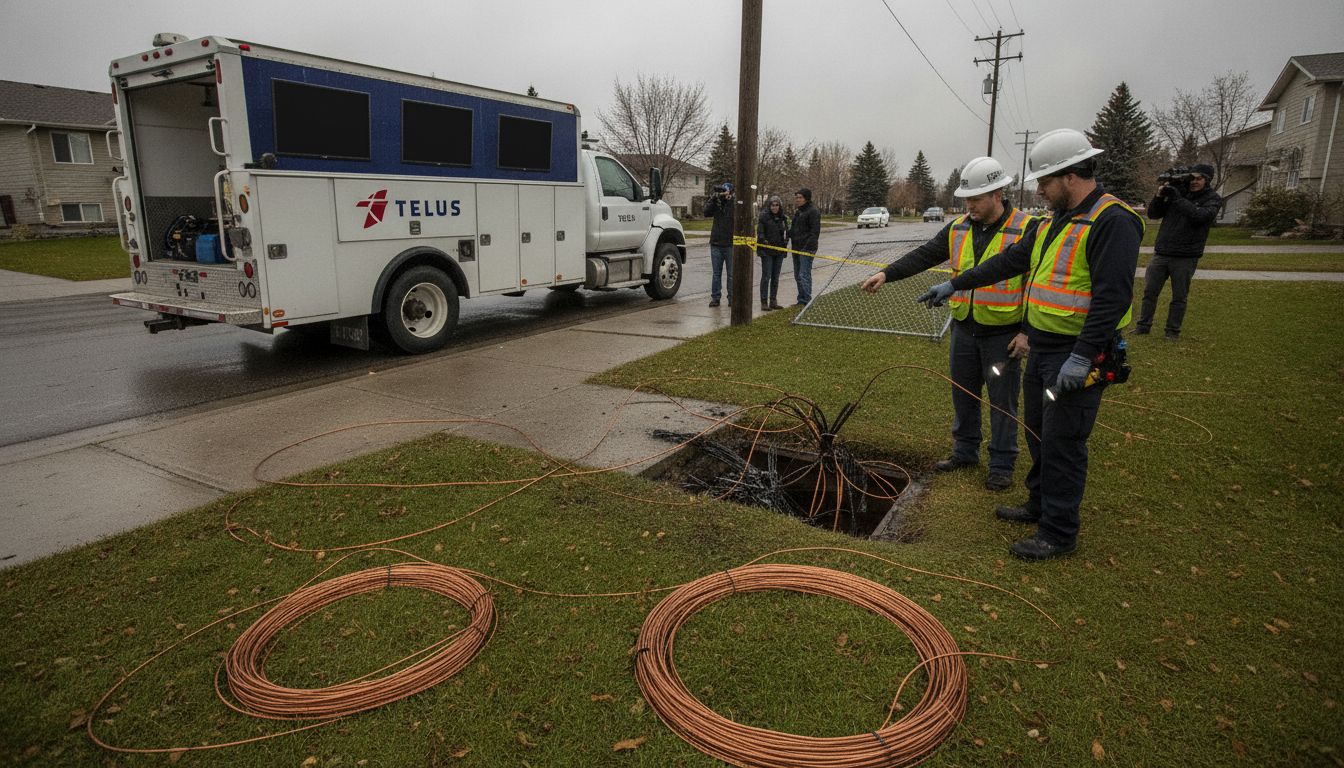
Telus copper thefts leave hundreds in Calgary without internet, cable and phone
Telus copper thefts have left hundreds of Calgary customers without internet, cable and phone. This report explains the scope, impacts and steps residents can take.
Calgary households across multiple neighbourhoods have experienced prolonged outages after a wave of targeted copper-theft incidents severed telecom lines, leaving some families and businesses without internet, cable and home phone service for more than a week. Several residents told reporters they returned from travel to find home networks dead and were unable to reach a clear timeline for repair from their service provider. Company statements and police accounts point to an upsurge in thefts this year, a trend telecom operators say has forced local crews into around-the-clock recovery work.
Residents report prolonged outages across Calgary neighbourhoods
The Softley family of Dalhousie described waking up the morning after a late-night return from vacation to find their Wi-Fi and home services offline, and their attempts to get an explanation met with frustration. They and their neighbours attempted repeated calls to customer service and were told remote resets could not resolve the problem when physical wiring had been cut. As of this week, dozens of households described spending many hours on the phone while still lacking a reliable estimate for when lines would be restored.
Customers in Ogden, Kingsland and Bowness were among those singled out in company notices as experiencing interruptions in home phone, internet and television service. Some residents who work from home said the outage disrupted remote employment, while others flagged concerns about essential daily tasks that rely on home connectivity. Community online groups and local neighbourhood associations became informal hubs for sharing outage updates and tips for temporary workarounds.
Telus identifies surge in copper thefts as cause
Telecommunications provider Telus confirmed the outages are linked to a string of copper-theft cases that have affected buried and above-ground cables across the city. The company reported a sharp rise in thefts this year, saying incidents have doubled compared with 2025 and that roughly 1,600 customers had been impacted in a recent roll of theft-related disruptions. Telus emphasized that while thieves typically seek copper, their efforts often damage fibre infrastructure as well, broadening the scope of service loss.
A company spokesperson explained that damaged distribution points and cut conduits make remote diagnostics and simple restarts ineffective, requiring on-site crews to secure, replace and in some cases re-route infrastructure. Telus also pointed to the challenges of working in multiple neighbourhoods simultaneously, noting that large-scale thefts can create cluster failures that take longer to address than isolated outages. The provider said it is coordinating repair teams and working with law enforcement to locate and secure damaged areas.
Public safety and critical services disrupted
Police and emergency services officials warned that the thefts carry consequences beyond individual inconveniences, saying damaged communications infrastructure can affect hospitals, emergency dispatch systems and critical agricultural operations. A Calgary police spokesperson explained that telecommunications lines are intentionally accessible for maintenance, which also makes them vulnerable to opportunistic theft. In certain rural-adjacent zones, cut lines have reportedly interrupted irrigation controls, creating risks for farm production during peak growing periods.
Healthcare facilities and emergency responders rely on redundant systems, but local officials said overlapping outages and targeted vandalism raise the risk of degraded service levels in particular pockets. Municipal departments and utilities that depend on telecom links for telemetry and remote control functions also reported heightened vigilance as crews worked to assess and shore up at-risk sites. Police urged residents to report suspicious activity near utility cabinets and to preserve any evidence of tampering for investigators.
Repair challenges and restoration timelines
Restoration crews face a number of technical and safety hurdles when responding to copper-theft incidents, including the need to secure cut lines, source replacement materials and work in discrete locations to avoid further damage. When copper and adjacent fibre are cut, technicians must complete physical splices, test signal integrity and sometimes replace whole sections of conduit, work that can extend repair windows from hours to days. The visible nature of much telecom infrastructure makes it both easier to find for crews and easier to target for thieves, complicating efforts to prioritize repairs.
Customers who called Telus recounted a common pattern: automated outage alerts followed by long hold times and limited detail on when repair crews would arrive. In some cases, service representatives attempted remote resets, but those were ineffective when the line itself had been removed or severed. Company statements said crews are being deployed across affected zones, but also warned that the logistics of coordinating equipment and ensuring worker safety in vandalized areas can slow progress.
Economic and industry-wide impacts of copper thefts
Industry stakeholders say the recent spike in copper thefts is tied to broader market and criminal dynamics, with rising prices for scrap metal creating incentives for opportunistic and organized theft. Telecom operators, electricity utilities, construction firms and natural gas services have all reported instances where copper targets were stolen or damaged, generating safety hazards and financial losses. The direct costs of replacement work and the indirect costs of service disruption ripple to customers, businesses and local governments that must respond to public complaints and emergency needs.
Aside from repair bills, utilities and service providers must invest in deterrence measures and recovery plans, including enhanced surveillance, physical hardening of installations and alternative materials where feasible. Some regions are exploring accelerated fibre upgrades and undergrounding of sensitive lines, but those projects require significant capital and time. In the short term, providers face the dual burden of restoring service while managing an increase in theft-related incidents that strain maintenance budgets and field crew availability.
Advice for customers and guidance from authorities
Officials and consumer advocates advise customers affected by service loss to document outages carefully, file reports with both their service provider and local police, and retain any correspondence or reference numbers related to repair requests. Where possible, residents should take photos of damaged infrastructure and log the timing of disruptions to help both repair crews and law enforcement with investigations and potential claims. Telus and other providers generally maintain outage reporting channels and can offer temporary workarounds such as mobile hotspot provisioning for certain account types.
For those who rely on home connectivity for work or medical monitoring, alternatives include using cellular data hotspots, arranging access to public or neighbour-friendly Wi-Fi with appropriate safety precautions, or coordinating with employers on flexible hours until service is restored. Police recommend not confronting suspected thieves and instead reporting suspicious activity immediately, and municipal authorities suggest that landlords and strata corporations prioritize securing common-area telecom closets and external cabinets to limit access.
The financial impact on small businesses and remote workers can be acute, and consumer rights groups recommend that customers keep clear records of lost income or missed appointments tied to outages should compensation discussions arise. Community organizations and municipal offices can sometimes help mediate between customers and providers, and local councillors may be able to escalate persistent cases that involve safety or public service concerns.
Community response and calls for coordinated prevention
Neighbourhood associations and online community forums have emerged as practical information hubs during the disruption, where residents share verified updates, safety tips and temporary resource suggestions. Some communities have organized watch programs and coordinated reporting to police to help identify persistent problem areas or repeated break-ins of telecom cabinets. Municipal staff said they are reviewing options for increasing surveillance or modifying access controls to equipment in high-incidence zones.
Public officials and service providers have also been urged to accelerate investment in theft-deterrent technologies and to pursue stronger legal and regulatory measures that make the sale of stolen copper traceable. Industry experts note that a multiplatform approach—combining policing, community vigilance, targeted infrastructure upgrades and market controls on scrap metal—offers the best chance of reducing repeat incidents. In the immediate term, officials emphasized that rapid repair capability and clear communication with affected customers are top priorities.
Residents who live in older buildings or neighbourhoods with visible above-ground wiring were advised to consider small steps that reduce vulnerability, such as reporting exposed junctions, requesting regular inspections from providers, and consulting with property managers about securing common communication rooms. While many mitigation strategies require investment and planning, community-level cooperation has already helped authorities locate and respond to several theft locations in recent weeks.
Local businesses and municipal services that depend on continuous connectivity are being encouraged to review continuity plans and to maintain redundant communication channels where feasible. Emergency service coordinators said they will continue to monitor infrastructure resilience and to coordinate with telecom operators to reduce risk during overlapping outages. At the same time, providers noted that public awareness and timely reporting by residents play a crucial role in enabling quicker detection and targeted response.
As crews continue patching and replacing damaged lines, Telus has reiterated that physical thefts are the principal driver of the most severe outages, and the company has asked customers to remain patient while prioritized repairs are completed. Telus said it is deploying additional technicians and equipment to areas with the highest levels of damage and is working with law enforcement to pursue leads on the thefts. Customers were advised to use official outage reporting channels to ensure their cases are logged and prioritized.
The recent disruptions from copper thefts in Calgary underscore the interconnected nature of modern services and the vulnerability of infrastructure that must remain accessible for maintenance. The immediate focus for residents and authorities alike is restoring service, documenting impacts, and strengthening protections to prevent a recurrence of incidents that have left households and businesses without critical communications for extended periods.
Public pressure on providers to improve communication during outages has mounted, and local officials say they will continue to press for clearer timelines and faster escalations when many customers are affected. Meanwhile, community groups and municipal staff are exploring longer-term mitigation strategies, including targeted infrastructure upgrades and tighter controls on salvage markets, to reduce the incentive for such thefts.
For now, affected Calgarians are managing with a mix of temporary fixes and mounting frustration, while crews work to restore service and investigators pursue those responsible for the thefts. The coordinated response among service providers, police and communities will be a test of both resilience and the capability of existing systems to protect critical infrastructure from opportunistic and organized criminal activity.
