
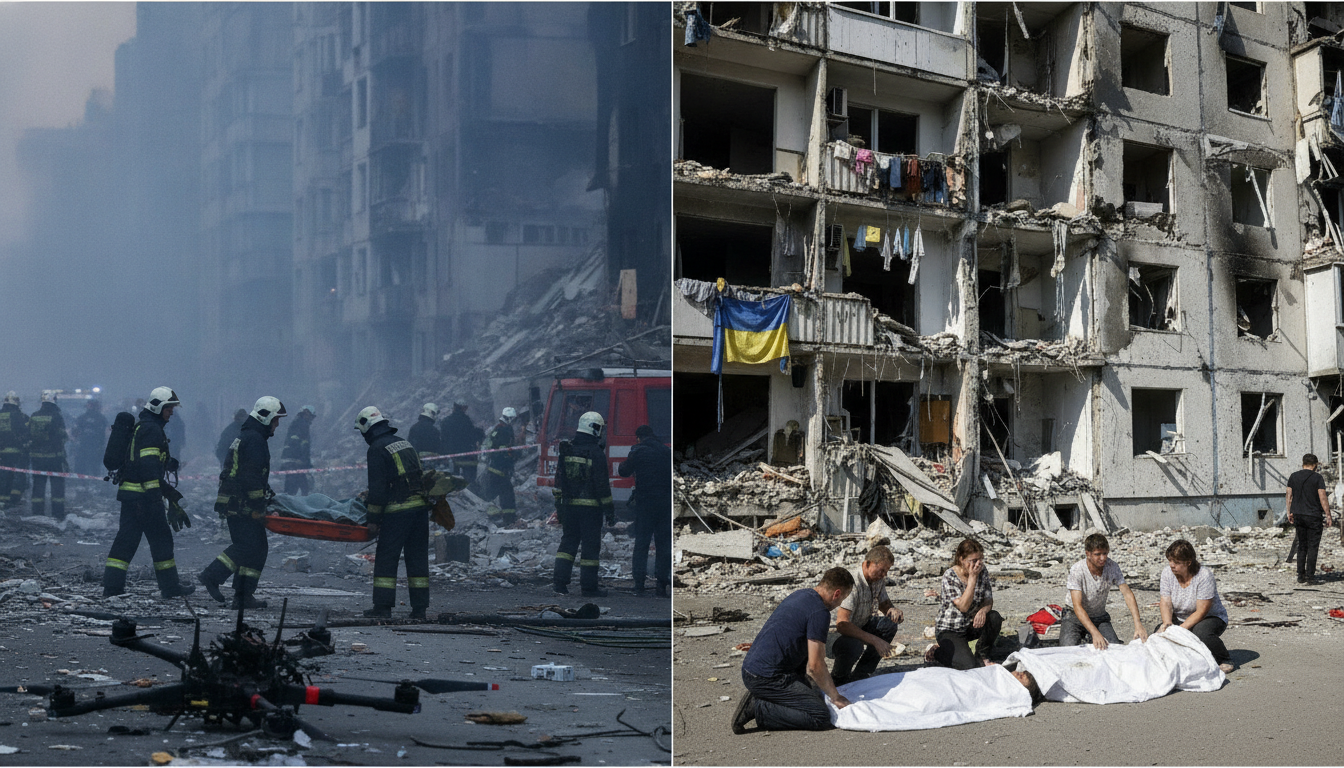
Drone attack Moscow region kills five as strikes on Sumy leave three dead, including children
Drone attack in Moscow region kills five; strikes on Sumy kill three, including two children, as long-range raids hit warehouses and spark fires nationwide.
A Ukrainian drone attack in the Moscow region killed five people and injured at least ten others on Tuesday, regional authorities said, as separate Russian airstrikes on Sumy in northeastern Ukraine killed three civilians, including two children. The drone attack Moscow region incident ignited fires in an industrial zone and targeted at least one warehouse, officials reported. The twin episodes mark an escalation in strikes affecting population centres and logistics sites hundreds of kilometres from front-line fighting.
Moscow region casualties and damage
According to the regional governor, Andrei Vorobyov, air defences engaged a swarm of drones over the Moscow region and fires broke out in the Novoselki industrial area after at least one impact. Vorobyov published preliminary figures saying five people had been killed and about ten others wounded as emergency services battled blazes at a logistics facility and adjacent buildings. The fatalities represent a significant civilian toll for the Moscow area, which sits several hundred kilometres from the main battlefields in eastern Ukraine.
Local emergency crews were reported on scene working to extinguish fires and secure damaged buildings, and authorities said investigations were under way to determine the precise sequence of events. Officials did not provide further details about the victims’ identities or whether the targeted warehouse belonged to a private company. The incident followed a series of long-range strikes that have increasingly reached inland Russian regions.
Wildberries warehouses struck across northwest Russia
Logistics centres operated by the major e-commerce firm Wildberries were among the sites struck in recent operations, company and regional statements indicated. In Leningrad region, a drone attack touched off a fire at a Wildberries logistics complex in Krasny Bor, the company’s press service said, while the regional governor, Alexander Drozdenko, reported that air defences had downed 17 drones during the incident. Another Wildberries facility in Emmauss, in Tver region, was also reported hit, with regional governor Vitaly Korolyov confirming damage.
Wildberries warehouses have been repeatedly mentioned in recent weeks as targets of long-range strikes, part of a campaign that officials on both sides describe as aimed at disrupting supply and logistics networks. The cluster of attacks on distribution hubs underscores the strategic focus on crippling material flows, while raising concerns about civilian risk when such sites are located near populated areas.
Sumy airstrikes kill children and elderly
In northeastern Ukraine’s Sumy region, Russian guided aerial bombs struck residential areas overnight, leaving three civilians dead, Governor Oleg Grygorov said. Two young girls were found in the rubble of their home, and an elderly person was also confirmed among the fatalities, according to local authorities. Residents and emergency teams searched collapsed structures and recovered victims while the governor called for increased protections for civilians in areas frequently targeted by bombardment.
Hospitals in Sumy reported treating multiple injured persons, and local officials documented extensive damage to housing and infrastructure. The attack on Sumy — itself a regular target since the start of the full-scale invasion — drew renewed attention to the humanitarian toll of strikes against non-combatant areas.
Kherson and other regional impacts
Nighttime shelling and airstrikes also affected other Ukrainian cities, with military administrations reporting further civilian casualties and damage. In Kherson, local authorities said one person, a 52-year-old resident, was injured in an assault on the city during the same night. Municipal emergency services described ongoing repair work to utilities and sheltering arrangements for displaced families.
Across both countries, authorities reported frequent radar and anti-aircraft activity as air defences attempted to intercept incoming drones and munitions. The pattern of strikes crossing long distances has complicated civil defence efforts and stretched emergency response capacities in multiple regions.
Strategic context and long-range campaign
Analysts on both sides characterise the recent operations as part of a broader long-range campaign that has targeted warehouses, logistics hubs and other infrastructure deep inside adversary territory. Ukrainian strikes have increasingly used drones and stand-off munitions against Russian supply chains, while Russia continues near-daily bombardment of Ukrainian cities and towns, a dynamic that has persisted since February 2022. Both sides say they are striking military and logistical targets; independent verification is often limited amid ongoing conflict.
The targeting of commercial warehouses and distribution centres raises legal and ethical questions when civilian workers and residents are exposed to harm. International humanitarian law obliges combatants to distinguish between military objectives and civilian objects and to take precautions to minimize civilian casualties, rights groups have repeatedly noted.
The incidents on Tuesday add to a mounting civilian death toll and underscore the conflict’s capacity to affect communities far from active front lines. Emergency services in affected areas appealed for calm and urged residents to follow civil defence warnings as authorities continue investigations.
The increasing reach of drone and long-range strikes complicates efforts to protect civilians and maintain critical supply networks, and officials on both sides framed the attacks as retaliation or preemption. As investigators compile damage assessments and casualty reports, regional governments and humanitarian organisations face the immediate task of aiding survivors and restoring essential services while broader diplomatic and military responses remain constrained by the ongoing hostilities.
