
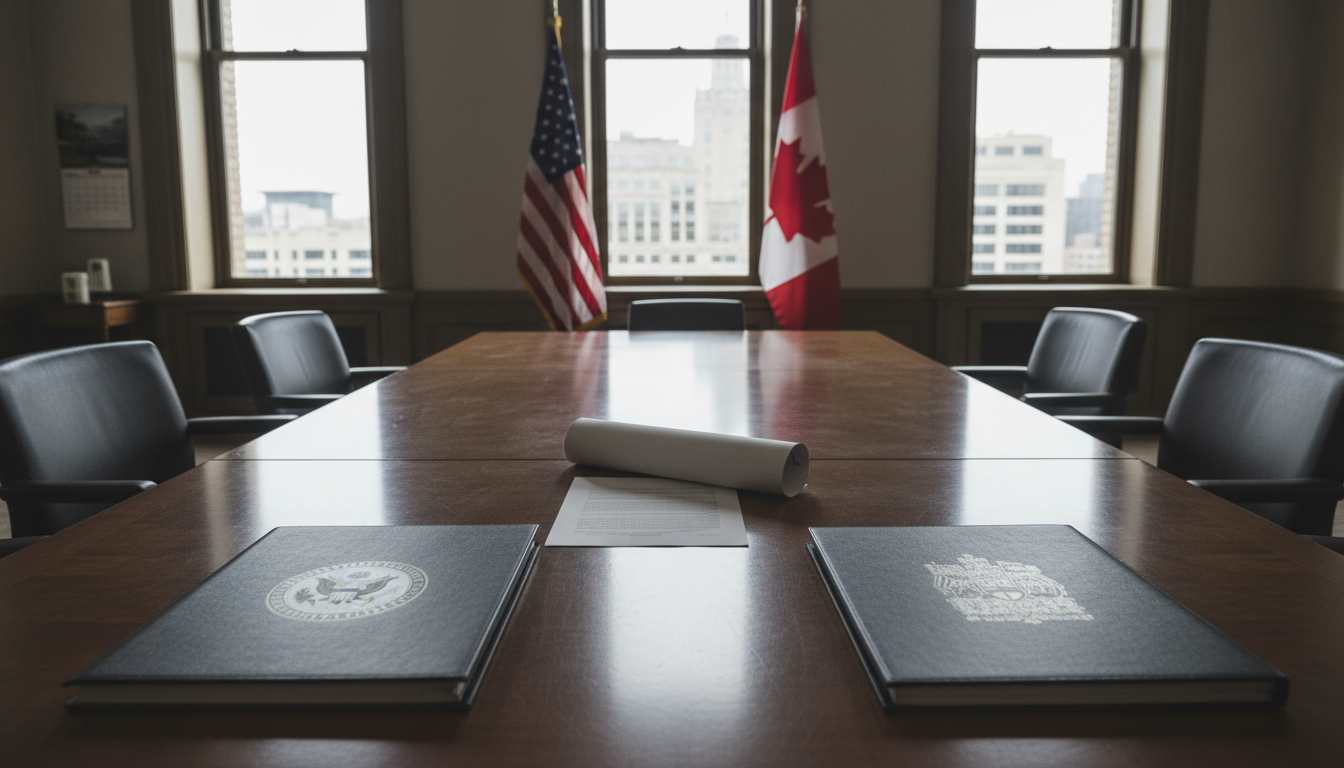
U.S. suspends Canada-U.S. Permanent Joint Board on Defence, citing lack of credible progress
U.S. suspends the Canada-U.S. Permanent Joint Board on Defence, saying Ottawa made no ‘credible progress’ and that Washington will reassess the board’s role.
Immediate pause announced by U.S. defence officials
The United States has announced it will suspend activity of the Canada-U.S. Permanent Joint Board on Defence, citing what it called a lack of credible progress by Canada on agreed defence commitments. The decision was disclosed publicly in a series of posts on X by Elbridge Colby, the U.S. undersecretary of defence, who said Washington plans to reassess how the long-standing advisory body serves North American defence.
The move marks a striking public rebuke between close allies and pauses a practical forum that for decades has been a primary channel for bilateral defence discussion. Colby framed the action as part of a review of the board’s utility to the shared security of the continent.
Colby’s critique and reference to recent speeches
In his posts, the undersecretary criticized a perceived gap between rhetoric and implementation on defence matters and highlighted a speech by Canadian prime minister Mark Carney as part of the public record. Colby argued the words of senior leaders must be matched by investments and operational commitments if the United States and Canada are to protect shared security and prosperity.
He referenced Carney’s address at the Davos forum in January, where the prime minister urged middle powers to unite against hegemonic threats, and suggested the sentiment required complementary action. Colby’s statement underscored that diplomatic messaging alone would not satisfy the criteria Washington is using to evaluate collaboration.
History and role of the board since 1940
The Permanent Joint Board on Defence was created in 1940 by Prime Minister William Lyon Mackenzie King and U.S. President Franklin D. Roosevelt amid the Second World War. Since then, the board has functioned as an advisory body composed of officials from both countries who meet to discuss common defence concerns and provide recommendations to their respective governments.
Its establishment during wartime made it a durable symbol of Canada-U.S. defence ties and a mechanism for coordinating continental defence planning. Over decades the board has addressed a range of issues from continental air defence to joint responses to emerging threats.
Prime Minister Carney’s international outreach noted
Since taking office, Prime Minister Mark Carney has pursued a high-profile international agenda aimed at broadening Canada’s economic and diplomatic partnerships. The prime minister’s travels and appearances, including his invitation to a European security summit in Armenia earlier this month where he was the sole non-European participant, were cited in Colby’s remarks.
Carney’s Davos speech calling on middle powers to align against dominant geopolitical actors remains part of the public dialogue, and U.S. officials referenced that rhetoric when questioning whether policy priorities are matched by defence investments. The juxtaposition of diplomatic outreach and the U.S. suspension frames a broader conversation about strategy and burden-sharing among allied states.
Practical implications for defence cooperation
Suspending the board’s activities does not itself sever military ties, but it removes a regular mechanism for bilateral discussion and could complicate coordination on areas such as continental warning and aerospace defence. Officials have routinely used the board to exchange technical assessments, refine joint planning and develop recommendations for governments.
A hiatus may prompt parallel channels of communication to remain open, but it increases the risk that routine, institutionalized dialogue will be diminished. Defence analysts say the loss of a formal forum can slow information-sharing and impede timely consensus on evolving threats.
Next steps signalled and possible outcomes
Washington’s announcement framed the pause as a precursor to a formal reassessment of how the board contributes to North American security, but it left open the timeline for any review or for resuming regular meetings. U.S. officials indicated their expectation that allies demonstrate measurable progress on commitments as part of the evaluation.
For Ottawa, the decision creates pressure to clarify its defence priorities and to outline tangible steps that would meet U.S. expectations. The suspension is likely to trigger consultations at senior levels on both sides, and it may lead to proposals for alternative mechanisms or conditions under which the board would be reinstated.
The coming days are likely to see statements and briefings from both capitals as governments respond to the public announcement and as officials weigh diplomatic and operational options to restore the forum or to create a new basis for joint planning.
