
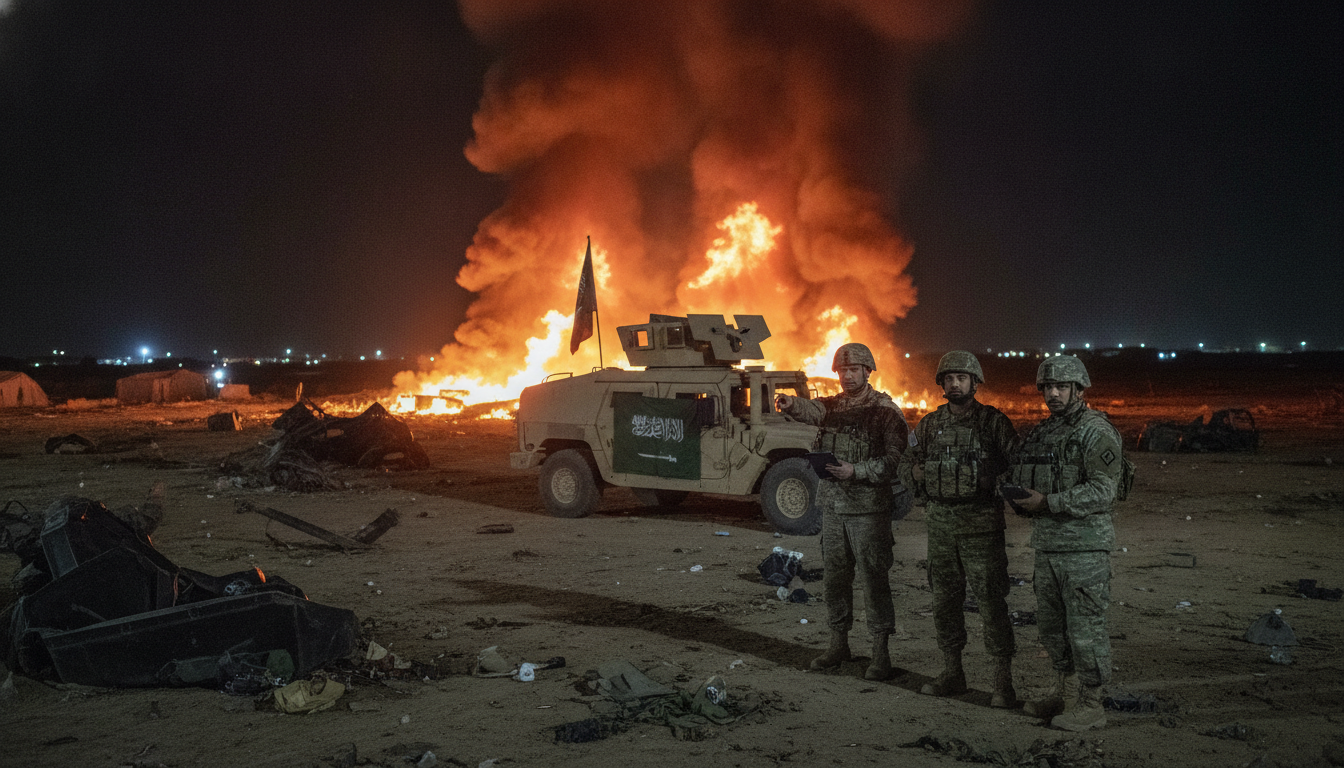
U.S.-Saudi air strikes in Iraq target pro‑Iran militia sites as Baghdad condemns violation of sovereignty
U.S.-Saudi air strikes in Iraq on July 28–29, 2026 struck pro‑Iran militia logistics sites, killing and wounding dozens and further raising regional tensions.
For the first time since the war that began on February 28, 2026, Saudi Arabia publicly acknowledged joining U.S. forces in air operations in eastern Iraq during the night of July 28–29, 2026. U.S. Central Command said the joint strikes hit multiple logistics and weapons sites it described as linked to pro‑Iran armed groups, and framed the operation as a response to more than 30 drone attacks attributed to Iran’s Islamic Revolutionary Guard Corps over the preceding 72 hours. Iraqi security officials and the Popular Mobilization Forces, a coalition of mostly Shiite militias, reported heavy casualties and immediately condemned the strikes as a breach of Iraqi sovereignty.
Joint U.S.-Saudi operation and stated rationale
CENTCOM said American and Saudi aircraft carried out the raids against facilities it identified as logistics hubs and armament depots used by militias opposed to U.S. and allied interests. The statement characterized the strikes as a calibrated response intended to degrade capabilities used in recent attacks on Saudi infrastructure.
U.S. officials also tied the operation to a series of aerial drone strikes in the preceding days that they blamed on groups with backing from Tehran. Saudi defence spokespeople warned they would respond to aggression against the kingdom’s energy facilities, while saying they did not seek escalation beyond those defensive aims.
Casualties reported and Baghdad’s reaction
The Popular Mobilization Forces reported that at least 20 of its members were killed and 32 wounded in the strikes, describing the operation as a dangerous escalation. Iraqi state institutions, including the presidency, denounced the raids as an unacceptable violation of national sovereignty and said civilians and security infrastructure had been affected.
Prime Minister Ali al‑Zaidi convened an emergency meeting of the Iraqi National Security Council on July 29, 2026, to assess the strikes and coordinate a response. Baghdad also said the planned visit by Mr. al‑Zaidi to Riyadh, originally scheduled for the following day, had been postponed indefinitely amid the diplomatic shock and security concerns.
U.S. claim of coordination and competing accounts
President Donald Trump told Fox News that the strikes had been coordinated with the Iraqi government, a claim that Baghdad has not embraced publicly. Iraqi officials insisted they were not informed in advance in a manner that would permit them to endorse or facilitate the operation, and called for inquiries into the circumstances that led to foreign airpower operating over Iraqi territory.
The divergent narratives — Washington describing a coordinated, defensive action and Baghdad decrying a breach of sovereignty — deepen tensions between partners who have sought to balance ties with both the United States and Iran since the Iraqi government returned to power with a Shiite‑led administration.
Iranian and militia responses, and missile exchanges
Earlier on the same day Iran’s Revolutionary Guards claimed to have launched ballistic missiles at a Jordanian air base and at a CENTCOM facility in the country, according to Iranian state outlets. The Jordanian military reported intercepting multiple missiles, and initial assessments reported no immediate casualties or damage.
Militias in Iraq and allied groups accused the U.S. and Saudi coalition of disproportionate force and vowed to respond. Tehran has repeatedly denied direct responsibility for militia actions while publicly supporting some of the factions that oppose Saudi and American presence in the region, a dynamic that continues to complicate efforts to contain the fighting.
Maritime incidents and pressure on oil routes
The wider conflict has spilled into regional waterways, with Houthi fighters in Yemen claiming attacks on Saudi shipping in the Red Sea and accusing Riyadh of violating blockades. Iran’s forces also reported detaining commercial tankers attempting to transit the Strait of Hormuz, an artery that previously carried about one‑fifth of global oil and LNG shipments before the outbreak of open hostilities.
These maritime confrontations threaten supply lines and have already contributed to increased volatility in global energy markets, as insurers and shipping firms reassess the risks of passages through the Red Sea, Bab el‑Mandeb and the Strait of Hormuz.
Diplomatic fallout and security planning in Baghdad
In the hours after the strikes, Baghdad’s National Security Council announced a comprehensive security plan intended to prevent foreign forces or proxy groups from using Iraqi territory to threaten neighbouring states. Iraqi leaders said they would press for explanations from both Washington and Riyadh and seek mechanisms to prevent future unilateral military actions on Iraqi soil.
Regional capitals, including those with ties to both Tehran and Washington, expressed concern at the risk of a broader escalation that could draw multiple states into direct confrontation. International diplomats warned that continued tit‑for‑tat strikes and missile launches would make de‑escalation increasingly difficult.
The strikes on July 28–29, 2026 mark a significant intensification in a conflict that has spread across multiple fronts in the Middle East and that has already produced major economic and humanitarian consequences. Observers say the next 48 to 72 hours are likely to be decisive in determining whether the region slips toward a wider war or whether back‑channel diplomacy can curb further military action.
