
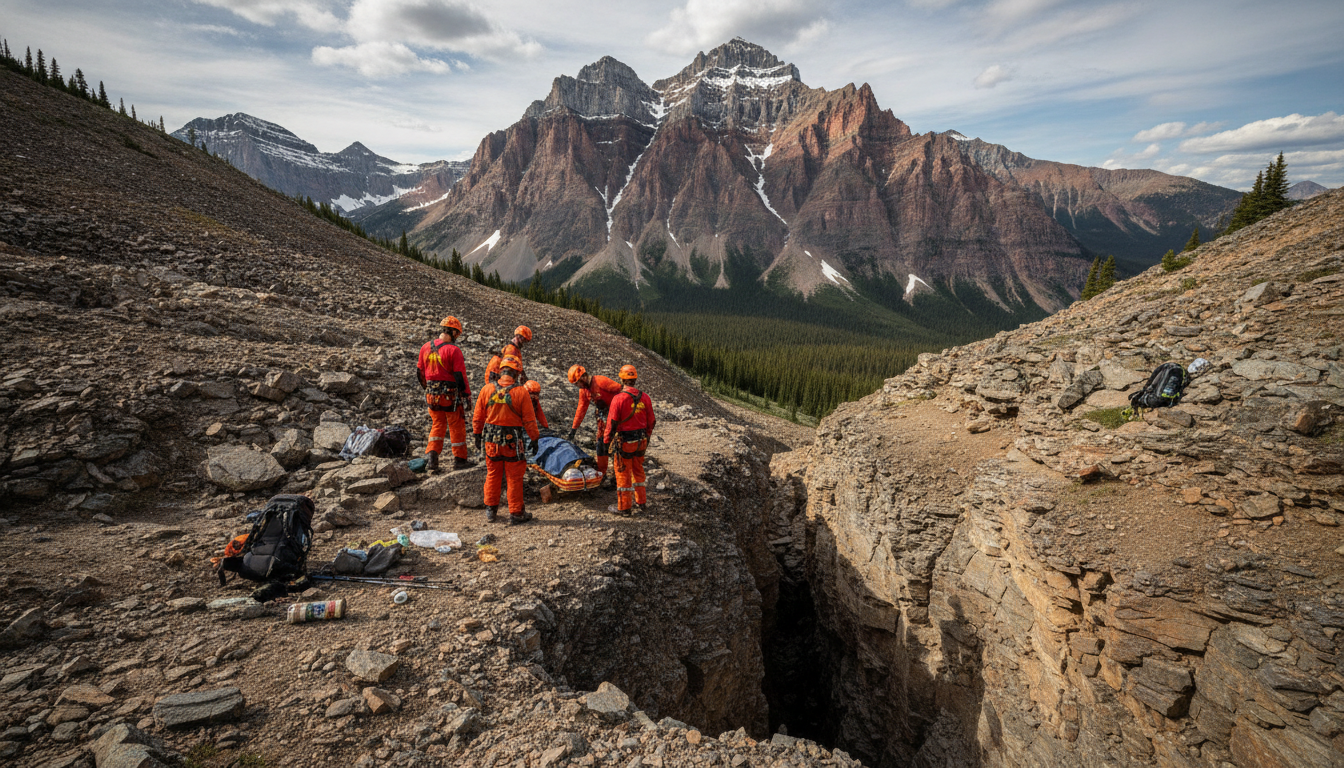
Banff National Park hiking death: young woman killed after fall near Marvel Peak
Young woman dies after falling near Marvel Peak in Banff National Park; helicopter rescue was delayed by poor weather and Parks Canada and RCMP are investigating.
A woman in her twenties has died after falling from terrain near Marvel Peak in Banff National Park in what authorities are treating as a fatal backcountry accident. The incident, described by the Canmore RCMP as a sudden loss of footing, occurred while the woman was part of a four-person group on a multi-day hike approaching from the British Columbia side. The phrase Banff National Park hiking death has circulated among local searchers and residents since emergency services confirmed the recovery the morning following the fall.
Incident details and initial response
RCMP officers from the Canmore detachment were notified after Parks Canada received a radio or satellite communication from the hiking party and alerted authorities. Staff Sgt. Greg Tulloch of the Canmore RCMP said members of the group reached the injured woman and carried out immediate first aid measures before contacting emergency services. Tulloch described the fall as severe enough that the injuries were unsurvivable, and said investigators are treating the scene as a non-survivable alpine fall.
Parks Canada rescue specialists attempted to access the location by helicopter on the day of the incident but were forced to stand down when weather conditions deteriorated. Helicopter crews later returned and the hiker was recovered early the following morning, according to RCMP. Authorities said they are continuing to work to identify and notify the woman’s next of kin as the investigation proceeds.
Alberta’s Emergency Health Services was involved in the response after Parks Canada requested their assistance, an agency official confirmed. Stuart Brideaux, a public education officer with Alberta EHS, said crews staged near Mount Shark in Spray Valley Provincial Park but were stood down when tactical decisions changed or a helicopter recovery became the priority.
Terrain and location near Marvel Peak
Marvel Peak sits in the southern reaches of Banff National Park, close to the boundary with British Columbia’s Mount Assiniboine Provincial Park and adjacent to the broader Kananaskis region in Alberta. The summit is roughly 2,650 metres above sea level and lies about three kilometres from the Continental Divide, placing it in exposed alpine terrain where conditions can change quickly. Routes in that area involve steep approaches, loose rock and sections where a single misstep can lead to a long, fatal descent.
The group involved in the incident was completing a multi-day route coming from the British Columbia side, which typically involves remote travel, route-finding skills and self-sufficiency. Hikers in this sector often navigate ridge lines and high cols where fall potential is significant and rescue is complicated by weather, remoteness and limited landing zones for aircraft.
Local search and rescue operations in such high-alpine settings must balance urgency with safety for responders, which can delay physical access to an injured person. The combination of steep slopes, variable weather, and limited communications makes recoveries technically demanding and sometimes only possible once conditions improve.
Rescue timeline and operational challenges
According to RCMP, Parks Canada teams sought to reach the site by helicopter on the afternoon the fall occurred but were hampered by adverse weather that prevented a safe insertion. The inability to fly into the area meant ground approaches would have been lengthy and potentially hazardous for rescue personnel. When conditions allowed, Parks Canada crews completed a helicopter recovery the next morning and transferred responsibility to RCMP and other agencies as needed.
Witnesses within the hiking party rendered first aid until rescue specialists could arrive, and an early on-scene assessment determined the injuries were incompatible with life. Emergency Health Services staging in Spray Valley reflects the coordinated, multi-agency posture used for backcountry incidents across the region, where responsibility is shared among Parks Canada, provincial health services, and local RCMP detachments.
Weather-related delays in aerial rescue are a recurring operational constraint for mountain rescues in the Rockies. Aviation crews must assess wind, visibility, cloud base and rotor turbulence before attempting hoist or landing operations, and crews will decline risky flights to avoid creating additional casualties among rescuers.
Regional context: recent mountaineering fatalities
This tragic event is the latest fatality in a region that has seen several serious backcountry incidents in recent weeks. Authorities noted another fall in Banff over the preceding weekend that resulted in the death of a 65-year-old Calgary man on Mount Temple. Earlier this month, on June 6, a 47-year-old woman from Airdrie died on Mount Bryant in Kananaskis, underscoring the narrow margin for error that alpine travel often leaves.
Search-and-rescue teams and park managers have pointed to a combination of steep terrain, variable rock stability, and inexperienced route selection as factors that commonly contribute to accidents. Mountain fatalities often involve parties who are well-intentioned but whose plans do not match the technical difficulty of the terrain or the prevailing weather and snow conditions.
Park officials and emergency responders emphasize that a cluster of incidents does not necessarily indicate a single causal change but rather reflects the persistent hazards of high-alpine travel during the warmer months. As more people venture into remote mountain areas each year, rescue agencies face mounting operational and logistical pressures.
Agencies involved and investigatory steps
Canmore RCMP are leading the investigation into the fall and are coordinating with Parks Canada’s Banff field unit on scene management and evidence preservation. Staff Sgt. Tulloch has spoken publicly to confirm the basic facts of the recovery and to note that officers are working to make contact with the family of the deceased to relay condolences and information. Parks Canada’s Banff field unit was reported as not immediately available to respond to media requests at the time the initial account was published.
Alberta Emergency Health Services confirmed it was called by Parks Canada to support the response and staged a team in the nearby Spray Valley area. Public education officers from EHS reiterated that medical resources in mountainous terrain are often used in a support and coordination role and may be stood down when aerial recovery becomes the only viable operational option.
Investigators will typically document the scene, take witness statements from the hiking party, assess environmental factors such as recent weather and route conditions, and, where feasible, review satellite or electronic communications that may provide precise timing. The RCMP and Parks Canada may also examine equipment carried by the party and gather information about their experience and prior trip planning.
Safety guidance for backcountry hikers
Experienced backcountry users and public agencies consistently advise thorough trip planning, including reviewing weather forecasts, route descriptions, and current trail or route conditions before setting out. Travellers should carry and know how to use appropriate safety equipment for the chosen route, including helmets where exposed rockfall or steep exposure is present, and personal locator beacons or satellite communicators for emergency notification. Group composition and skills should match the intended route, with realistic turnaround times and margin for deteriorating conditions.
Many rescues are precipitated by a single unexpected event such as a slip on loose scree, an encounter with unexpected winter-like conditions, or failure to account for an exposed section of trail. Simple risk management steps—staying together, avoiding high-exposure sections in poor weather, and making conservative decisions when visibility or footing deteriorate—reduce but do not eliminate the danger inherent in alpine travel.
For those planning multi-day traverses into the Continental Divide corridor, authorities recommend advanced navigation training, experience with route-finding in broken terrain, and contingency planning that assumes limited or delayed external support. Where possible, novices are urged to travel with experienced partners or to hire local guides familiar with route-specific hazards.
Community reaction and park management considerations
Local search and rescue volunteers, guides, and frequent backcountry users often respond to such incidents with sorrow and reminders about the inherent risks of mountain recreation. Community groups that work on trail maintenance and mountain safety outreach say these tragedies reinforce the need for ongoing public education about alpine hazards, seasonal hazards such as lingering snow patches, and the importance of conservative decision-making in exposed terrain.
Parks Canada and regional authorities balance facilitating public access with managing safety and environmental protection, and each fatality prompts internal reviews of signage, public warnings, and outreach programs to ensure visitors are adequately informed. In some cases, authorities will adjust communications or increase patrols in areas that experience a spike in incidents, though much of mountain risk reduction rests with individual planning and behavior.
Families and friends of those lost in mountain accidents often call for better awareness about route difficulty and more transparent reporting about conditions. At the same time, search-and-rescue resources face limits; volunteer organizations and public agencies repeatedly stress that even the most timely and well-coordinated response cannot always prevent a fatal outcome when falls are severe.
Authorities continue to work to contact the woman’s next of kin and to provide them with support, RCMP said. As investigations conclude, officials will determine whether additional public advisories or route-specific guidance are warranted to warn future visitors to the area.
Mountain safety messaging remains a central priority for both provincial and federal agencies as the summer season unfolds. Parks Canada and provincial partners typically update backcountry advisories, trail condition reports, and safety recommendations through official channels, and hikers are encouraged to consult those resources before embarking.
The loss near Marvel Peak is a sobering reminder of how quickly a routine outing can turn fatal in alpine environments. Responders, park managers and community groups are urging visitors to plan conservatively, carry proper emergency communication devices, and respect the limits of their skills when traveling in high, exposed country.
